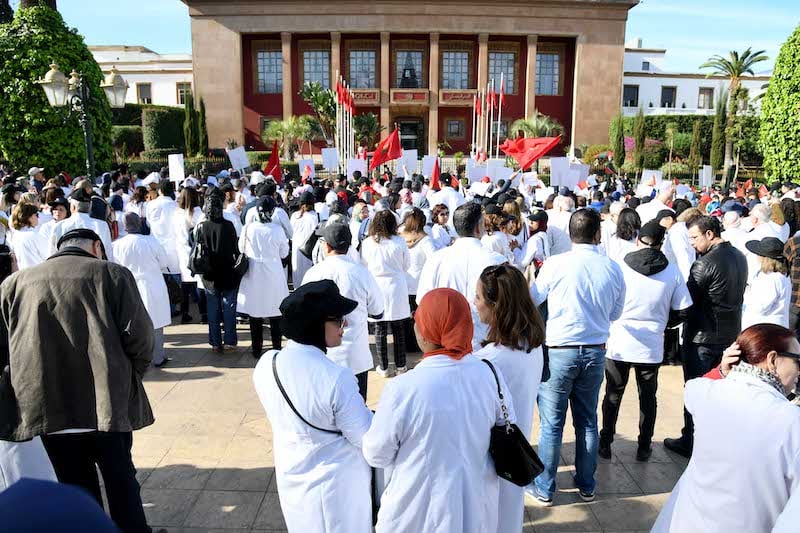
The National Commission of Internal and Resident Physicians (CNIR) in Morocco has reaffirmed its commitment to its demands while emphasizing it “is not seeking escalation” after a month of strikes that disrupted public hospitals.
General Coordinator Ali Farsi stated at a press conference last Wednesday in Rabat that the Ministry of Health initially showed some openness, but their letters to the Ministry of Higher Education since February 2024 have gone unanswered. “The strike is not an end in itself; it is a last resort after many unsuccessful negotiations aimed at securing legitimate rights while safeguarding patients’ right to care,” he added.
Resident and intern doctors welcomed new Ministers of Health and Higher Education, Amin Tahraoui and Ezzeddine Midaoui, by announcing a comprehensive strike set to begin tomorrow and continue until Thursday.
The CNIR condemned the “long and ongoing struggle” against the ministries’ intransigence and disregard for their legitimate demands, emphasizing that the lack of serious engagement threatens not only healthcare professionals but also the quality of services provided to citizens.
The CNIR seeks involvement in discussions on implementing Law 08.22, which concerns the creation of territorial health groups, and participation in reforms of the third cycle of medical studies. They are demanding an increase in non-contractual residents’ compensation to 12,000 dirhams and an adjustment of internal doctors’ allowances to 10,000 dirhams, citing their essential roles in emergency departments.
An internal physician in their sixth or seventh year of training, or a non-contractual resident, earns only 3,500 dirhams per month—just 5 dirhams per hour—despite the demanding nature of their work. Anas Alami Idrissi, a resident physician in Marrakech, noted these professionals can work 56 consecutive hours without compensation while receiving only 220 dirhams per shift, which he deemed unacceptable.
Despite previous meetings with the former Minister of Health, little has changed since February. The demands center on raising compensation for specialist doctors and pharmacists and ensuring quality training. Strikes were planned before the new ministers’ arrival and serve as an invitation for serious dialogue to address the concerns of healthcare professionals.









add your comment
Terms of publication : Not to offend the writer, people, sacred things, or attack religions or the divine self, and refrain from racist incitement and insults.