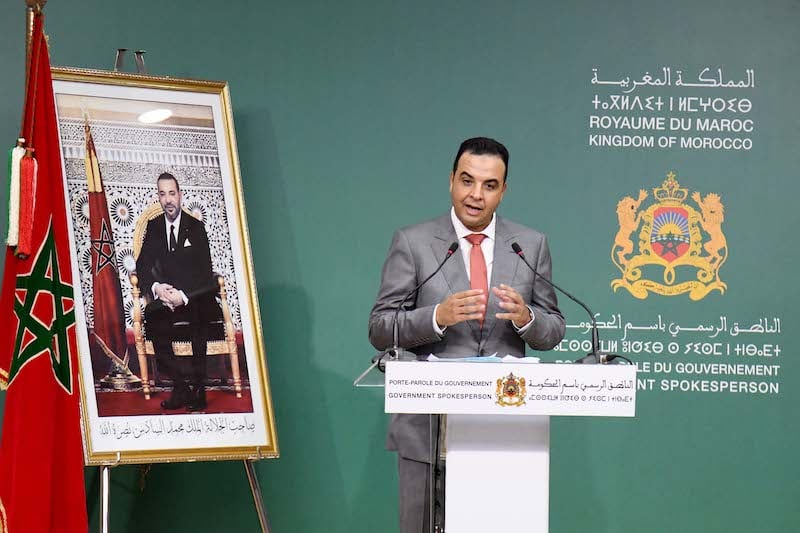
Mustapha Baitas, the Minister Delegate for Relations with Parliament and the government spokesperson, defended Mohamed Saad Barada, the newly appointed Minister of National Education, Preschool, and Sports, who succeeded Chakib Benmoussa, following the criticism surrounding his appointment to such a vital ministry.
Known in the business world, Barada is the founder of “Michoc,” a company specializing in sweets, as well as “Pharma Prom,” which focuses on pharmaceuticals, and the “Jibal” group, known for dairy products under Safilait.
In a press briefing held on Thursday, Baitas said, “all the ministers appointed in this government reshuffle have significant experience and a solid political background that enables them to implement the necessary reforms.”
He added, “while it’s true that expertise in a specific field can be beneficial for certain professions, we see that many political figures have succeeded in sectors unrelated to their original fields,” citing the example of Taib Bencheikh, an applied statistics engineer who was appointed as Health Minister.
Baitas emphasized that “it’s too early to discuss these issues, which are related to public management and public policies.”
In a different vein, the government spokesperson revealed that “the process for discussing the strike law has officially begun within the relevant committee of the House of Representatives.”
He explained that “the regulatory law regarding strikes was agreed upon in the committee after the Minister of Labor presented it to outline a meeting for a detailed discussion.”
Baitas mentioned that “the draft strike law has been introduced by several successive governments to the House of Representatives, but it has sat for many years without any progress in the discussion process.”
He further clarified that “after the date was set, the opposition parties exercised their rights under the House’s internal regulations to request a postponement of the discussion on the draft law,” emphasizing that “the discussion has been scheduled for early next week.”
Baitas confirmed that “the government will consider the feedback and proposals from all parliamentary groups at the committee level and will ensure that this process is followed carefully.” He also noted that “it’s too early to raise any concerns about the draft strike law, as the general features of the discussion haven’t yet taken shape.”
Regarding the medical students’ crisis, Baitas stated that “solving this issue is linked to the settlement process initiated by the Mediator’s Office, which has not yet issued any decision.”
He stated, “there is still ongoing dialogue between the students and the relevant government sector. Once the Mediator’s Office makes its final decision, we can then discuss the necessary steps moving forward.”
In a different vein, Baitas acknowledged that the government is aware of the rising prices of red meat in Morocco, pointing out that its measures to tackle inflation have borne fruit.
The minister said, “we’ve seen inflation decrease across various sectors, and even the inflation forecasts for the coming year look reasonable. However, there is a problem with red meat.”
He mentioned that last week, “the government approved 4 decrees specifically addressing red meat, stressing that the current issue is the decline of the national herd compared to previous years.”
Baitas explained that “it makes sense for the government to take two approaches to this issue: first, rebuilding the herd, and second, ensuring a steady supply to help lower prices.
He highlighted that “the approved decrees include provisions for importing all types of livestock, including cattle, as well as other regulations that allow for meat imports under established protocols.”
The government official noted that the aim of these measures, and others related to the agricultural sector, is to manage the inflation of red meat while also preserving and rebuilding the livestock population.”
Baitas also pointed out that “livestock farming is one of the most significant sources of employment in rural areas, adding, “this explains why job opportunities in rural areas have declined—because the herd has shrunk, and farmers’ resources have diminished since the rainy years.”
He concluded, “government support for inputs, seeds, and fertilizers has stabilized vegetable prices, but for livestock, the only option is to import, as these are living animals. Imports will be paired with a system to support feed so farmers can maintain their livestock in these conditions.”





add your comment
Terms of publication : Not to offend the writer, people, sacred things, or attack religions or the divine self, and refrain from racist incitement and insults.