
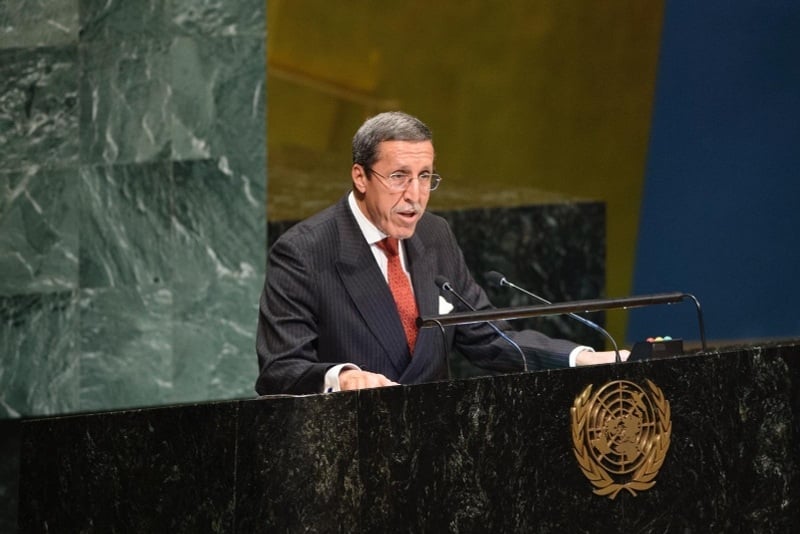
Morocco’s Permanent Representative to the United Nations, Ambassador Omar Hilale, affirmed, on Wednesday in New York, that the Autonomy Initiative, presented by the Kingdom to definitively resolve the regional dispute over the Moroccan Sahara, is a future-oriented solution, while Algeria’s position remains stuck in a backward-looking vision.
“In presenting this Initiative to the Security Council in 2007, Morocco made the bold choice of a negotiated solution instead of an imposed one, an inclusive solution instead of a non-partisan one, a future-oriented solution rather than a solution that is stuck in a backward-looking vision,” Hilale emphasized before the 4th Committee of the UN General Assembly.
He noted that the principles and values guiding the recently adopted Pact for the Future by UN member states advocate for a more peaceful, just, and sustainable world, expressing a collective determination not only to resolve existing conflicts but also to build resilient societies capable of living in peace and facing future challenges together.
The Kingdom of Morocco has embraced these very principles and values to settle the dispute over its Sahara, on the basis of the Autonomy Initiative, Hilale argued, noting that this Initiative “represents a strategic and irreversible choice, which today is enshrined both in the spirit and the letter of the Pact for the Future ,” particularly in the following principles:
1. The Pact recalls the UN role in maintaining international peace and security
Morocco sees no resolution to the issue of the Moroccan Sahara outside the framework of the United Nations and its Security Council, the ambassador pointed out, recalling that Morocco has always reaffirmed its full adherence to the political process, led under the exclusive auspices of the UN Secretary-General with the facilitation of his Personal Envoy.
However, he lamented that for the past three years, this political process has unfortunately been obstructed by Algeria, which refuses to re-engage as the main party, despite repeated calls from the Secretary-General, Security Council resolutions, and efforts by the Personal Envoy.
2. The Pact endorses the pursuit and implementation of measures to promote international peace and security
Hilale noted that Morocco has always shown goodwill and called for sincere and cordial dialogue with Algeria to resolve this dispute, which Algeria created from scratch. He explained that this outstretched hand policy, consistently reiterated by His Majesty King Mohammed VI, stems from the Sovereign’s sincere desire to create an environment of peace, security, and harmony in the region.
However, the diplomat noted, these calls have gone unanswered as Algeria persists in its hostility against Morocco’s territorial integrity and fuels tension through its proxy, the separatist armed ‘polisario’ group.
3. The Pact reaffirms the commitment to preventive diplomacy, the peaceful resolution of disputes, and the importance of inter-states dialogue
The Moroccan ambassador further highlighted that the Kingdom’s commitment in this context has already been reflected in the submission, in 2007, of the Moroccan Autonomy Initiative, in response to the Security Council’s call, stressing that the Council has considered this initiative as “serious” and “credible” in its last 20 resolutions.
He regrettably pointed out that Algeria, for the past three years, has refused to return to the round-table discussions, “which undermines the principle of the peaceful resolution of disputes, paralyzes the political process for resolving the Moroccan Sahara issue, blocks UN efforts, and condemns the populations held in the Tindouf camps to live in inhumane conditions, without any future prospects,” the ambassador warned.
4. The Pact highlights the commitment to adopting a coordinated approach and implementing policies that safeguard the needs and interests of future generations
Before the Commission members, Hilale specified that the Moroccan Autonomy Initiative “proposes substantial local democratic governance, through a wide devolution of powers for greater participation of the local population in political decision-making. This aligns with the principles of the Pact, which aim to empower local communities and ensure governance is carried out by the local population and meets their needs and aspirations.”
“Unfortunately, this is not the case in the Tindouf camps, where the populations are held hostage by a separatist armed group, with the complicity of Algeria, thus depriving them of returning to their homeland, Morocco, to participate in the political, economic, and social life of the Saharan provinces,” he deplored.
5. The Pact calls for the participation and representation of women and youth in political and economic life
In the Moroccan Sahara, the diplomat noted, women and youth play a central role in society and enjoy high-level political participation, including in local governance through legislative, executive, and judicial bodies. They have contributed to the development of the Moroccan Autonomy Initiative, as well as to the roundtable discussions of the political process.
“In contrast, their brothers and sisters in the Tindouf camps are victims of the exploitation of their youth and childhood by Algeria, which recruits them into polisario’s armed militias, in violation of international law and the Paris Principles,” criticized the ambassador, adding that Algeria has replaced schools and education with training and indoctrination camps.
6. The Pact emphasizes strengthening efforts to ensure access to justice for all
The ambassador representing Morocco at the UN noted that the Autonomy Initiative provides several justice mechanisms aimed at establishing an appropriate legal and judicial framework, notably the creation of local courts, thus facilitating more direct and equitable access to justice.
“For its part, Algeria has, in violation of international law, handed over its sovereignty, including its jurisdictional powers, in the Tindouf camps to the ‘polisario’, as highlighted by the Human Rights Committee,” Hilale denounced.
7. The Pact supports the implementation of economic, social, and environmental policies
On this point, the ambassador explained that the solution based on the Moroccan Autonomy Initiative “has the potential to strengthen economic growth and development in the Moroccan Sahara, through economic initiatives meeting the needs of the local population, particularly through the New Development Model for the Southern Provinces, initiated by His Majesty King Mohammed VI. This has led to job creation and an improvement in living standards.”
However, the 40,000 people in the Tindouf camps live in absolute poverty, worsened by 50 years of dependence on international humanitarian aid, which is systematically diverted by the separatist armed ‘polisario’ group, Hilale deplored once again.
8. The Pact supports the establishment of institutions to defend human rights and fundamental freedoms
In this regard, the Moroccan Autonomy Initiative provides all guarantees for the respect and promotion of human rights, notably through local representation, inclusiveness in decision-making, the independence of the judicial system, the promotion of socio-economic rights, and the preservation of Hassani cultural identity, the ambassador stated.
He also raised concerns about the conditions in the Tindouf camps, which “are an open-air prison, where the worst abuses are committed with impunity against these populations, who are deprived of their most basic rights. Even human rights treaty mechanisms are prohibited from visiting,” he warned.
9. The Pact promotes regional integration and cooperation
In line with the Pact for the Future , the Moroccan Autonomy Initiative aims to bring peace to the region by fostering good neighborly relations, enhancing stability, encouraging bilateral cooperation, creating conditions for development, and promoting sub-regional and regional integration, the diplomat said.
In this respect, he further noted that Algeria, for its part, acts against the Pact by closing borders, hosting and arming a separatist armed group, imposing visa requirements, condemning the Arab Maghreb Union to stagnation, and thus depriving the countries of the region of a vast potential for cooperation to address challenges, especially security threats in North Africa.



add your comment
Terms of publication : Not to offend the writer, people, sacred things, or attack religions or the divine self, and refrain from racist incitement and insults.