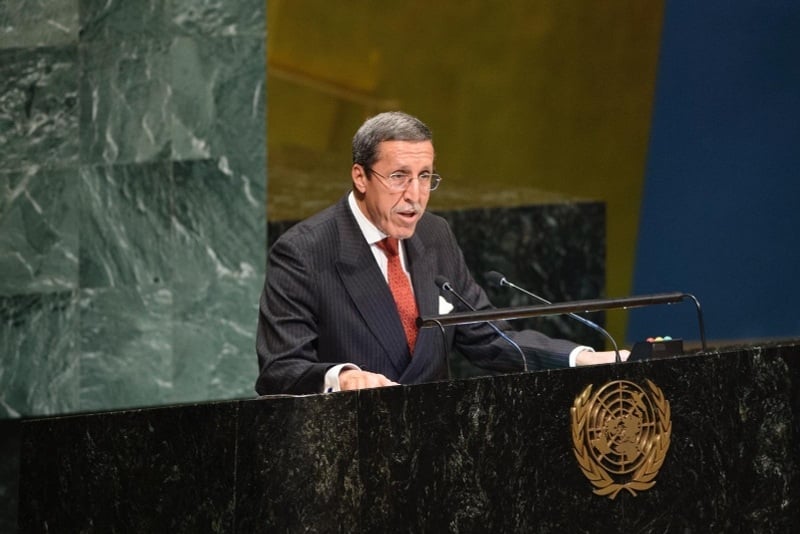
Morocco’s Permanent Representative to the United Nations, Omar Hilale, directed a series of pointed accusations at Algeria during an address to the UN General Assembly, questioning its claim to be an observer in the Sahara dispute while alleging that it participates directly in negotiations, proposes dividing the territory and threatens to withdraw from the political process.
Speaking at a General Assembly meeting following Russia’s Oct. 30 veto of a U.S.-drafted Security Council resolution on the Sahara, Hilale said the veto had prevented the adoption of a text that, in Morocco’s view, could have paved the way for a final settlement based on its autonomy initiative under Moroccan sovereignty.
He noted that 11 Security Council members had voted in favor of the U.S. draft, arguing that the result sent a clear message that the status quo was no longer acceptable and that a political solution was within reach.
Hilale said Morocco had not come to the meeting to criticize the use of the veto or express regret over the outcome, but to reaffirm what he described as an established historical position.
“The Sahara was Moroccan before Oct. 30, is Moroccan after Oct. 30, and will remain Moroccan forever,” he said, adding that Russia’s veto was not the cause of the deadlock but a consequence of it. He attributed the continuation of the dispute for more than five decades to what he called Algeria’s political choices.
The Moroccan ambassador structured his address around six questions that he said explained Algeria’s opposition to a settlement and the continued suffering of residents of the Tindouf camps, whose population he estimated at around 30,000.
Autonomy and Algeria’s position
Hilale’s first question concerned what he described as Algeria’s fear of autonomy under Moroccan sovereignty.
He said Morocco had submitted a detailed autonomy plan as the basis for resolving the dispute, adding that the proposal had been discussed at meetings in Washington and Madrid, and at a subsequent meeting in Washington, with Algeria and the Polisario Front taking part.
According to Hilale, the discussions covered elements of the proposal and produced documents outlining areas of convergence. He also said Algeria had proposed addressing disarmament, demobilization and reintegration through a bilateral agreement with the United Nations.
Hilale linked the concepts of autonomy and self-determination through the idea of people managing their own affairs. He argued that Morocco’s initiative would allow residents to manage local matters and make decisions on the ground.
Algeria’s role in the dispute
His second question challenged Algeria’s refusal to be recognized as a party to the dispute.
Hilale said accepting that designation would mean acknowledging that the key to a settlement lay in Algiers. He then pointed to what he described as contradictions in Algeria’s position.
He questioned how a country that describes itself as an observer could propose dividing a territory it says it supports, attend the Oct. 30 Security Council meeting to follow the vote and explain its position, or threaten member states with withdrawal from the political process if they backed the U.S. draft.
He also referred to Algeria’s relationship with the Polisario Front, noting that the camps are located on Algerian territory and alleging that the group relies on Algeria for weapons, financial resources and diplomatic support.
Hilale said differences between the Front’s public statements and positions expressed during meetings in Washington and Madrid reflected Algeria’s influence over its stance.
“Algeria is not observing this conflict; it is managing it and pulling its strings,” he said.
The debate over MINURSO’s referendum mandate
In his third question, Hilale addressed Algeria’s insistence on retaining the letter “R” in the name of the United Nations Mission for the Referendum in the Sahara, known as MINURSO.
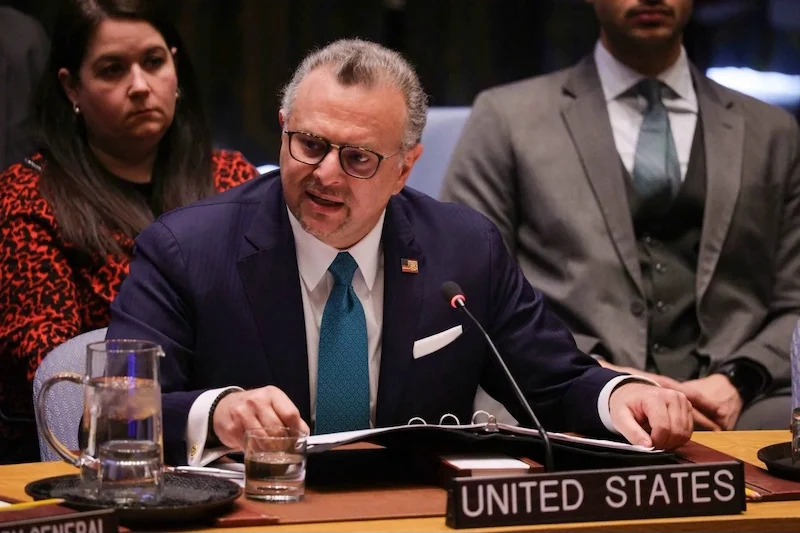
He argued that the reference to a referendum had become a pretext for maintaining the status quo. Hilale also praised explanations provided by U.S. Ambassador Mike Waltz on the history of discussions surrounding the referendum process.
He recalled that former UN Secretary-General Kofi Annan had acknowledged in 2000 that the process had reached an impasse, adding that the United Nations had not referred to a referendum as a practical path for a settlement for many years.
The letter “R,” which stands for “referendum,” had therefore become, in Hilale’s interpretation, a symbol of opposition to Morocco’s autonomy proposal rather than a reference to a viable process.
Questions over the Tindouf camps
Hilale’s fourth question focused on what he described as Algeria’s refusal to register and conduct a census of the population in the Tindouf camps over the past five decades.
He argued that a census would raise questions about the actual number of people living in the camps and the management of humanitarian assistance provided to them.
The Moroccan envoy said reliable population figures had not been made available to the UN High Commissioner for Refugees and other UN agencies. He also raised allegations of diversion of humanitarian aid and human rights violations, referring to reports by the UN refugee agency and the European Union.
Hilale further cited restrictions on access to the camps and the alleged exclusion of human rights bodies as reasons for concern about residents’ circumstances and rights.
He summarized his argument with the phrase: “The refugee who does not count.”
Humanitarian consequences of the stalemate
In his fifth question, Hilale asked why Algeria opposed what he called durable solutions, arguing that it feared the camps could disappear if refugees were allowed to choose freely between returning to Morocco and settling in a third country.
He said refugee status could not continue indefinitely unless it became an instrument of diplomatic leverage. He added that four generations had been born and raised in the Tindouf camps under conditions he described as harsh.
Hilale held Algeria politically responsible for the continuation of the humanitarian situation, which he said had persisted for half a century. Contrasting the camps with refugee settlements elsewhere that serve as temporary places of refuge, he described the situation in Tindouf as resembling “hostage-taking.”
Calls to broaden UN consultations
The sixth and final question concerned what Hilale described as Algeria’s reluctance to broaden consultations by the UN secretary-general’s personal envoy to include Sahrawis in the territory’s southern provinces, members of the diaspora abroad and people in the Tindouf camps whom he said were excluded from political participation.
Hilale argued that broader consultations would challenge the Polisario Front’s claim to be the sole representative of the Sahrawi population.
He said Sahrawis in the southern provinces participate in elections and choose their political representatives, while alleging that residents of the Tindouf camps do not have the same freedom to decide their future.
Four conclusions on the Security Council veto
At the end of his address, Hilale returned to the question of why the General Assembly had convened, setting out four conclusions that he said summarized Morocco’s position.
First, he argued that the use of the veto could affect the mandate of a UN mission but could not change history or Morocco’s sovereignty over the Sahara.
Second, he reiterated that Morocco’s detailed autonomy plan under Moroccan sovereignty, discussed by the parties at meetings in Madrid and Washington, remained, in his view, the only framework for resolving the dispute.
Third, Hilale referred to the participation of Morocco and Algeria in meetings in Washington and Madrid, as well as at the Security Council, asking which country had taken responsibility and which had sought to avoid it. He said Morocco had assumed its responsibilities while Algeria had disclaimed them.
His fourth conclusion concerned the location of the political deadlock. Hilale rejected the idea that it lay in Rabat, which he said had fulfilled its commitments, or in New York, where he pointed to efforts by the United States, as the Security Council’s penholder on the file, and last-minute attempts to reach an agreement before the Oct. 30 meeting.
He concluded that the deadlock lay in Algiers, accusing Algeria of rejecting proposals and diplomatic efforts aimed at ending the dispute.




add your comment
Terms of publication : Not to offend the writer, people, sacred things, or attack religions or the divine self, and refrain from racist incitement and insults.