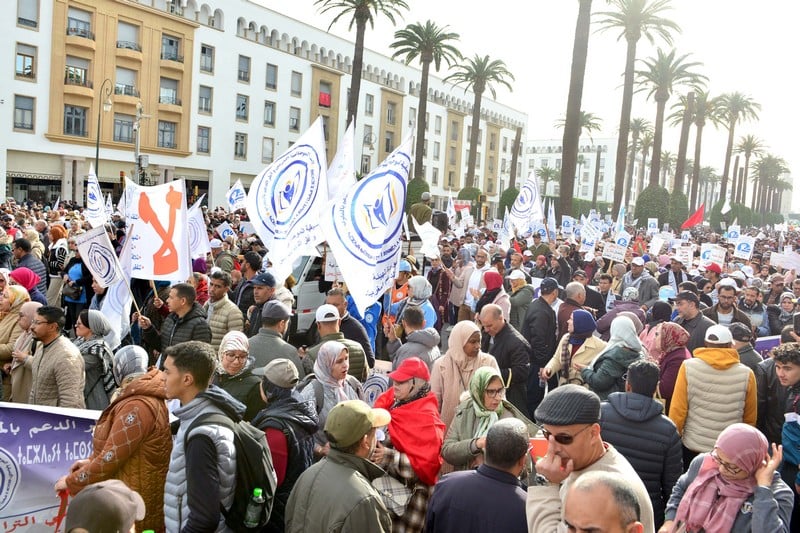
The National Council for Human Rights has expressed its stance on the implementation of the “pay for work” principle, which unions view as a threat to the right to strike.
The council stated that the practice of deducting wages from striking workers, as outlined in national legal frameworks and upheld by judicial precedent, aligns with standards set by the Committee on Freedom of Association, which confirmed that wage deductions during strikes do not violate principles of trade union freedom.
In a memorandum regarding draft regulatory law No. 97.15 on exercising the right to strike, obtained exclusively by Hespress, the council noted that the Freedom of Assembly Committee found this practice “does not raise objections from the perspective of assembly freedom.”
The memorandum emphasized that legal interpretations deem this measure acceptable when workers submit demands. However, in cases where strikes are due to wage payment delays, restrictions on trade union freedoms, or calls for legal enforcement, this principle should not apply.
The council referenced French legislation that exempts the “pay for work” principle when a strike results from significant employer failures, including wage payment.
The council highlighted Article 14 of the draft, which establishes the pay-for-work principle for wage deductions from striking workers, considering absence due to strike participation as non-performance. This aligns with labor code provisions and financial accounting principles established by the royal decree of April 21, 1967.
It noted that deductions from striking workers’ wages are based on Law No. 81-12 concerning deductions from the salaries of civil servants and local authorities for unauthorized absences.
The council pointed out that the Court of Cassation has affirmed the legality of deducting wages from strikers based on the pay-for-work principle.
In this context, the council recommended “respecting the principle of proportionality between the duration of work stoppage and the amount deducted” when applying the pay-for-work principle, and identifying exceptions where this principle should not apply, particularly for strikes due to unpaid wages.
In its general recommendations regarding the strike law project, the council called for ratifying ILO Convention 87 on Freedom of Association and Protection of the Right to Organize (1948) and institutionalizing social dialogue across sectors to foster collaborative efforts in improving working conditions and maintaining balance between workers and employers.
The council urged the adoption of a concise version of this regulatory law that emphasizes fundamental principles for exercising the right to strike, in line with the constitution’s spirit, rather than imposing punitive measures.
Additionally, it stressed the importance of aligning this law with constitutional provisions on trade union freedoms and the labor code, particularly regarding mechanisms for resolving collective labor disputes.
The council emphasized enhancing mechanisms for resolving collective labor disputes and negotiations, adopting a proactive approach to reduce strike occurrences. It called for expediting Bill No. 24.19 concerning trade union organizations, establishing specialization in social judiciary, and providing adequate financial and human resources.
Finally, the council proposed creating an effective institutional framework for collective labor relations in the public sector, strengthening reconciliation committees, and enhancing labor inspection resources. It also suggested reviewing the October 29, 1962 decree on employee representation in companies regarding workers’ delegate elections.





add your comment
Terms of publication : Not to offend the writer, people, sacred things, or attack religions or the divine self, and refrain from racist incitement and insults.