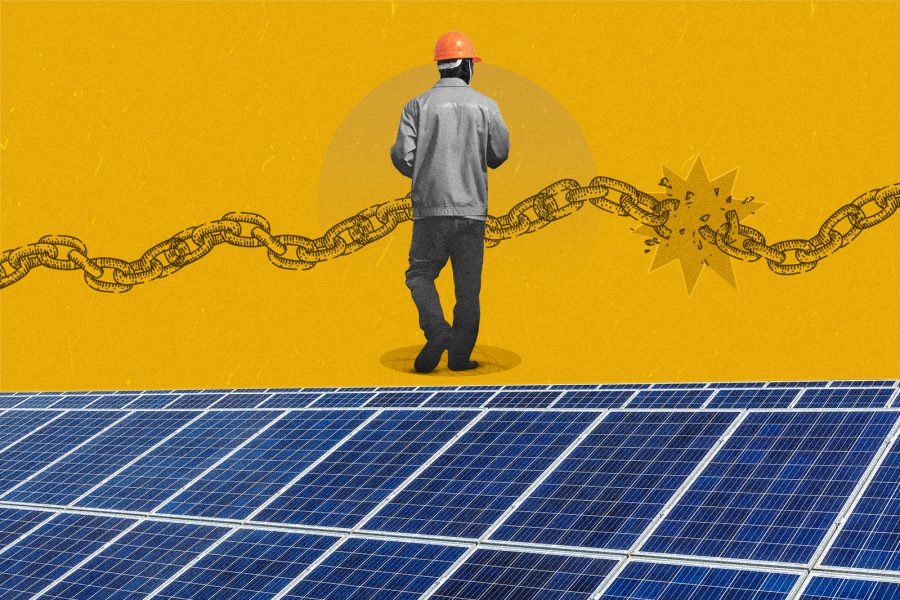
It’s known as the resource curse: natural wealth that leads to economic pitfalls instead of prosperity. Morocco’s shift from fossil fuels to clean energy promises economic growth and sustainability, but it also raises a troubling question: could a “resource curse” undermine this progress?
The resource curse describes the paradoxical situation where countries with abundant natural resources often experience slower economic growth and development compared to countries with fewer resources.
While the traditional resource curse is associated with commodities like oil and minerals, the advent of renewable energy has introduced a new dimension to this challenge.
Low- and middle-income countries (LMICs) are particularly vulnerable to the “resource curse” when it comes to renewable energy (RE). These countries often have abundant RE resources, like solar power, which can be exported to high-income countries (HICs) seeking to reduce their carbon emissions.
While this can create jobs and economic growth, it also carries risks. LMICs often have weak governments and institutions, which can make them more susceptible to the negative consequences of the resource curse.
In Morocco, renewable energy potential is significant, comparable to that of Nigeria and Venezuela in terms of gas production. Fully utilizing this resource could decrease our energy dependence, increase the purchasing power of our citizens, improve the competitiveness of our industries and public finances, and strengthen Morocco’s international position.
But 14 potential negative consequences of Morocco’s renewable energy development need to be navigated in order to circumvent the resource curse linked to the Kingdom’s transition, said a 2024 study called “Renewable Energy in Morocco: Assessing Resource Curse Risks.”
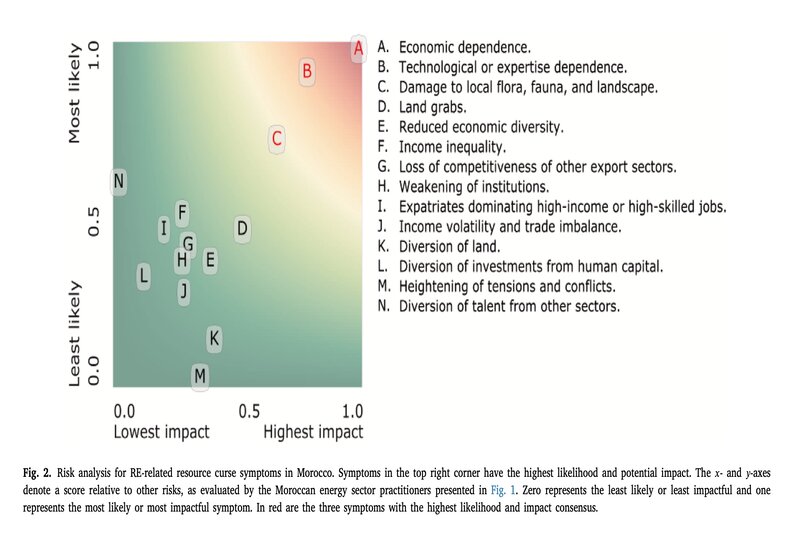
Economic dependence
One of the most pressing concerns of renewable energy projects is economic dependence. Morocco’s renewable energy projects often involve partnerships with foreign investors, leading to a reliance on external funding and expertise.
While these collaborations can provide essential capital and technology, they also carry the risk of compromising the country’s economic autonomy.
Even though Morocco’s economic future is increasingly tied to renewable energy, which is expected to create jobs and income, some people worry that the country’s reliance on foreign investment could lead to financial mismanagement.
“Renewable energy projects in Morocco are partially financed by international banks, partially financed by the Moroccan state. There is a risk of misappropriation of Moroccan state finances. Funding for infrastructure, social projects, and health could be diverted,” one interviewee in the study said.
Others argue that it’s fair for Morocco to rely on foreign economic support, especially for large-scale renewable energy projects that benefit high-income countries.
However, with so many countries competing for investment, Morocco may have less bargaining power, making the country vulnerable to being influenced by foreign interests.
‘‘We have a lot of European countries interested in developing renewable energy… we’re getting countries like Norway and Switzerland who don’t want to sacrifice the competitiveness of their industries; they’re coming to Morocco to purchase cheap carbon credits. They’re win-wins, but they’re still influential at an international level. They’re trying to push us in certain directions,” one of the interviewees explained.
Morocco’s economic dependence on foreign funding may be particularly influential in the southern part of the country. Some international financial institutions are hesitant to invest in this region, which could influence Morocco’s development decisions and contribute to tensions and conflicts.
Technological Dependence
Another challenge is technological dependence. Morocco’s renewable energy sector currently relies heavily on imported technologies and expertise.
Despite Morocco’s expertise in renewable energy research, its domestic capacity for manufacturing renewable energy technology is relatively weak. This has resulted in a dependence on foreign companies for essential components and equipment.
Specifically, the reliance on expatriates in high-level positions within Morocco’s renewable energy industry raises concerns about the transfer of skills and knowledge to local professionals.
Some argue that the dominance of expatriates hinders the development of domestic expertise.
“Instead of having expatriates work, they should come and train our local employees. Perhaps if there is a policy in this direction, it will be more effective,” said one interviewee.
The choice of technology in Morocco’s renewable energy projects is often influenced by foreign investors, who may dictate the type of technology used and where it is sourced. This can reinforce both technological and economic dependence.
“We are currently dependent on some technologies, such as CSPs produced in Europe. The World Bank requires us to avoid PV, which is produced in China, as a condition for providing a loan,” an interviewee explained.
Explaining the choice of this technology, another interviewee said that “the decision to use CSP was influenced by Germany. The choice was not rational in the sense that Morocco already had wind power that was producing energy at a reasonable cost. It turned out that CSP was more costly, took up more space, and used up water in a country with water scarcity.”
Environmental concerns
Environmental concerns are also a significant factor in the renewables sector. While renewable energy projects often have a lower environmental footprint than fossil fuel alternatives, they can still have negative impacts, such as habitat loss and water consumption.
While environmental impact assessments are typically a requirement for renewable energy projects in Morocco, these assessments are often mandated by investors, such as regional investment centers or international financial institutions. This means that privately funded projects may not be subject to the same level of environmental scrutiny.
While Morocco has plenty of non-agricultural land suitable for renewable energy development, increased hostility from local populations towards large-scale projects can hinder land acquisition and lead to greater environmental impacts.
Deserts, commonly used for wind and solar development in Morocco, are often viewed as unproductive land. However, they are valuable parts of the natural world. Not to mention that Morocco’s nomadic pastoralist cultures, which rely on traditional land-based knowledge, could be threatened by renewable energy development.
According to the study, renewable energy infrastructure can deplete scarce water resources and contaminate them with pollutants from cooling and washing processes.
Informants cited examples of land exploitation with limited economic benefits for local communities, poor communication, and temporary employment opportunities that resulted in the degradation of farmland.
‘‘It becomes difficult to mobilize land. When they mobilize land, the population has to sell it cheaply. They are made promises of job creation, which did not materialize,’’ one interviewee said.
These experiences have fueled resistance to renewable energy projects and made it more difficult to find suitable development sites that minimize environmental impacts.
What’s to be done about these risks?
Foreign investments in renewable energy can create a positive cycle of growth. These investments can generate income for foreign investors, attracting more capital and boosting renewable energy development. This can also generate tax revenue for social programs. However, it can also lead to economic dependence.
To mitigate this risk, Morocco could negotiate more favorable terms in foreign investment agreements, ensuring that the benefits align with national priorities. Diversifying investors can also reduce dependence on any single entity, said the study.
By attracting multiple, smaller investors, Morocco can increase financial inflows and strengthen the positive feedback loop while minimizing the influence of individual foreign entities.
When it comes to technological dependence, a common approach is to use protectionist measures like requiring local contratcs or restricting imports.
While this might seem like a quick solution, it can actually harm the renewable energy sector as it can increase costs, reduce profitability, and discourage investment.
A better strategy is to build local capacity. This means training local experts, developing domestic technologies, and creating a supportive environment for renewable energy innovation.
By doing this, Morocco can reduce their reliance on foreign inputs and make their renewable energy projects more competitive.
However, building local capacity is not without risks. Technologies can become outdated quickly, so it’s important to carefully evaluate the potential benefits and drawbacks of investing in specific technologies.
As per damage to fauna, flora, and landscape, one exciting solution is agrivoltaics. This technique involves installing solar panels above crops, creating a win-win scenario.
The panels provide crucial shade for crops in hot climates, improving their yield and reducing water usage. At the same time, the crops help cool the panels, boosting their efficiency.
Agrivoltaics offers a promising way to address the intertwined challenges of food, water, and energy security.
While still in its early stages, agrivoltaics demonstrates the potential for win-win interventions in renewable energy development.
By combining renewable energy generation with agricultural production, this approach can minimize environmental footprint, increase food production, and reduce land-use conflicts.






add your comment
Terms of publication : Not to offend the writer, people, sacred things, or attack religions or the divine self, and refrain from racist incitement and insults.