
The Moroccan League for Citizenship and Human Rights has called on the Office of the Public Prosecutor to halt legal proceedings against youths detained in connection with recent migration attempts from Fnideq.
The organization argues that migration driven by poverty and marginalization is not a crime, referencing the Global Compact for Safe, Orderly and Regular Migration, which Morocco endorsed in 2018.
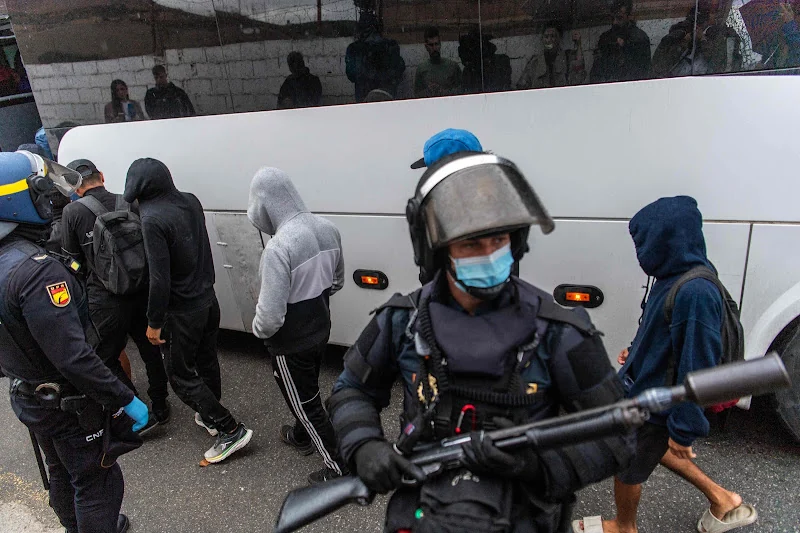
In a statement, the league expressed concern over the heightened security measures in Fnideq, where hundreds of young people attempted mass migration toward the Spanish enclave of Ceuta.
The move followed widespread calls on social media encouraging the migration, which saw significant participation from individuals across various age groups, including minors from impoverished backgrounds.
The organization highlighted that the Moroccan Ministry of Interior reported thwarting about 11,300 migration attempts to Ceuta in August alone.
The league noted that while the security response was generally professional, some minors faced harsh treatment, including beatings and forced deportations to distant cities. The group also criticized the use of force, which resulted in injuries to some public officials.
The LMCDH criticized the Moroccan government for its lack of action on the underlying issues leading to migration, such as high unemployment, inadequate educational and vocational training, and the widespread impact of drugs. The organization stressed that the challenges faced by Moroccan youth require urgent attention, noting a significant demand for equitable opportunities.
The rights group condemned government policies affecting marginalized youth, particularly in areas like employment, education, and sports, and urged the government to address these issues proactively.
They called for the development of youth policies that foster economic participation and provide access to education and job opportunities with fair wages and rights.
Furthermore, the LMCDH called for a national dialogue involving government bodies, civil society, and experts to create a comprehensive plan for Moroccan youth. They also urged families to discourage their children from risky migration attempts and to resist external pressures that might endanger their lives.
The statement reflects growing concerns about the socioeconomic conditions driving migration and calls for a coordinated response to support and integrate young people into the economy and society.
Significant security response
Since September 10, Morocco has initiated a comprehensive security operation across its northern regions in response to social media calls for a “mass invasion” of the Spanish enclave.
The operation targeted irregular migration, particularly along the Fnideq coastline, a popular hotspot for previous mass migration events.
The Moroccan government’s decisive actions to curb migration have been lauded as a strong response to external criticisms. Some critics, including right-wing factions in Spain such as VOX, have accused Morocco of using migration as a political tool to pressure Spain and the European Union during election periods, which has strained diplomatic relations.
Strategic affairs experts, however, view Morocco’s recent measures as a serious commitment to combating illegal migration. They stress that effective solutions require deeper political and security cooperation between Morocco, Spain, and the EU to address the root causes of migration.
Hicham Moatadid, a researcher in strategic affairs, told Hespress that Morocco’s enhanced security presence in northern regions like Fnideq and Martil demonstrates the country’s commitment to border protection. Moatadid emphasized that Morocco’s actions challenge claims by some Spanish political factions who accuse the kingdom of leveraging migration for political purposes.
“Rabat is taking decisive and effective steps to prevent mass illegal migration attempts,” Moatadid said. “This shows Morocco’s responsibility and respect for its commitments to European neighbors, especially Spain.” He also highlighted the strong security and intelligence collaboration between Morocco and Spain, noting that both countries are working together to manage their shared borders.
In a similar vein, Abdelhamid Jamour, a researcher specializing in South-South migration and development, discussed the importance of bilateral cooperation in managing migration. Jamour criticized some Spanish political parties for downplaying Morocco’s efforts, asserting that the migration issue has become a political tool manipulated by certain politicians.
Jamour also praised Morocco’s proactive approach to regularizing the status of migrants, particularly from sub-Saharan Africa, through its National Immigration and Asylum Policy. This policy offers migrants access to healthcare, education, and vocational training, reflecting Morocco’s broader commitment to addressing migration challenges.









add your comment
Terms of publication : Not to offend the writer, people, sacred things, or attack religions or the divine self, and refrain from racist incitement and insults.