Small and medium-sized enterprises (SMEs) in Morocco have been revving their engines to carve a niche in the country’s booming automotive industry by increasing their integration rate, balancing competition and vulnerability, and switching from labor-intensive to high-tech.
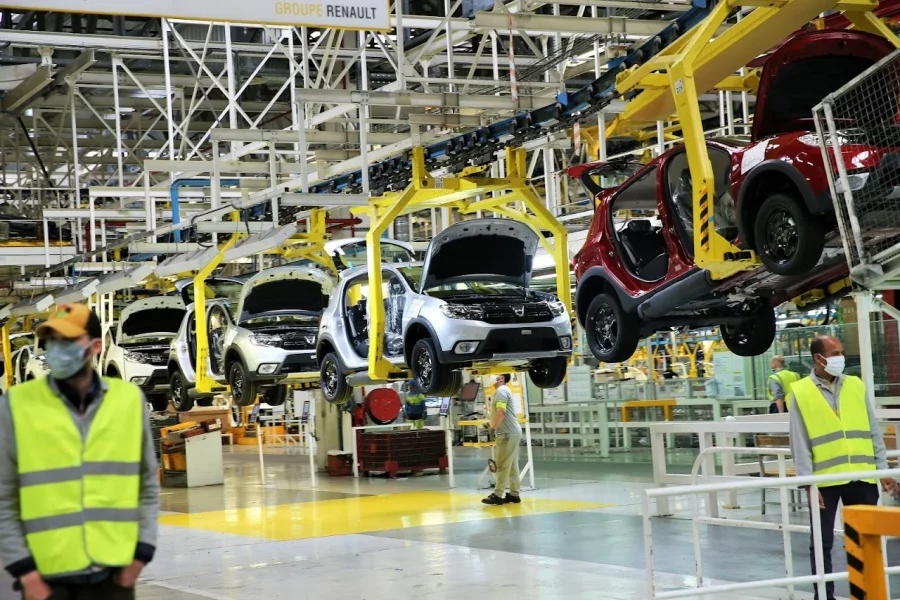
This sector, virtually non-existent in the 1990s, has undergone a remarkable transformation, boasting a production capacity of 700,000 vehicles annually and a leading position in African exports.
Morocco’s auto industry is fueled by a vast network of 250 global corporations and smaller suppliers, which deliver parts to 75 export destinations worldwide.
The arrival of companies like Renault in Morocco presented exciting opportunities for collaboration and growth for Moroccan SMEs, but the road to success remains a winding one marked by both opportunities and challenges.
Beyond 60%: The SME Push for Higher Integration
The Moroccan automotive sector operates like a well-oiled machine but with a crucial component missing: a stronger presence of Moroccan SMEs at the higher echelons.
Renowned international car manufacturers like Renault and Stellantis act as the driving force, attracting a network of tier 1 and tier 2 suppliers.
These suppliers are often multinational corporations, with limited participation from Moroccan companies in joint ventures.
Consequently, Moroccan SMEs find themselves primarily in the lower tiers of the value chain, functioning mainly as subcontractors or even tier 4 suppliers.
This limited role translated, up until 2016, into a 40% local integration rate, lower than envisioned.
For international companies, stronger local integration in Morocco offers a double benefit: easier access to local suppliers and economies of scale. This translates to lower costs and a more competitive edge for suppliers because they don't have to spend as much on logistics.
While the local integration rate currently stands around 60%, the question remains: how can Moroccan SMEs ascend the value chain and contribute more significantly to the industry's success?
Abdelmonim Amchraa, an expert in sustainability and global value chains, told Hespress En that, in Morocco's growing automotive industry, SMEs have started going beyond basic assembly and are venturing into more complex areas like design and high-tech parts.
However, these SMEs still struggle to fully participate in the most profitable parts of the supply chain, often due to difficulty securing funding for research, development, and certifications needed to become qualified suppliers, the expert added.
Another challenge for Moroccan SMEs in their ascent within the automotive value chain is the stringent quality standards and certification requirements.
To become a Renault supplier, for instance, both international and Moroccan companies must meet high standards. This includes common certifications like ISO TS and ISO 14001 and Renault's own internal rating system.
The selection process is rigorous, with thorough assessments and regular audits to ensure compliance. While demanding, these requirements are seen by some as a key barrier for Moroccan companies entering higher tiers of the supply chain.
Moroccan SMEs, often lacking the economies of scale of their international counterparts, struggle to meet the demands of international car manufacturers for cost reduction.
Double-Edged Sword: Competition vs. Vulnerability
“The lack of upstream integration capacities in the automotive sector at the national level reinforces Morocco’s dependence on Asian equipment manufacturers,” says Amchraa.
Data showed a heavy reliance on imports for Morocco's automotive sector (CL0), with over 40% of material costs (nearly 30% of total production costs) stem from imported inputs.
This echoes a global concern: overdependence on a single source can be risky. Therefore, while foreign investment in clean energy and electric vehicle infrastructure is welcome, relying too heavily on a small number of foreign companies for such a critical sector could be a gamble.
In response to these hurdles, the Moroccan government launched the "integrated industrial ecosystems" policy. This initiative aims to boost local content, exports, and employment by fostering dedicated clusters for specific sub-sectors like cabling, metal stamping, and batteries.
By targeting specific sub-sectors, this initiative has effectively provided Moroccan SMEs with the necessary infrastructure and support to flourish in these dedicated areas of the value chain.
But in a climate led by industrial groups and multinational enterprises (MNEs), local players struggle to gain a foothold due to the complexities of entering global value chains (GVCs). These GVCs demand high investment capabilities and rigorous manufacturing standards.
Take Renault, for example. With local production and a 40.6% market share, it exemplifies this trend of dominance by large multinational corporations. The recent establishment of the Stellantis plant in 2019 further reinforces this dominance.
The future of Morocco's automotive industry hinges on fostering a more balanced relationship between international players and Moroccan SMEs.
International companies benefit from local sourcing, which reduces logistical costs and allows them to tap into economies of scale. On the other hand, Moroccan SMEs gain access to cutting-edge technology and expertise through collaboration.
A 2013 study by Nadia Benabdejlil shows a Moroccan automotive supplier's success with a Renault in exhaust pipes/stampin came from both formal training, which included knowledge transfer through training, establishing internal structures for internal knowledge transfer, and the support from Renault – and informal connections with colleagues and other businesses.
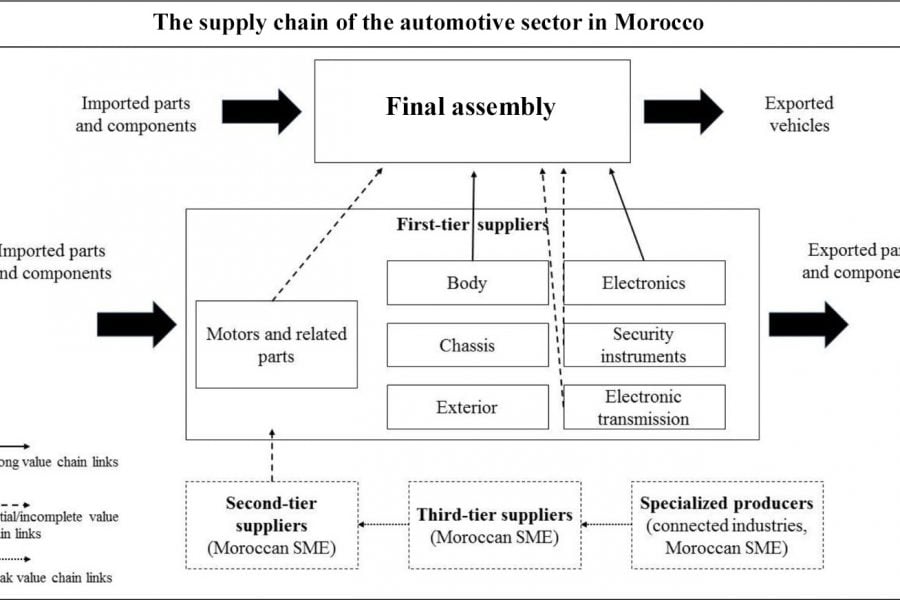
He is one of only two Moroccan firms of the 18 first-tier suppliers in the industry, despite initial efforts of multinational companies and the state to upgrade local companies to fulfil the necessary requirements.
To unlock this industry's full potential and empower young Moroccans, a robust system of vocational and technical education and training (TVET) is crucial.
TVET programs, a type of education program that focuses on developing practical skills and knowledge for specific careers, can equip young people with the specialized skills needed to thrive in high-tech production, advanced design, and innovative areas of the automotive value chain.
A skilled workforce is essential for Moroccan companies to climb the value chain and contribute meaningfully to the industry's future.
From Labor-intensive to High-tech
Morocco's automotive sector has focused on activities requiring a large workforce, such as seat wiring and car assembly. Although the number of companies engaged in spare parts (engine components, mirrors, headlights, etc.) is limited, their economic value has increased.
Morocco created six specialized industrial zones focused on key car parts. These zones, grouped into four categories, target areas like cabling, metal stamping, batteries, vehicle interiors, drivetrains, and truck bodies.
However, if Moroccan SMEs want to become more competitive, they'll need more financial backing, especially for research and development, prototyping, and certifications, Amchraa told Hespress EN.
Morocco's car industry is shifting gears, aiming to specialize in advanced and complex value chains. This is evident in the recent focus on electric vehicles and research and development (R&D).
The goal is to integrate environmental, social, and governance (ESG) principles while fostering innovation and local participation. However, a significant hurdle remains: the dominance of two foreign manufacturers (Renault & Stellantis).
This limits opportunities for Moroccan SMEs, who often struggle with limited capital and ambitions.
Morocco's automotive future hinges on two key factors: the rise of electric vehicles (EVs) and the European Union's (EU) potential delay on banning combustion engines by 2035.
While Morocco aims to join the EV supply chain, it could also continue producing gasoline-powered cars for both EU and non-EU markets.
Simply sourcing the cheapest parts on the global market won't secure Morocco's long-term success. The key lies in strengthening the local ecosystem.
According to Amchraa, equipping young Moroccans with the necessary skills is paramount. Morocco should empower its workforce and foster a thriving domestic supplier base, ultimately achieving a more integrated and innovative automotive sector.
This could come in government grants or loan guarantees, incentivizing these businesses to innovate and take on more high-tech projects in the automotive supply chain.
Moroccan SMEs can become valued partners who contribute significantly to the overall value chain by focusing on innovation, efficient processes, and a skilled workforce.
To achieve this, investments are needed in training, knowledge-sharing, and collaboration among these businesses. This will ultimately enhance their contribution to the global automotive value chain.






add your comment
Terms of publication : Not to offend the writer, people, sacred things, or attack religions or the divine self, and refrain from racist incitement and insults.