
Morocco’s wheat sector is reeling from the harsh effects of a prolonged drought, which has drastically reduced its cultivated land. To satisfy the soaring domestic demand and offset the losses from these now barren fields, wheat imports have surged dramatically.
In 2022, Morocco imported a staggering $2.32 billion worth of wheat, catapulting it to the 8th largest wheat importer globally. That same year, wheat became Morocco’s second most imported product.
The majority of this wheat flows in from France ($1.21 billion), Canada ($377 million), Argentina ($223 million), Germany ($149 million), and Brazil ($102 million).
However, with the surge in imports, a crucial question arises: Is this affecting Moroccan agriculture, particularly by disadvantaging local farmers who must compete with the flood of low-priced imported wheat?
Omar Yaakoubi, President of the National Federation of Grain and Legumes Traders, dismissed this concern, in a statement to Hespress English, and emphasized that “there is absolutely no relationship between the two.”
He explained that “Morocco’s domestic grain production simply can’t meet the country’s need,” a statement further echoed by Mohamed Jedri, an expert in Economy.
Economist Jedri pointed out that Morocco ideally should produce about 75 million quintals of grain. However, recent harvests have fallen short at just 32 million quintals. With a national demand hovering around 100 million quintals, this shortfall forces imports to exceed 60 million quintals.
“The real challenge for Moroccan farmers would arise if, for instance, 200 million quintals of grain were imported, flooding the local market and undercutting local farmers’ ability to sell their produce,” elaborated further the economist.
For this reason, he believes that the imported low-priced wheat does not compete with local produce. “Both domestic production and imported quantities will find buyers,” he emphasized.
Beyond imports not directly competing with local crops, Morocco faces another challenge, he explained, low rainfall has reduced cultivated land from 3.6 million hectares last year to just 2.5 million, necessitating increased imports to bridge the gap and meet domestic demand.
“ Morocco’s grain import bill is projected to balloon past 100 billion dirhams this year, a significant jump from last year’s 89 billion,” expected Economist Jedri.
For context, the Ministry of Agriculture, Maritime Fisheries, Rural Development, Water and Forests had anticipated a 43% decrease in domestic grain production compared to the previous year, due to scarce rainfall and consecutive years of drought that impacted crop yields,
This decline in Morocco’s wheat production reflects a persistent trend influenced significantly by climate change, which also plays a role in global wheat price fluctuations.
Cultivated land dedicated to wheat has shrunk from 2.7 million hectares in 2020-21 to an estimated 2 million hectares in 2024-25.
This decline is linked to critically low reservoir levels, currently at around 23% capacity. The shrinking irrigated area, previously estimated at 750,000 hectares but now at 400,000, is likely impacting overall cereal output.
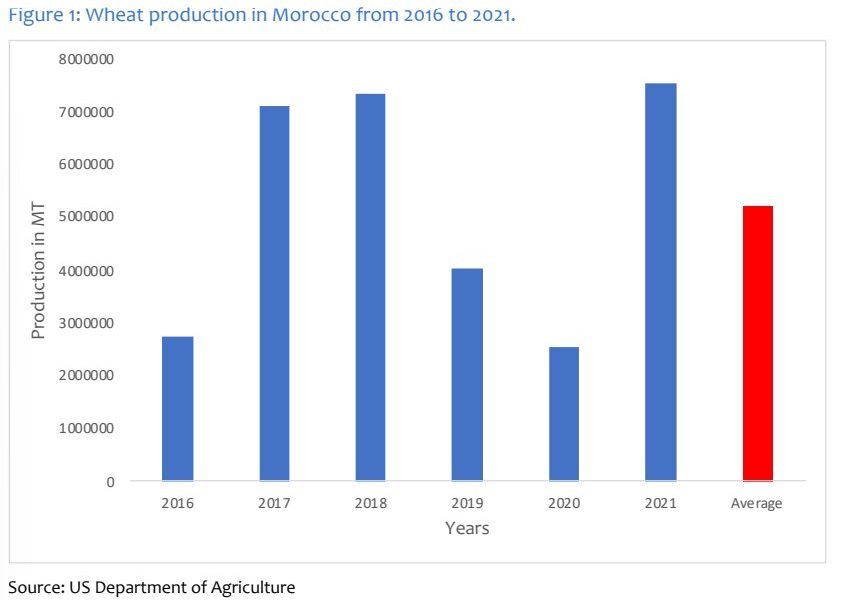
Reports by the US Department of Agriculture showcased that wheat production in Morocco between 2016 and 2020 fluctuated significantly, with highs in 2017 (7.09 million MT), 2018 (7.34 million MT), and 2021 (7.54 million MT), and lows in 2016 (2.73 million MT), 2019 (4.03 million MT), and 2020 (2.56 million MT).
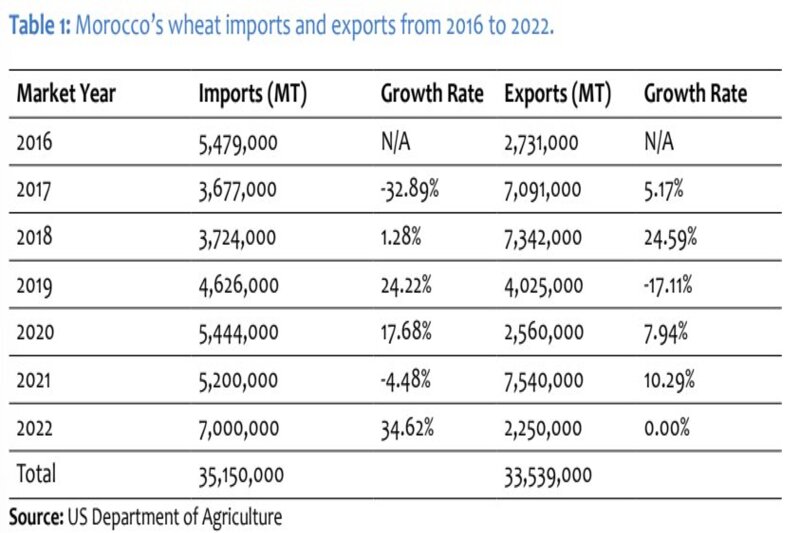
As a consequence, wheat imports were expected to rise significantly. The US Department of Agriculture (USDA) forecasted imports to reach 7.5 million metric tons, a 52% increase from the country’s average. This trend aligns with Morocco’s growing reliance on imports.
A previous study by the European Journal of Sustainable Development (EJSDà indicated a substantial gap between wheat production and consumption in Morocco, highlighting the increasing need for foreign supplies.
This gap is expected to widen further, with estimates suggesting wheat import needs could reach 46.3 million quintals by 2030 and 57.3 million quintals by 2050.







add your comment
Terms of publication : Not to offend the writer, people, sacred things, or attack religions or the divine self, and refrain from racist incitement and insults.