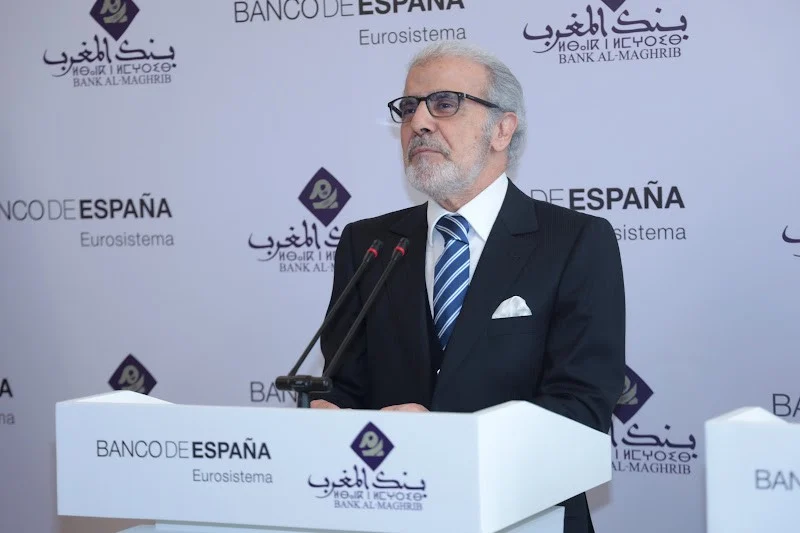
Bank Al Maghrib (BAM) Governor Abdellatif Jouahri defended the decision to cut the key interest rate by 0.25 basis points to 2.75 percent, after it remained stable at 3 percent for four consecutive quarterly meetings of the central bank’s board.
Jouahri, who was answering questions from the media during a press meeting on Tuesday evening following the second meeting of the Central Bank Board, emphasized that “the decision to reduce the interest rate was taken unanimously by the board members, who include economic experts and academics,” noting that “it was based on a set of indicators that gave the green light to the reduction after previous meetings that witnessed a hike or stabilization.”
“We might have been criticized if the BAM had not taken this decision in light of the existing data, which changed between March and June 2024 according to the analysis carried out,” he said, recalling a chronological process that led to the hike decisions (meetings in March 2023, June, September and December of the same year), in parallel with efforts to curb a rapid escalation of inflation.
Enumerating the reasons for the rate cut, the official said: “We have reached a level of inflation in 2024 of less than 2 percent, with a forecast to end 2024 at 1.5 percent, and then a forecast of 2.7 percent in 2025, excluding increases related to the price of butane gas. For us, the BAM is operating within the framework of achieving the target associated with controlling the inflation target range.”
The “green light” is also “the growth rate of non-agricultural activities to 3.4 percent before reaching 4.8 percent in 2025.” “We are starting to touch numbers that we have not seen for years, as we have always been close to 3 to 3.3 percent, in addition to the public finance situation with a budget deficit forecast of 4.1 percent and a state debt ceiling controlled in a range between 68 and 70 percent relative to GDP,” Jouahiri said, adding that “the external deficit has shown comfortable conditions with the GDP.
Morocco’s top financial official also emphasized that “the external deficit has shown comfortable conditions with official reserves sufficient for about six months, as well as huge investment projects and major projects inaugurated by Morocco (Dakhla and Nador ports, desalination, dams…)”; all these indicators “have improved significantly and have given us reassurance,” he said.
“At the September meeting, the Bank’s Board will reassess all economic data and the Kingdom’s financial indicators,” Jouahiri said, stressing that “economic uncertainty exists, especially in light of shifting geopolitical realities, escalating tensions and the outcome of elections in 70 countries, some of which have strong ties with Morocco.”
The official also recalled the “message of the Prime Minister’s letter framing the 2024 fiscal law, which set out the objectives of preserving macroeconomic balances,” adding: “…the government has tried to fulfill its word for the next two years in terms of expectations and implementation,” noting that “this is an additional green light for the decision to reduce the interest rate.”
On a related topic, after expressing his support last March for the Akhannouch government’s disbursement of “direct subsidies to deserving families,” the governor of the Bank of Morocco went on to support the decision to lift subsidies on butane gas as part of a gradual reduction of the clearing fund expenditures, saying it “came at the right time, as the decision to reduce subsidies on butane gas was delayed until the launch of direct subsidies and the start of benefiting vulnerable families.”
According to Jouahri, the decision “affects not only Moroccan families, but also the agricultural sector, which uses this gas heavily,” he said, stressing that “the timing chosen by the government is appropriate, and the gradual implementation of the decision is also appropriate.”
“The decision to raise the price of buta was not implemented all at once, but rather in a gradual manner,” he said, noting that “the reduction of clearing costs provides important financial margins for the Kingdom’s budget within the framework of financing the social protection project and direct support.”
In an update to its forecasts, the Central Bank of Morocco said, following its second quarterly meeting this year, that “internal inflation, after registering 6.6% in 2022 and 6.1% in 2023, continues to decline to low rates as a result of low external inflationary pressures and low prices of volatile foodstuffs.”
“Inflation is expected to end the current year at an average of 1.5% before rising in 2025 to 2.7%,” the bank said, “taking into account these data and the resumption of the process of lifting subsidies.”





add your comment
Terms of publication : Not to offend the writer, people, sacred things, or attack religions or the divine self, and refrain from racist incitement and insults.