
Cicero Moraes, a Brazilian 3D designer and graphics expert, has revealed what the oldest known Homo sapiens on the planet, whose remains were discovered in Jebel Irhoud, located in the southeastern Youssoufia region of Morocco, may have looked like.
A team of scientists reconstructed the oldest known Homo sapiens skull found in Morocco, which was missing a mandible when it was discovered in 2017.
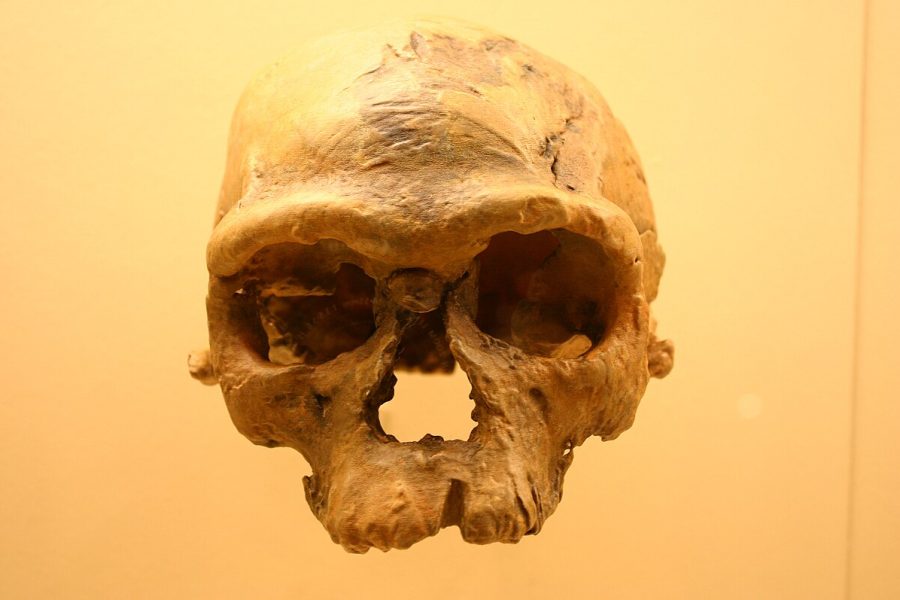
According to the British newspaper “The Mirror”, “It is now possible to see the ‘strong and calm’ face of a man who is the oldest known human being after his remains were found in Jebel Egoud, Morocco, for the first time in 300,000 years.”
The same source added that the face of the oldest human being on the planet can now be seen by scientists reconstructing his form based on his discovered skull.
He described the drawn face as “strong and calm,” after this result was reached by “using tomography of modern humans, modifying it, and the deformation ends with the formation of a compatible face, while using additional data from modern humans to predict the thickness of soft tissues, and the possible projection of the nose and other facial structures.”

“The final face is the distillation of all this data, generating two sets of images to reach a single goal, with more technical elements,” said Cicerone, who published his study in the 3D computer graphics journal OrtogOnLineMag.
The data used was from a low BMI adult male from the modern era, with Moraes emphasizing that he “chose to give the skeleton a masculine face because he found the skull more robust,” according to the same source.
The skull itself is a composite of different fossils, reconstituted in a complete form, the British newspaper reported, explaining that “Cicero described the final face as ‘excellent and completely coherent anatomically.’
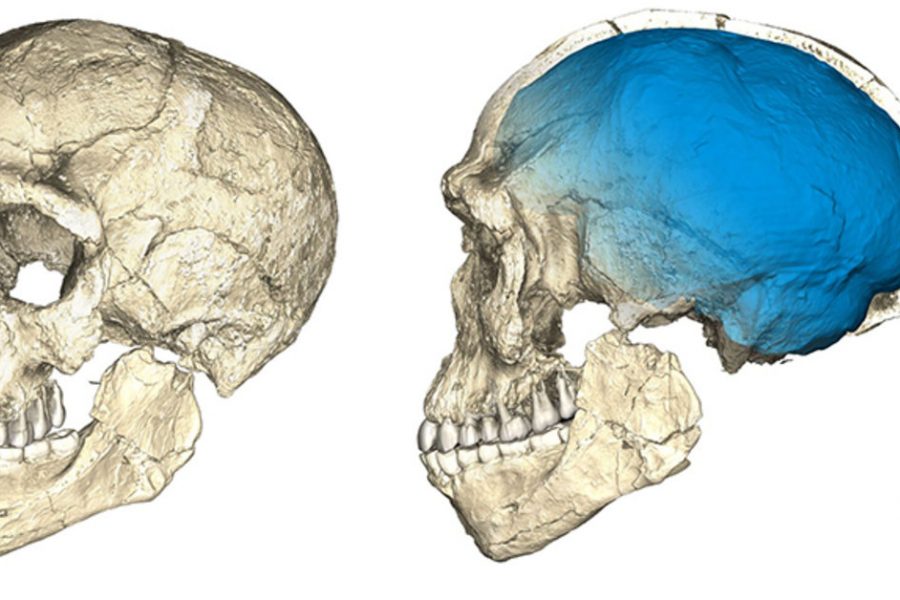
“The Mirror” explained that “the skull of Mount Igoud is very similar to the skull of ‘Sekol V’, which is the remains of another ancient homo sapiens, however, it also contains some characteristics compatible with Neanderthals or Heidelbergers,” noting that “the Brazilian study author Moraes drew a series of approximations in educational images and the result was interesting, as we can observe the differences and harmonies between skull structures and faces over thousands of years.”
Moraes stressed, according to the study, that “the remains in Igoud constitute the oldest member of our species ever found; this discovery also places our species in a historical time 100,000 years earlier than was imagined, and is currently the oldest homo sapiens, dating back to approximately 315,000 years before the present.”




add your comment
Terms of publication : Not to offend the writer, people, sacred things, or attack religions or the divine self, and refrain from racist incitement and insults.