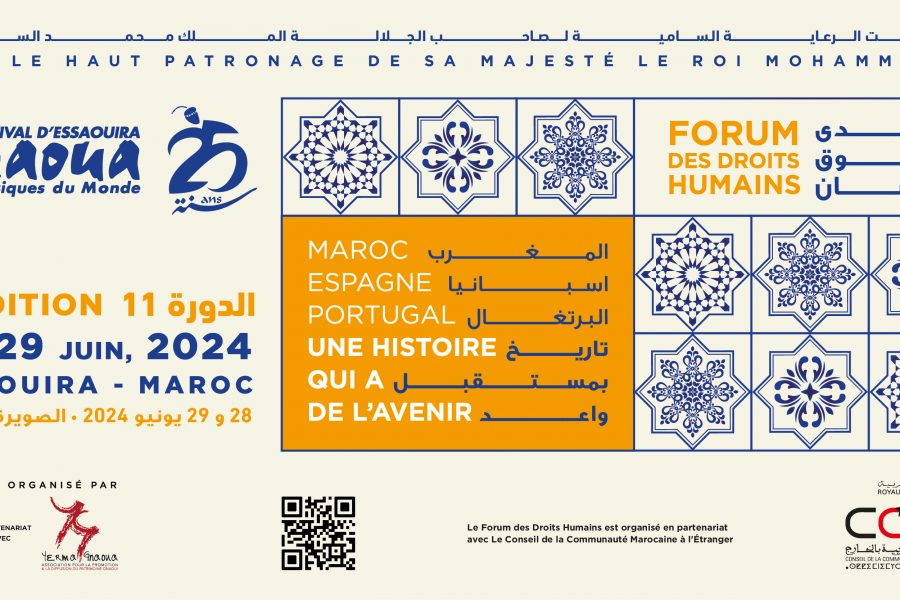
On the occasion of its 11th edition, the Human Rights Forum of the Gnaoua and World Music Festival will be held on the theme “Morocco, Spain, Portugal: A history with a future”, on Friday June 28 and Saturday June 29, 2024 at the Atlas Essaouira Riad Resort.
Organized in partnership with the Conseil de la Communauté Marocaine à l’Etranger (CCME), the Forum invites, as every year, personalities from different horizons to debate, in complete freedom, within the framework of three thematic panels
and an introductory speech by the former President of the Spanish Government, José Luis Rodriguez Zapatero.
In 2030, less than six years from now, Morocco, Spain and Portugal will co-host the Football World Cup. This unprecedented joint bid testifies to the exceptional relations that have linked the three countries for over a thousand years, with human, economic and cultural flows that vary but are virtually uninterrupted. This shared history has not been without its share of frictions and even conflicts of all kinds.
The strengthening of economic and political relations between Morocco, Spain and Portugal, and the joint organization of the 2030 World Cup, represent real advances and clear opportunities for dialogue and cooperation.
But the challenges facing the three countries have also changed in nature, requiring greater creativity, understanding and mutual respect.
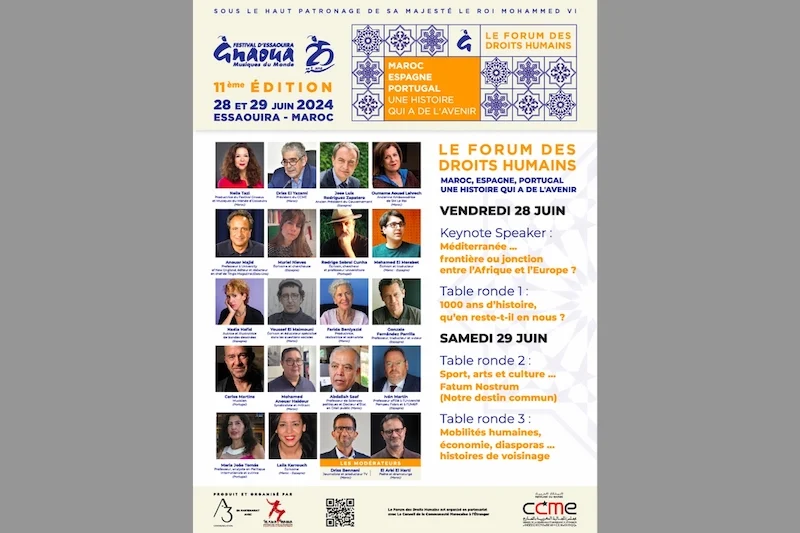
Against this backdrop, a number of issues will be put forward for debate at three themed panels, each bringing together intellectuals, political, economic and community players from the three countries.
“The Forum has always been attentive to the debates and issues that shape our societies. The organization of this World Cup is a great moment in our contemporary history.
The choice of theme for this 11th edition is our way of supporting it through the insights and contributions of leading personalities,” explains Neila Tazi, producer of the Essaouira Gnaoua and World Music Festival.
“Given the new challenges facing the three countries, we will be questioning the roles of civil society, intellectuals, artists and sportsmen and women in building healthy, lasting relationships.
It is also important to explore the evolution of mobility in this part of the world. We need to know how, in each diaspora, subjects such as exile, community and country, for example, are discussed”, says Driss El Yazami, President of the Conseil de la Communauté Marocaine à l’Etranger (Council for the Moroccan Community Abroad).




add your comment
Terms of publication : Not to offend the writer, people, sacred things, or attack religions or the divine self, and refrain from racist incitement and insults.