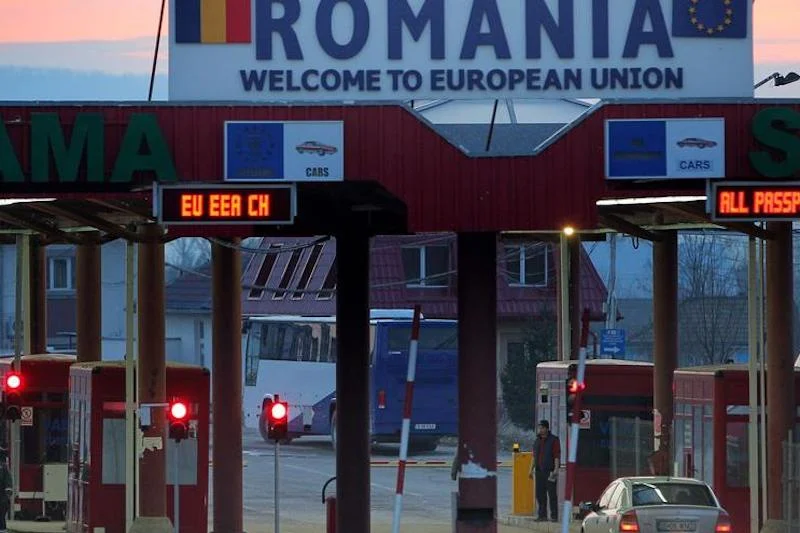
After 13 years of waiting, they are finally in the Schengen area. On Sunday, Romania and Bulgaria officially entered this vast zone of free movement, with the notable exception of land borders.
On the roads, controls will remain in place for the time being, much to the dismay of truck drivers. This is due to a veto by Austria, the only country in the EU to refuse entry for fear of an influx of asylum seekers.
Despite this partial membership, limited to airports and seaports, the milestone has strong symbolic value.
“This is a great success for both countries,” said European Commission President Ursula von der Leyen in a statement.
“This is a historic moment for the Schengen area, the largest area of free movement in the world. Together, we are building a stronger, more united Europe for all our citizens”, she said.
At the Romanian capital’s airport, where the majority of flights serve the Schengen area, teams have been busy all week preparing for this small revolution.
With the promise of more staff to carry out unannounced checks, particularly on minors “to prevent them falling prey to human trafficking networks”, according to the government.
The agents deployed will also be there to “guide passengers and identify those who would take advantage of the opportunity to leave Romania illegally”.
For we need to show our credentials if we are to overcome Vienna’s reluctance.
And become full members of the Schengen area, within which over 400 million people can travel freely, without internal border controls.
Croatia, which joined the EU after Romania (population 19 million) and Bulgaria (6.5 million), members since 2007, had already beaten them to the punch in January 2023.
With this double entry, the area created in 1985 will now comprise 29 members: 25 of the 27 European Union states, plus their associated neighbors Switzerland, Norway, Iceland and Liechtenstein.
Excluded from the process, road hauliers are not taking it lying down. The wait lasts “from 8 to 16 hours” at the border with Hungary, “from 20 to 30 hours with Bulgaria, with peaks of three days” in both cases, deplored one of the sector’s main Romanian unions in a press release, lamenting “colossal financial losses”.
“We’ve waited 13 years, we’re at the end of our tether”, reacted General Secretary Radu Dinescu.
Bulgarian bosses were equally up in arms. “Only 3% of Bulgarian goods are transported by air and sea, the remaining 97% by land,” says Vassil Velev, president of the Bulgarian Industrial Capital Association (BICA), interviewed by AFP.
“We’re 3% into Schengen and don’t know when we’ll be allowed to join completely,” he laments.
While he hopes for progress by the end of the year, the entrepreneur fears that he will have to bear the brunt of the parliamentary elections scheduled for the end of September in Austria, when the conservative chancellor Karl Nehammer has to contend with the rise in the polls of the far right.
In any case, both Sofia and Bucharest have warned that there will be no turning back. “It’s clear that this process is irreversible,” declared Romanian Interior Minister Catalin Predoiu in early March, calling for it to be completed by 2024.








add your comment
Terms of publication : Not to offend the writer, people, sacred things, or attack religions or the divine self, and refrain from racist incitement and insults.