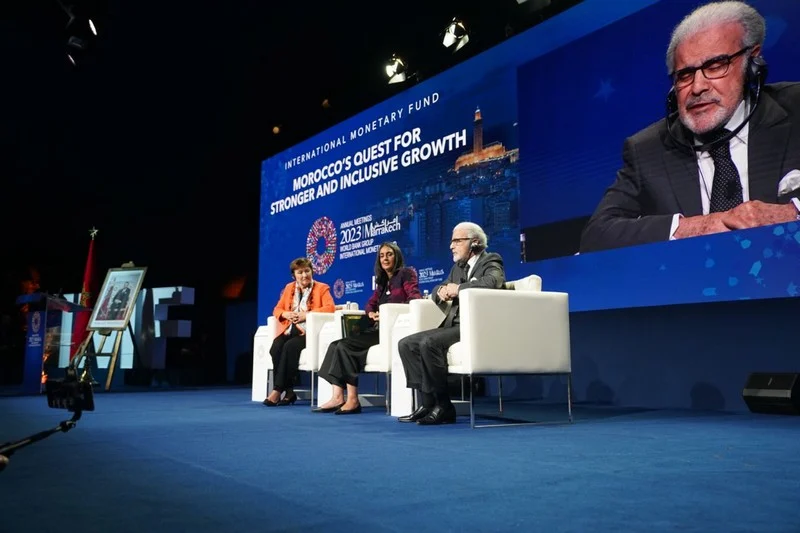
Despite encountering numerous challenges in 2023, the International Monetary Fund (IMF) acknowledged the resilience of Morocco’s economy.
This was one of the key preliminary findings of the IMF presented on Wednesday after conducting fruitful discussions with Moroccan authorities, including senior officials of the government, Bank Al-Maghrib, and representatives of the public and private sectors, in Rabat from January 31 to February 15, 2024, during the annual consultations under Article IV. The final report is expected to be issued in March.
Presented by Roberto Cardarelli, Head of IMF Mission for Morocco, the results showcased that despite 2023 being a challenging year marked by water scarcity impacting agricultural production, earthquake, drought, and low water levels in reservoirs, “IMF continues to be impressed by the resilience of Morocco’s economy.”
The preliminary findings highlighted that output growth accelerated to around 3% in 2023 due to a revival in domestic demand and strong export performance.
Projections also suggest that this growth will further rise to 3.5% in the medium term, supported by investments.
“We expect that growth will continue, especially as investment is expected to accelerate in the country with infrastructure plans related to the water sector, energy sector, and infrastructure related to the 2030 World Cup,” underscored Cardarelli.
The findings also showcased that the external situation has strengthened, highlighted the same speaker, with a significant reduction in the current account deficit, and that foreign exchange reserves are comfortable.
“This is all good news to prove the resilience of the Moroccan economy to a situation which continues to be challenging domestically and externally,” reiterated the head of the IMF Mission for Morocco.
The IFM also announced that inflation is expected to fall slowly as pressures from commodity and food prices fade, with a projected decrease to 2% over the next couple of years, as noted by Cardarelli.
“The current monetary policy stance is appropriate, in light of the falling inflation and future changes to the monetary policy stance should remain data-dependent. As inflation continues to fall, Bank Al-Maghrib should resume its transition to an inflation-targeting framework,” according to the preliminary findings.
The IMF also commended the gradual reduction of the fiscal deficit, noting that it strikes the right balance between the authorities’ objectives of rebuilding fiscal buffers and financing structural reforms. However, the global organization noted the need for increased tax revenues and rationalized spending.
It underscored that the current monetary policy stance is appropriate and should remain data-dependent.
The IMF also stressed the urgency of structural reforms to unlock job-rich, inclusive growth. This includes reforming the state-owned enterprise (SOE) sector, expanding targeted social protection, advancing health and education reforms.
It also encompasses addressing water scarcity and increasing the role of renewable energy sources in the energy mix.
The global organization also acknowledged the government’s commitment to fiscal consolidation in the medium term. The generalization of social protection through the Unified Social Registry holds promise for more targeted support to families in need, according to the findings.
IMF applauded the VAT reform which is anticipated to enhance neutrality and promote formality, broadening the tax base. Cardarelli mentioned that the data already indicate a positive effect of this reform on the revenues.
He also emphasized the importance of reducing the deficit to rebuild the margin maneuver in preparation for future shocks. This approach ensures that the government has the flexibility to respond effectively, as demonstrated during the 2020 pandemic crisis.
While the gradual fiscal deficit reduction over the next 3 years is appropriate, there is a need to accelerate fiscal consolidation by completing tax system reforms, improving tax administration, rationalizing spending (including SOE transfers), and expanding the Unified Social Registry to all social programs.
Cardarelli expressed his satisfaction with the government’s focus on employment policies, noting that creating jobs, in the long run, depends on boosting the private sector.
In the short term, the IMF noted that reforming the unemployment insurance system and boosting active labor market policies may help improve job growth, emphasizing that further efforts are needed to improve female labor force participation, which is at historic lows.







add your comment
Terms of publication : Not to offend the writer, people, sacred things, or attack religions or the divine self, and refrain from racist incitement and insults.