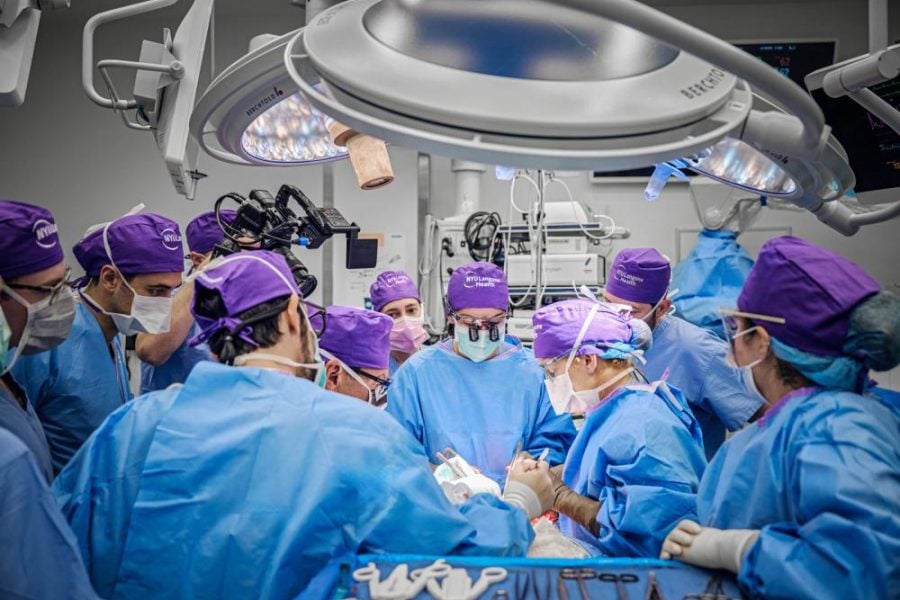
Nizar Baraka, minister of equipment, said that Morocco faces an annual loss of 600 to 700 doctors, as they opt to work abroad.
Speaking at a party gathering last week, Baraka said that the issue of doctor shortages within the healthcare sector is pressing, with a shortfall of approximately 30,000 doctors.
In response to this crisis, the government aimed to increase the number of healthcare professionals to over 90,000 by 2025.
In an attempt to address the shortage of doctors, the government has proposed reducing the duration of medical education from 7 to 6 years.
This initiative seeks to mitigate the severe shortage of medical personnel while enhancing healthcare services in the country, as outlined in the framework law 06.22 on the health system.
However, this decision has stirred confusion and opposition among medical students, who firmly reject the proposal.
This rejection has left the health sector grappling for alternative solutions to render the public health sector more attractive.
Several reports over the past few years have sounded the alarm about the steady loss of doctors to Foreign countries.
The National Human Rights Council has repeatedly raised alarm about this issue, citing reports that portray the healthcare sector’s fragility in Morocco as a major obstacle hindering citizens’ access to proper healthcare.
According to the National Human Rights Council, although Morocco has 23,000 doctors working within its borders, between 10,000 and 14,000 Moroccan doctors are practicing abroad.
This imbalance means that one out of every three Moroccan doctors works outside the country.
This trend exacerbates the country’s urgent need for additional medical professionals, with the World Health Organization indicating a requirement of 32,000 more doctors and over 65,000 additional healthcare professionals.
There’s also a disparity in the distribution of medical professionals across Morocco, with a significant concentration in certain regions like Casablanca, Rabat, and Kenitra.
The Court of Auditors’ report concerning the healthcare workforce revealed that by the end of 2021, there were only 1.64 health workers for every 1,000 people in the country.
This falls far short of the United Nations’ goal of 4.45 health workers per 1,000 people. The report also noted that this ratio varies greatly across different regions of the country.
While the total number of health workers has been slowly increasing, their proportion relative to the population hasn’t seen significant improvement. From 2011 to 2020, the number of workers for every 10,000 people only rose from 15.1 to 16.4.
This slight increase is mostly due to more doctors working in the private sector, which went up from 2.5 per 10,000 people in 2011 to 3.8 in 2020.
Conversely, the number of doctors in the public sector decreased from 3.6 to 3.3 during the nine-year period covered by the report.





add your comment
Terms of publication : Not to offend the writer, people, sacred things, or attack religions or the divine self, and refrain from racist incitement and insults.