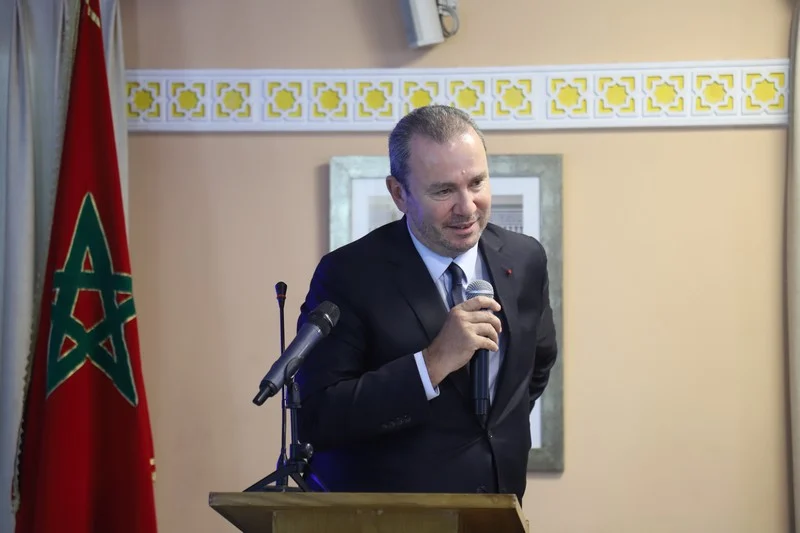
French Ambassador to Morocco Christophe LeCourtier said that relations between France and Morocco “should be renewed,” and that relying on close common history and traditional positive ties alone would be arrogant, as crises will not resolve themselves.
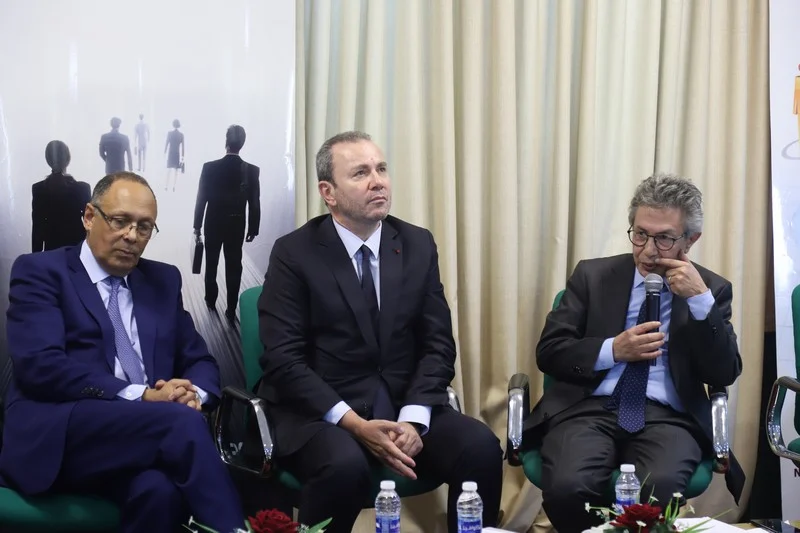
In a lecture on Morocco-France relations organized by the Center for Legal, Economic and Social Research at the Faculty of Legal, Economic and Social Sciences in Casablanca on Friday, the French ambassador said that the Kingdom has “changed for the better” in the last two decades, but this has not been accompanied by a change of perception on the French side.
“We French have lost a little bit more knowledge and intimacy with Morocco than Morocco has with France.”
Recalling that President Jacques Chirac’s period was “beautiful” in relations between the two countries, the diplomat said it was “now old.”
“The world has changed tremendously, and there is a lot around you and us, not just relations between both countries, and France has also changed (…), but I prefer to see the glass half full in France.”
“2023 was not so bad in relations between the two countries, tourism was strengthened with 5 million French people visiting Morocco, even if there were no official visits, and I felt that the French were more intimate with Morocco.”
The ambassador stated: “I felt that there are more French than Moroccans in the old city of Marrakech, and there is no (negative) impact on the will of the French to come to Morocco and learn about its richness and generosity, and the very important remittances coming from abroad to Morocco, more than 30% of which come from people living in France, whether Moroccans or French Moroccans,” he said.
On the issue of visas, the reduction of visas and the persistant refusal to grant them to Moroccans after an official French decision, the ambassador said that “the president himself (Emmanuel Macron) said at the annual meeting with French ambassadors that the decision was wrong, as it alienated our friends and harmed our image.”
The French ambassador recalled the increase in the number of visas granted last year compared to the previous year, when the decision was first made.
The French ambassador also recalled the increase in the number of visas granted last year by 100,000 compared to the previous year, and expressed an “attempt” to extend the visa periods for “as long as possible,” noting that “Morocco is the first beneficiary of the number of visas after China, whose population exceeds one billion.”
“We have a Moroccan or French-Moroccan population, without ethnic statistics, there is one French category, many of us are of Moroccan origin, and 6 million French Muslims are of Moroccan origin, of Moroccan origin and from sub-Saharan Africa or Asian countries with which we have less historical relations, and this is a development, and I see it as a factor of richness,” LeCourtier said.
“The question of today is: What can this become in a spectacularly chaotic world, with the financial and climate crises and conflicts we see?” he said, speaking of visions that exist today of “the double standards of our aid to Ukraine, as opposed to Palestine, the Middle East, the Global South, and the decline of the West.”
Le Courtier argued that the relationship of “mutual engagement (…) must be redefined in a world completely changed from the one we knew, beyond the good or bad between our governments, and find a new legitimacy,” without “excluding other countries in the South.”
On the issue of the Western Sahara, the French ambassador responded to questions that recalled the Kingdom’s criterion that evaluates its relationship with the countries of the world based on its position on this issue.
“This is a very important topic, because how can we have the ambition that we are talking about without taking into account the major concerns of the Kingdom on the subject? It is stupid and disrespectful to imagine that we build what we aspire to stone by stone without clarifying this subject, without recognizing the fundamental status of the subject for Morocco, yesterday, today and tomorrow.”
He recalled that the new French foreign minister, Stéphane Séjourné, said that he was entrusted by the president of the republic with the issue of relations with Morocco “of course in order to improve them,” saying: “It is not easy for a foreign minister to talk about this in a world where there is no shortage of problems.”
The two countries are governed by an “objective destiny,” the ambassador said, noting that “Europe’s relationship with the South goes through Morocco.”
The ambassador expressed French interest in King Mohammed VI’s vision for Africa, saying: “If we succeed in building an open, dynamic, prosperous and shared region, it will be a great thing, and if we don’t find common ground, we will lead to instability and terrorism.”
The question is: “Will we succeed in building (the great destination) without being closed to others, by strengthening cooperation and developing a common project?”
He went on to talk about “the idea of blending with Morocco’s vision and strategy expressed in a clear and convincing way,” before going on to envision “re-establishing our partnership with Morocco and accompanying it, not with a philanthropic and paternalistic approach, but because it is in our interest, and to strengthen the relationship with the European Union, because a lot has been done with Morocco, and a lot still needs to be done in industry, values, human capital and standards.
“Morocco is a smart country, and since the 1960s it has had very special relations with the EU, and standardization with the EU will enable deeper integration,” the ambassador said, noting that “all conflicts today are the will to impose special standards on the other.”
The ambassador also reiterated that this comes “in harmony with the royal vision,” given Morocco’s “historical, religious and human dimension.”
In West Africa, “there are other actors who are not our friends, and I’m not talking about Russia in particular, but Turkey and China, they are not our enemies, but they won’t leave us a seat (…). What each of our countries is doing on its own is good, but we have to work together and strengthen it, given the presence of competitors and enemies,” LeCourtier said, giving the example of ISIS, which threatens everyone.
“The events in Paris in 2015 show that we should not believe that a distant desert place does not mean that we will not be a victim of what happens there (…) in terms of extremism.”
The diplomat emphasized the need to work “for a common roadmap,” saying: “Whatever we say and read about France, it still has the capacity to be a useful partner, without arrogance and without paternalism (…) Morocco has the right to see France at the table, just as we for our part also want Morocco to rebuild the agenda around Europe and Africa (…) We can move a lot, in funding, expertise, industry and research.”
On migration and brain drain, the French ambassador said that among the points of interest for the two countries “there is an ambition in terms of human capital, the choice cannot be protectionism and putting up barriers or the other extreme, which is brain drain and robbing engineers, doctors, Maghreb and sub-Saharan brains (…) The key is access to ensure education for a significant number of Moroccan, French, European and sub-Saharan African youth (…) and joint training with recognized degrees and possible mobility,” which will benefit everyone.


add your comment
Terms of publication : Not to offend the writer, people, sacred things, or attack religions or the divine self, and refrain from racist incitement and insults.