“How far have they advanced in the narrative of the ‘Sirah’?” asks a mentor artisan, his young apprentice in the dense, vivid souk of “Semmarine” in Marrakech. “They are still indulged in ‘Al-Azalia’,” replies the boy instantly as if he had been asked this question tens of times previously.
The aforementioned brief dialogue is a typical conversation in the monumental, historic, and vibrant heart of Marrakech in the early twentieth century, Jamaa El Fna Square. Decidedly, it is the Circle Art, al-halqa, that has for centuries joined myriads of avid story-lovers in the renowned Square to partake in the performers’ mystique spectacles and detach themselves from the woes of life.
A CENTURY AGO
These events took place a century ago when there were few or no sources of entertainment save books and performances. Until the late 90s of the prior century, the monumental square had always constituted a harbor for the lonesome and the forlorn who sought to listen to folklore narratives and legendary sagas.
Most of those spectators were local vendors, artisans, or passersby who attended the circle regularly; that is, the performers and storytellers had to render fitting and suitable content that conforms to the interests of these categories of audience.
storytelling, preaching, and music were the chief spectacles that fall into the confines of the audience’s interests.
If the square could voice its grievances, it would poignantly relate tales of melancholy and dismay, commemorating the destitute artists who performed on its grounds in weal and woe.
One of the unforgettable iconic storytellers, philosopher as the locals favoured to name him, described in so an indelible fashion the square saying: “O son, study well, for when I die I will bequest thee the Institution. Jamaa El Fna is the biggest Institution in North Africa; it is a social phenomenon; it is civilization and reality. In it, fifty thousand workless individuals earn their daily bread under the radar of the minister of finance!”.
The state of affairs
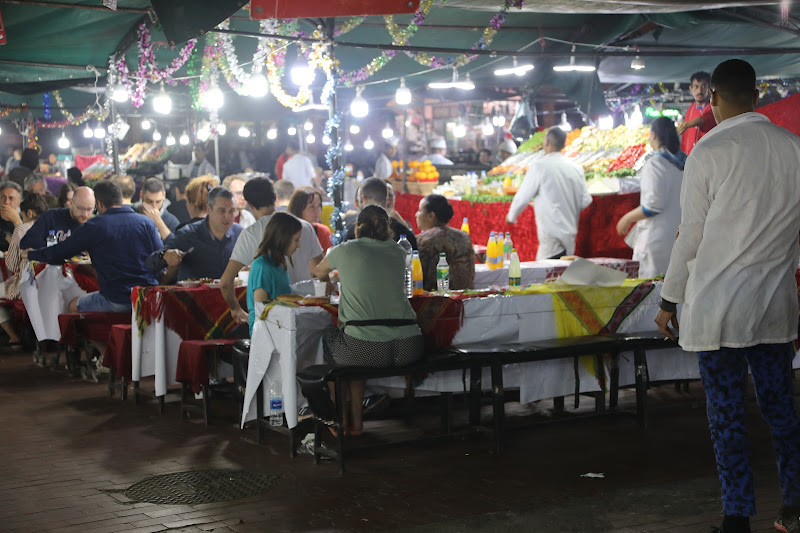
Be that is it may, the vibrance of the square has now swerved to serve opposite purposes whose endeavours are solely pecuniary; the artist feels suffocated inside the cavernous shroud of food smoke and penetrating rambunctious music and hubbub.
Owing to the predominance of food booths, a performer nowadays has to elbow his way to find enough room for his small spectacles.
The dreadful disappearance of al-halqa from the Square, which many people sadly perceive as the current state of affairs, may precipitate the dethronement of the standing renown thereof.
Food booths dominate the arena
The painter and photographer Ahmed Ben Ismail wrote in an article for the UNESCO: “Urbanization, in particular real estate speculation and the development of the road infrastructure, are seen as serious threats to the cultural space itself.”, he adds: “While Jemaa el-Fna Square enjoys great popularity, the cultural practices may undergo acculturation, also caused by widespread tourism.”
To get to the barebone essentials, the Square is sheltering a cultural battle wherein culture and arts are in the clutches of commercialization, food, and consumerism. The culmination is manifest and crystal clear, yet action has not yet been taken to reclaim the aesthetic notion with which the city has incessantly evaded the firm grip of mediocrity.








Yes, it is detedriorating ! I hope it will reclaim its performances sooner or later.