
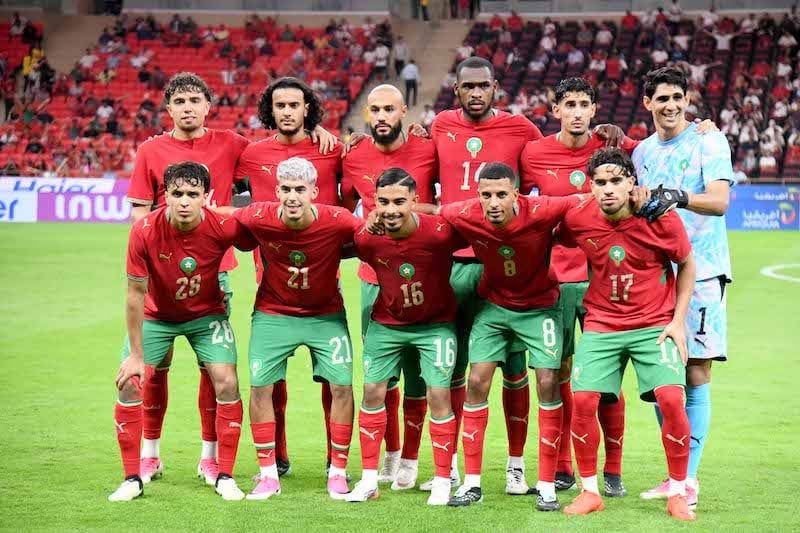
The Moroccan national team is ready for its first African Cup of Nations (AFCON) match today against Tanzania, with projections placing the Atlas Lions among the top contenders for the coveted continental title.
However, many Moroccans doubt the team’s ability to take home the prized trophy.
“Do you expect the Moroccan national team to win the African Cup of Nations in Côte d’Ivoire?,” Hespress AR asked this question to its readers. Surprisingly, the data indicated that most Moroccans do not think the team will win the championship.
According to the survey results, 7.566 of the 12.459 participants answered the “no” question at a rate of 60.16%. In comparison, 5.011 participants said that the Atlas Lions could return with the African title from Côte d’Ivoire.
Badreddin El Idrissi, a sports analyst, considered that the results of the poll “confirm the dual vision, and show that the Moroccan fans are divided between their certainty in the ability of the Moroccan national team to reverse the course of history at the level of the African Cup of Nations and obtain a title that has been long awaited for 48 years, and their certainty of the difficulties that Moroccan players feel whenever it comes to an African competition that takes place in the African jungle in particular.”
In a statement to Hespress AR, El Idrissi said that the results took into consideration the challenges the team has always faced playing in African countries , particularly in a challenging competition that is challenging and complex, and occasionally yields unexpected results.
The sports analyst explained that people in favor of the national team winning the African Cup of Nations did so based on the team’s performance in the current tournament, which essentially puts it in the lead among the contenders.
The analyst additionally pointed out that the team performed admirably in the Qatar World Cup 2022.
The Moroccan national team has been positioning itself among the continent’s best, proving its strong character, commitment and craft.
El Idrissi considers that winning the CAN is “the culmination of the work, spirit and sacrifices of a team, and not the presence of specific individuals or players.”
He added, “I think if we put the Moroccan players on one side and the players of all African teams on the other side, Morocco will have superiority,” explaining that this must be embodied on the field, and that the Moroccan team should start acting like a winner and play all the games with this mentality.
The expert stressed that the national team should be able to tackle all of the concerns that led 60% of Moroccans to believe that it will not win the title.
He hopes that the players would be consistent throughout the games and deliver a remarkable performance.
On the other hand, sports analyst Jamal Staifi believes that Morocco’s World Cup run puts it at the forefront of the competition, justifying why many believe that Atlas Lions would take home the winning title.
« Morocco has ample chances, because many players have already played in over one African Cup, such as Saiss, Bounou, and more,» said the expert.
For his part, Moustapha El Haddaoui, a former national team player, after wishing the Atlas Lions success in Cannes Côte d’Ivoire, explained that the Moroccan national team today is at the peak of its performance, especially after the Qatar World Cup.
He stressed the need to be aware of possible surprises of the Cup.
In his statement to Hespress AR, El Haddaoui said that “the national coach and all the team’s staff and players are well aware of the necessity of mental, technical and tactical preparation to make a difference and win, supported by their experience in various tournaments and competitions. »
This tournament features strong teams that also aspire to win the continental title despite their unexpected stumble in their first matches.
Moroccans look forward to winning the prestigious title, and all conditions are provided so that the coach, Walid Regragui triumphs with the team, added the former player.




add your comment
Terms of publication : Not to offend the writer, people, sacred things, or attack religions or the divine self, and refrain from racist incitement and insults.