
On Thursday, Rabat was the scene of a massive demonstration organized by the national coordination of the education sector (comprising 24 sectoral components), the unified coordination of the teaching corps, the support cadres in Morocco, as well as the national coordination of the education sector and the coordination of qualifying secondary education.
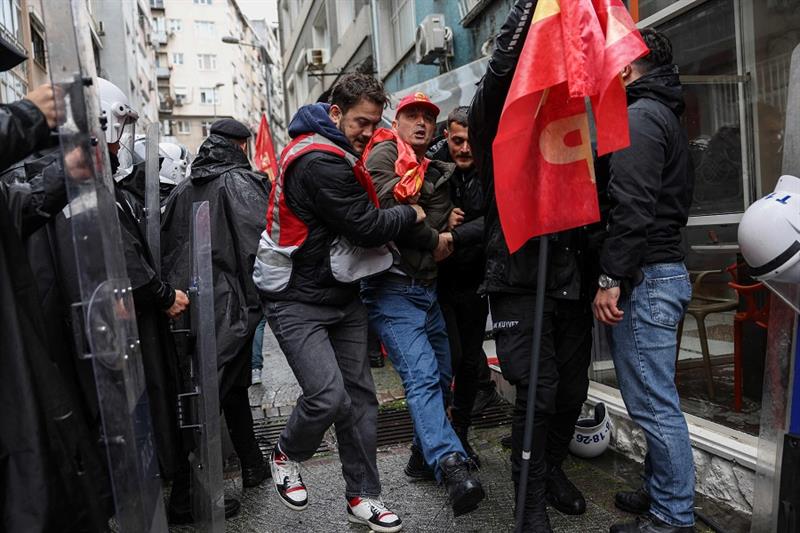
During this demonstration, teachers took to the Avenue Mohammed V in Rabat to express their anger. Throughout the march, which ended in front of the Ministry of National Education, indignant voices were raised and harsh slogans were chanted against the unions, the ministry in charge, the government and the state.
The demonstrators denounced “the failure to manage the education dossier and the stalemate that has affected the sector in an unprecedented way since the approval of the unified statute.”
The coordinations taking part in the march announced “the withdrawal of confidence in the five unions involved in the dialogue” and “the rejection of the modification process to which the unified statute is subjected in a biased manner, failing to address the real problems that have led to an unprecedented crisis in the sector.”
They asserted that “it is the coordinations that should take part in the dialogue, and not the unions, which represent only themselves and do not reflect the opinion of those involved in education.”
Iyachi Tikerkra, a member of the national committee of the national coordination of the education sector, participating in the march, declared that “this step is central and decisive, in the context of the escalation and global rejection of what was agreed, whether on December 10 or December 26 of last year, because these are agreements that do not meet the minimum of the demands of educational staff.”
He pointed out that “more than 40 issues have not been definitively resolved, and were not even discussed during the dialogue.”
Zakaria Sabi, a member of the National Council of the National Coordination of Qualifying Secondary School Teachers, declared that “the results of the dialogue were not satisfactory for educational staff.”
He confirmed that “the results do not reflect the real demands of the men and women in education, and that they deliberately excluded the main players, namely the coordinations”.
With this latest escalation, the teaching profession is showing that it is not about to give up, and that the education movement persists despite the government’s efforts to bring this issue to a definitive close.
The numerous agreements recently reached between unions and the government have unfortunately failed to persuade the teaching profession to return to school, as the school year progresses.
What makes the situation even more complex is that these coordinations vigorously assert that the unions do not represent them, thus rendering the agreements reached with the government null and void, since the coordinations are maintaining the strikes.






add your comment
Terms of publication : Not to offend the writer, people, sacred things, or attack religions or the divine self, and refrain from racist incitement and insults.