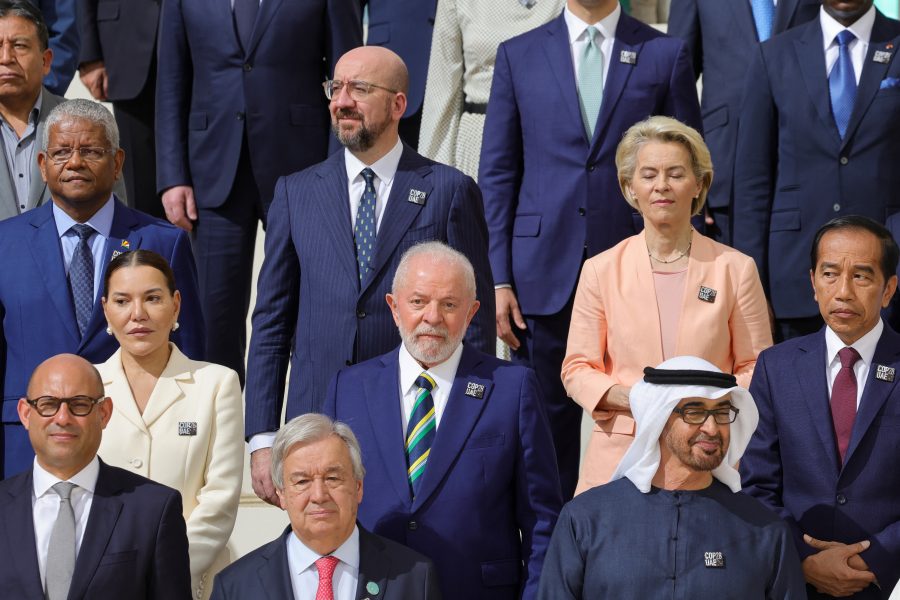
During the 28th United Nations Conference on Climate Change (COP28), held this year in Dubai, Morocco renewed its commitment to addressing the pressing challenges of climate change, making several significant announcements that pave the way for a greener and more resilient future.
These announcements included signing several Memorandums of Understanding (MoU), renewing bilateral cooperation, and launching projects.
Phasing out coal
Morocco joined an international campaign to phase out coal and announced intentions to produce more than half of its energy needs from renewables in the next seven years.
The Powering Past Coal Alliance (PPCA) “will work together with the PPCA to develop a plan for phasing (coal) out.”
Attijariwafa Bank:
Morocco’s Attijariwafa Bank and Schneider Electric Group, suppliers and manufacturers of cutting-edge technological energy-saving equipment sealed a MoU to boost energy efficiency initiatives.
The collaboration envisages studying, developing, and implementing energy efficiency solutions and supplying electric equipment and solutions for renewable energy production plants as part of Morocco’s Energy Strategy.
Royal Air Maroc (RAM):
Royal Air Maroc (RAM) and Africa CMDC launched Africa’s first zero-carbon emission flight.
The flight, powered by eco-friendly aviation fuel, exemplifies Morocco’s dedication to using less fossil fuel and more renewable energy sources.
40% of the fuel consumed by the Dreamliner aircraft was sustainable, with the remaining 40% being offset by carbon credits obtained through an optional program.
UM6P, OCP, 4C Maroc:
The Moroccan Center of Competence in Climate Change (4C Maroc), Chérifien Phosphates Office (OCP), and Mohammed VI Polytechnique University (UM6P) signed a partnership agreement in the field of Climate Change mitigation.
The three-year agreement between 4C Maroc and UM6P focuses on providing training in climate change and developing feasible climate financing initiatives.
It also aims to support OCP’s greenhouse gas emission reduction policy and achieve carbon neutrality goals. In addition, it seeks to promote and provide scientific as well as technical support for projects that contribute to climate change adaptation.
Mohammed VI Investment Fund:
The Mohammed VI Investment Fund (FM6I) signed the Declaration of Principles for Responsible Investment (PRI), demonstrating its commitment to promoting responsible and sustainable investment practices.
The PRI establishes guidelines for incorporating environmental, social, and governance (ESG) factors into investment choices.
The European Union:
The European Union (EU) granted Morocco a €50 million donation to encourage sustainable energy and decarbonization in development sectors.
This grant, which is distributed over five years, includes € 43.6 million in budget support and € 1 million in additional support for technical assistance, twining, and capacity building.
The agreement is part of the Green Partnership programs between the Kingdom and the European Union, which promote Morocco’s reforms in renewable and new energy sectors, including green hydrogen, research, innovation, and decarbonization of development sectors.
United Arab Emirates:
The meeting at COP28 activated a memorandum of understanding agreed during King Mohammed VI’s visit to the UAE, to lay the groundwork for agricultural and maritime fisheries collaboration and investment partnerships.
The purpose of the pact is to provide the groundwork for future collaboration and investment in agriculture and maritime fishing.
The conversation also touched on climate change adaptation, water irrigation mobilization, and the economy.
Ethiopia:
The Kingdom of Morocco and the Federal Democratic Republic of Ethiopia inked a MoU to establish a Coalition for Sustainable Energy Access (CSEA).
The agreement establishes a framework for the parties’ relations and outlines their cooperation’s terms and conditions to create a CSEA.
It also states that the new entity be inclusive, open to all UN member countries, have flexible governance and operation, and provide a balanced representation of different areas and backgrounds.
The parties agreed upon maintaining the CSEA an independent body recognized by the UN system, geared toward sharing information and experience, as well as exchanging knowledge and skills in the field of sustainable energy.
Norway:
Morocco and Norway also signed a MoU to collaborate on Article 6 of the Paris Agreement.
This agreement enables countries to cooperate in mitigating emissions through purchasing and selling greenhouse gas reductions, accelerating the transition to renewable energy and contributing to the global climate goal.
The MoU seeks to provide incentives for more decentralized renewable energy production in Morocco, encouraging more households and private actors to sell excess electricity.
This energy must be able to be linked, distributed, and sold on Morocco’s power infrastructure.
For its part, Norway may eventually negotiate to purchase quotas from Morocco, which might help Norway meet its objective of achieving climate neutrality by 2030.
Ivory Cost:
The General Directorate of Meteorology in Morocco (DGM) and the Airport, Aeronautical and Meteorological Operation and Development Company in Ivory Coast (SODEXAM) also inked a MoU to fortify their cooperation in meteorology and climatology sectors.
The bilateral cooperation envisioned in the agreement includes weather forecasting, climatology, meteorological network surveillance and measurement systems, information and communication systems, databases, institutional capacity building, and technology transfer.
The agreement seeks to promote the exchange of effective meteorological management and forecasting experiences between Morocco and the Ivory Coast as well as the “Ghait” program for artificial rain production and flood forecasting centers.
It also allows Ivory Coast to benefit from Morocco’s knowledge, equipment, and technology in meteorological prediction to combat the effects of climate change.
Oman:
The Kingdom of Morocco and the Sultanate of Oman signed an agreement to strengthen their collaboration in the field of their environment and sustainable development.
The agreement aims to establish a framework for bilateral cooperation in the environment and sustainable development, focusing on climate change, energy transition, environmental governance and waste management circular economy, as well as biodiversity and natural resource protection.
It also includes desertification control, ecotourism, air quality monitoring, marine and coastal environment protection, and environmental awareness.
The agreement promotes the exchange of knowledge, information, and technical support, as well as capacity building in the implementation of international environmental treaties.
Egypt:
Morocco and the Arab Republic of Egypt signed a MoU on sustainable water resource management.
The agreement seeks to fortify bilateral cooperation in water resource management and development, as well as establish a cooperative relationship based on equality and mutual interests in this sector over the short, medium, and long term.
The MoU establishes collaboration in several water-related sectors, including rainwater reuse, flooding, dam management, agricultural wastewater treatment, climate change adaptation, and desalination technologies.
It also includes data exchange, expert sharing, training sessions, and participation in water-related activities.
Portugal:
Morocco and Portugal inked a joint declaration on an electricity interconnection project.
The declaration aims to strengthen renewable energy development plans between Rabat and Lisbon, as well as to investigate prospects for energy exchange between the African and European continents.
The accord also called for furthering conversation to promote a resilient and inclusive energy transition that is consistent with global goals for sustainable development and climate change.
This includes promoting the use of renewable energy and hastening the implementation of critical projects of mutual importance, such as the countries’ electrical interconnection projects.
Germany:
Morocco and Germany emphasized recent government negotiations on a water management support program, as well as the formation of a climate and energy alliance including numerous ministries from both countries.
The ministries from both countries also discussed strengthening bilateral cooperation, specifically in the fight against climate change.
The meeting’s topics included energy transition, water resource preservation, and food security.






add your comment
Terms of publication : Not to offend the writer, people, sacred things, or attack religions or the divine self, and refrain from racist incitement and insults.