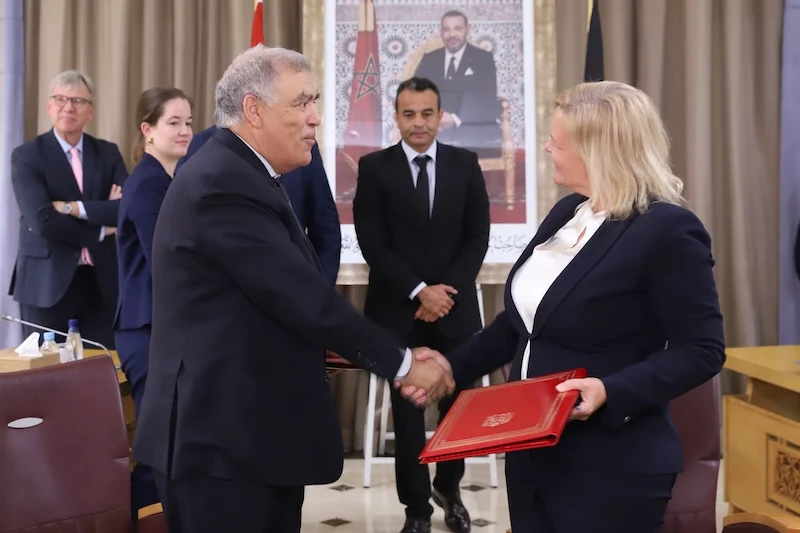
Germany has secured Morocco’s approval for the deportation of around 900 Moroccan citizens who are migrants without legal residency permits in Germany.
During a diplomatic visit to Morocco, Nancy Fraeser, German Minister of Interior and her Moroccan counterpart, Abdelouafi Laftit, signed a Joint Statement of Intent to solidify their commitment to bolstering cooperation across various sectors, including migration, security, civil protection, and the fight against transnational crime.
Regarding Morocco’s agreement with Germany to deport 900 Moroccan migrants, Khalid Mouna, an anthropologist and expert in migration, told Hespress En that this agreement has no negative economic impact on Morocco since it constitutes only one aspect of the broader relations between Morocco and Germany.
Mouna stressed that Morocco’s relations with certain European Union countries, including Spain and Germany, extend beyond economic calculations and should be seen in the context of security and intelligence cooperation.
“The migration and security aspects are closely intertwined, as Europe often fails to distinguish between irregular migration and security threats, and usually perceives migrants as terrorist threats” said Mouna. This interdependence further complicates the issue of migration.
Mouna notes that Morocco’s agreement with Germany is one step of the country’s active pursuit to bolster its position within the European Union, particularly concerning migration issues
“In light of this goal, Morocco has offered certain concessions, including accepting the return of 900 Moroccan migrants,” added the expert.
This pursuit is driven by the paramount importance of the Western Sahara issue in all of Morocco’s foreign policies.
Mouna further explained that Morocco’s stance on migration may change after the resolution of the Western Sahara issue, especially since Germany has not officially recognized Moroccan sovereignty over the region, only endorsing the credibility of the Moroccan proposal.
In evaluating the advantages of this agreement for Morocco, Mouna asserted that “the substantial political gains that Morocco stands to achieve with this agreement with Germany are paramount.”
Mouna emphasized that receiving 900 Moroccan migrants does not constitute a significant loss for Morocco compared to the potential political benefits.
The agreement between Morocco and Germany establishes a crucial legal framework for the repatriation of these migrants to Morocco.
Mouna explained that without such an agreement, no country could deport migrants from its territory, pointing out that this framework does not apply to minors, who have their unique legal protections, preventing their deportation to their home countries unless reception centers and reintegration prospects exist.
“This is why European courts typically refrain from issuing deportation orders for teenagers,” Mouna added.
In the case of Morocco, Mouna clarifies that it is considered an unsafe destination for minors but is regarded as a safe destination for adults.
In Mouna’s perspective, the European Union’s community policy has failed leading to a reliance on bilateral agreements for the deportation of migrants to their countries of origin, such as the one established between Morocco and Germany, and Italy and Tunisia.
The expert noted that this is not a new development, citing a 1991 agreement between Morocco and Spain as an earlier example.
Mouna stated that “migrants remain a statistic, and migration is treated as an issue that involves intricate political calculations, weighing gains and losses.”
Nevertheless, Mouna emphasized the singularity of the Moroccan discourse on migration, underscoring its distinct focus on the humanitarian and economic dimensions when handling migration such as resolving the conditions that lead these migrants to migrate in the first place. However, in practice, this discourse has yet to be implemented.
Mouna clarified that the practice of repatriating migrants to their home countries is not as widespread as commonly perceived, citing the lengthy processes, and the substantial costs associated with such deportations.
The expert further noted that this inclination to deport migrants tends to escalate when elections are approaching, as the migration card is exploited in the political agendas of various parties to promote their policies.








add your comment
Terms of publication : Not to offend the writer, people, sacred things, or attack religions or the divine self, and refrain from racist incitement and insults.