
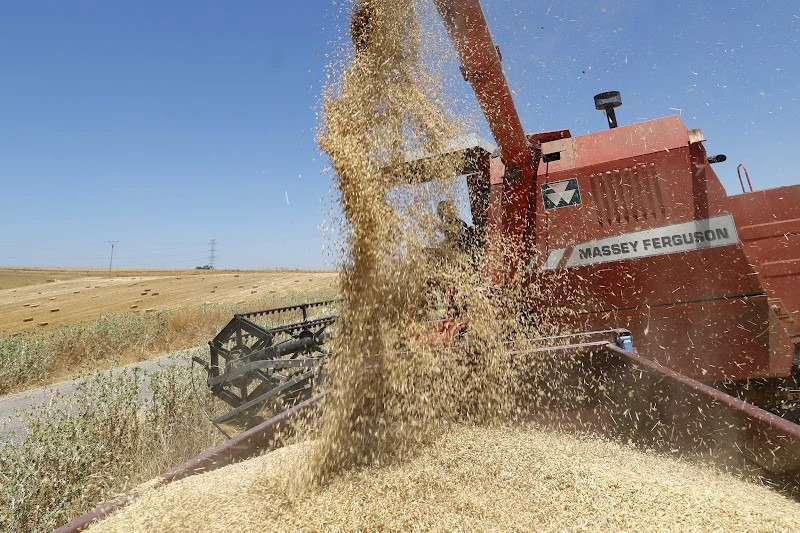
Head of the Interprofessional Federation of Grain Activities, Jamal Mohammadi said Morocco’s grain supply will likely remain unscathed by Russia’s recent decision to end the Black Sea Grain Initiative, but cautioned that the true impact, if any, will only become apparent in five months or more, as the Russian decision is intricately linked to potential future changes.
“Morocco will not be affected by this Russian decision due to its diversification of import channels, which are not limited to Russia and Ukraine only,” Mohammadi told Hespress AR.
The UN-mediated agreement to export Ukrainian grain over the Black Sea has been officially ended by Russia, putting tens of millions of tons of international food exports in jeopardy. The agreement permitting Ukraine to securely export grain over the Black Sea expired at midnight in Istanbul.
Morocco was among the beneficiaries from the Black Sea Grain Initiative, along with several other countries.
Algeria, Tunisia, Libya, Egypt, and Sudan are among the recipients, in addition to Spain, Portugal, France, and Ireland.
Before the war, Ukraine’s exports went to Asia and North Africa, but during the war, they went mostly to Europe due to easier shipping and increasing demand in several EU member states due to drought.
Morocco recorded less demand for wheat due to decreased consumption in 2023, as well as in Pakistan, Afghanistan, and Nigeria.
In Morocco, wheat production is constrained by factors like water scarcity and land availability.
Accordingly, Morocco Imports reached a consensus of 7,000 MT on wheat imports in June 2023 as opposed to 5500 in 2022. Morocco’s consumption has increased from 10,400 to 10,600 MT between 2019 and 2023.
In 2023, it is predicted that Ukraine will export 10.5 million tons of wheat, or 40% less than it did on average before the conflict.
Morocco continues to rely heavily on wheat imports from the US, Russia, and the EU despite significant advancements in agricultural practices, increased use of technology, and support for research and development.
Ukraine’s planted acreage has decreased dramatically because of the conflict with Russia. 17.5 million tons of production are anticipated in 2023, the lowest harvest in more than ten years.
North Africa’s total domestic consumption decreased from 35, 511 MT in 2019 to 31, 767 MT in 2023.
However, Morocco worked to diversify their import sources following the suspension of exports from the Black Sea ports of Ukraine.
“Morocco will not be affected by this Russian decision due to its diversification of import channels, which are not limited to Russia and Ukraine only,” Jamal Mohammadi, head of the Interprofessional Federation of Grain Activities .
The decision’s impact or lack of it will become apparent in five months or more, and the Russian decision is tied to numerous changes that could occur in the future, according to Mohammadi.
The Black Sea Grain initiative intends to fight global food insecurity and hunger by distributing food and fertilizer from Ukraine to diverse places globally, according to the US State Department.
Over 32 million metric tons of Ukrainian grain and commodities have been sent since August 2022 under the Black Sea Grain Initiative, including to some of the world’s most food-insecure countries, including the Horn of Africa, the Sahel, Yemen, and Afghanistan.




add your comment
Terms of publication : Not to offend the writer, people, sacred things, or attack religions or the divine self, and refrain from racist incitement and insults.