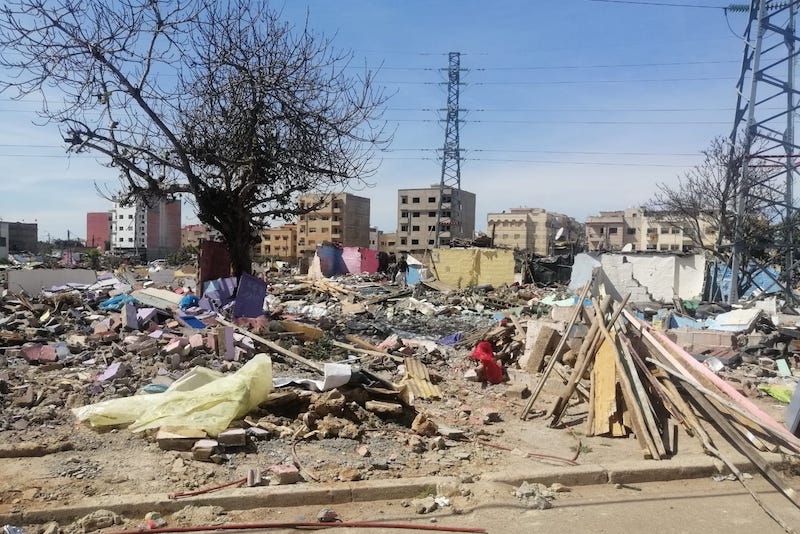
In a recent study published in the Journal of Urban and Spatial Planning, researcher Abdulghafour Alwali has put forth a distinctive psychological approach to urban planning in Moroccan cities.
This approach aims to address deviance and organized crime while helping the security apparatus in addressing these social phenomena.
The study reveals that Moroccan authorities are actively working to combat informal housing, driven by security concerns. This is in response to their discovery that such living environments provide fertile grounds for the emergence of extremist religious ideologies.
The study highlights that religious extremism among some Moroccan youth is tightly linked to their environment, particularly in slums.
These areas often experience economic, psychological, and social hardships, which become catalysts for embracing religious extremist ideas. These conditions have a psychological impact on children and adolescents.
Alwali states that cramped living spaces and the resulting lack of privacy within families often drive children to seek solace on the streets. This indirectly contributes to their involvement in organized crime.
The study demonstrates that slum housing serves as a conducive environment for the emergence of organized crime..
The study also explores the connection between activism and housing. Alwali observes that housing marginalization is a key factor in generating activist behavior. Social movements primarily arise from individuals’ sense of housing deprivation and the perceived injustice between their marginalized living conditions and other urban environments.
The study warns that while addressing slum housing in Morocco, the authorities have not sufficiently implemented economic, social, cultural, and educational programs to mitigate the psychological and societal repercussions of slum housing.
These repercussions include educational dropout, unemployment, and an unstructured economy. This neglect has contributed to the ongoing presence of organized crime in Moroccan cities.
The study indicates that urban planning in Moroccan cities now focuses primarily on addressing the security challenges presented by organized crime. It draws on a Saudi Arabian study that presents two models of urban planning: the grid system and the closed system.
The closed system, known for its accurate knowledge of neighborhood channels, has proven highly effective in maintaining security and combating organized crime.







add your comment
Terms of publication : Not to offend the writer, people, sacred things, or attack religions or the divine self, and refrain from racist incitement and insults.