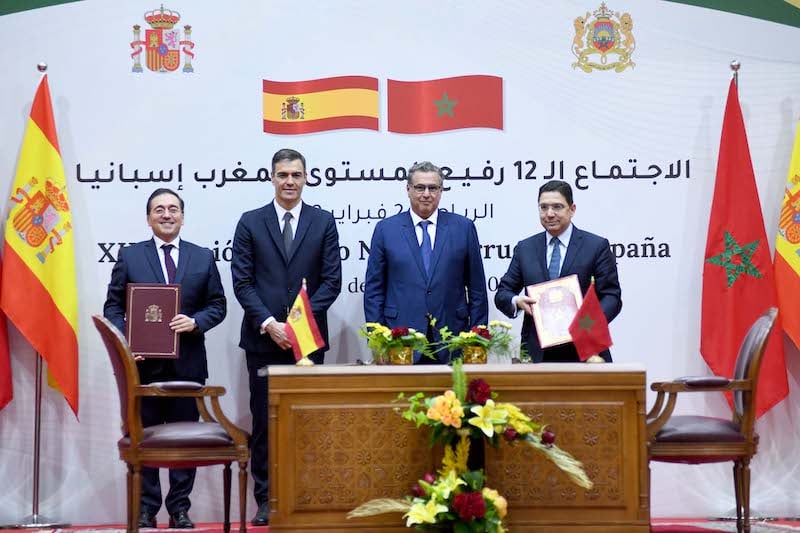
Tensions have sparked once again between Madrid and Rabat over t Ceuta and Melilla. After Rabat’s protest against the statements of Spanish official Margaritas Schinas, the “Sanchez government” responded to the Kingdom stressing that the two cities were unarguably “Spanish”.
Spanish Foreign Minister Jose Emmanuel Albaris said, in statements to Europe Press, that “the Spanish borders are known and clear,” and that “the cities of Ceuta and Melilla are internationally recognized as Spanish.”
This response from the Spanish government comes in light of the “election battles” against the right wing, which achieved the triumphant results it had been aiming for during the municipal elections, and showed a clear superiority in various Spanish cities’ polling centers.
This prompted the head of the Spanish central government, Pedro Sanchez, to announce early legislative elections for next July.
A fleeting storm
After the phases of “clear serenity” and “close rapprochement” in the previous period, have relations between the two parties risen to another level of tensions?
Abdelali Barouki, a university professor specializing in Moroccan-Spanish relations, answers, saying that “the current developments between the two parties cannot be considered a crisis , because the debate over Moroccan Ceuta and Melilla was and is still headed in the same direction.
Barouki added, in an interview with Hespress, that “Rabat and Madrid agreed during the recent bilateral summit not to raise any sensitive issue regarding the Ceuta and Melilla file.”
Morocco has fully committed to this agreement, given that the protest note by Rabat was sent mainly to the European deputy commissioner in charge of migration, Margaritis Schinas, and not to the Spanish government.
The same spokesman continued, “The issue of Ceuta and Melilla is of utmost importance to Morocco, as the Kingdom has repeatedly stressed that the two cities are, by proof of history, undeniably Moroccan.
Spain has rationally acquiesced to Morocco’s claims on more than one occasion, and what is currently happening are simply routine matters between the two countries, just a “passing cloud.”
The same professor explains that “Albaris’ quick and furious response came in the context of his desire to gain electoral points for his government, against the prevailing right-wing glow in the elections,” before adding that “the Spanish government raised the issue first for fear that their rival right would be in power Elections are the first to talk about.”
Election fever
Abdelhamid Bajouki, a writer and specialist in Spanish affairs, stressed that “the Ceuta and Melilla file is not a priority for Madrid and Rabat, but as it coincides with the Spanish electoral campaign, it is currently a pressing issue for the Spanish government.”
Bajouki added, in a statement to Hespress, that “the Spanish foreign minister was obligated to respond to Morocco, so that Spain’s right-wing will not exploit his inaction to their advantage in the elections; However, his statements do not indicate that the two sides have entered a new phase of tension.”
The same specialist continues, “the two countries have established a common path for cooperation and solidarity, and Rabat is a priority for the Moncloa Palace,” and stresses that “the recent bilateral summit between the two parties took care to avoid raising sensitive issues, in an effort to maintain the good atmosphere between them.”
The writer concluded to Hespress that “Morocco’s presence in the Spanish election campaign is natural, but most of the Spanish parties this year tacitly agree not to raise any sensitive issues between the two countries, fully aware of the importance of establishing good relations with their southern neighbor.”
This article was translated from Hespress AR by Hiba Aariche






add your comment
Terms of publication : Not to offend the writer, people, sacred things, or attack religions or the divine self, and refrain from racist incitement and insults.