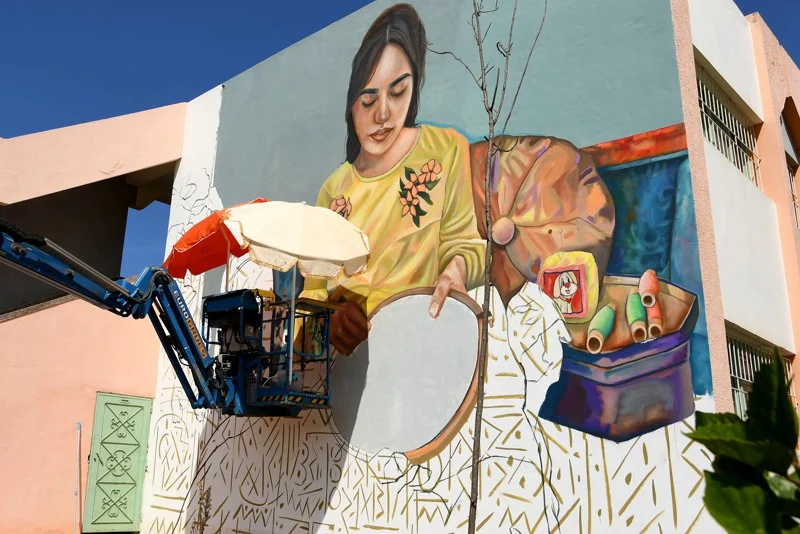
The walls of different streets and alleys in the capital, Rabat, were decorated with new paintings on the occasion of the eighth edition of the Jjdar Street Art Festival, which concludes its activities today, Sunday.
Each mural tells a special story, whether it is through faces, landscapes, or objects, and comes to add to the hundreds of other creations that were drawn in previous sessions, integrated into the corners of the city as if urging the static to think and reflect through drawing.
On Mohammed Ben Abdellah Street, two people work on a crane to complete the finishing touches to a mural: an old car from the 1990s parked at night on the outskirts of the city.
It’s a painting by Spanish street artist Sebas Velasco, who has toured the Mediterranean countries and former Soviet republics in order to what he says is “capturing the charming atmosphere of the communities, the unique architecture and the liveliness of the streets.”
The Spanish muralist confirms, in a statement to MAP, that this first visit to the Kingdom allowed him to understand the charm of the atmosphere, lights and unique monuments in the Moroccan heritage.
And he adds, “Today, by examining the Moroccan nature and population, I better understand the admiration of the Catalan painter Maria Fortuny (1838/1874) for the details of plastic art in Morocco.”
With regard to the “Jidar” festival, the same painter stressed the importance that this event attaches to youth and the various artistic initiatives to develop new talents and enable them to develop and flourish alongside experienced international artists.
For this, not far from Velasco’s mural, many young people gathered around the walls of the Social Complex of Hope. Here, each person places an initial version that will later become a dedicated space where different artistic expressions will blossom under the direction of Younis Amris, who is a pure product of the Jidar festival.
Omaris, also known as “Dynam”, has preceded all previous editions of the festival since its inception eight years ago. He previously participated in a group mural, and accompanied a famous foreign mural artist in one of the previous sessions, before creating his own painting.
Speaking about the impact of “Jidar” on his artistic career and that of his colleagues, Dinam indicated that this event represents “a laboratory for cooperation and a platform for launching towards a national and possibly international career path in street art.”
The young woman, Wiam Azhar, hopes to take advantage of this platform provided by “Jidar”, where she participates for the first time in the collective wall, and expresses her satisfaction at interacting with artists, the fun atmosphere and the generous sharing of experiences and ideas.
“This is the first time I have painted on a wall,” says the budding artist, with a wide smile on her face. My creations have never gone out of paper before. I am now discovering how unique this activity is. I want to continue on this path and develop this passion.”
In turn, Nabil Ait Salah, a graduate of the High School of Fine Arts, works with dedication to revive his creativity: a landscape of shapes and colors. The young man tells the story of his involvement in graffiti since his young childhood and how he has not stopped “devoting his passion for street art” over the years, a passion that he continues to enhance as a form of expression and social communication.
Ait Saleh says: “I chose to live from this passion and make it a means of communication between me and others, and I draw from Moroccan heritage in everything I do. Oftentimes it is difficult to convey a message, but with the murals, I feel able to say something to the audience.”
Throughout its various sessions, the festival contributed to giving a new face to the city of Rabat through more than 100 works of art bearing the signatures of the most prominent Moroccan and foreign muralists, a heritage that will be enriched this year with the works of other artists such as Telmo, Miel, Sebas Velasco, Elisa Capdevila, and Bizet. , Alegria del Prado, Meryem Benkirane, and Machiman. These artists hail from the Netherlands, Spain, Poland, Mexico and Morocco.
The “Jidar-Street Art” festival seeks to highlight the voices of urban cultures, giving them the same consideration as other artistic genres, as well as opening new horizons for the Moroccan public, and creating the appropriate conditions in order to ensure a favorable environment for artists to express their ideas.
Since the beginning of the “Jidar-Street Art” festival in Rabat in 2015, organized at the initiative of the Association for Artistic and Cultural Education – Boulevard, the city has witnessed a significant increase in the number of murals that adorn the large facades of buildings.




add your comment
Terms of publication : Not to offend the writer, people, sacred things, or attack religions or the divine self, and refrain from racist incitement and insults.