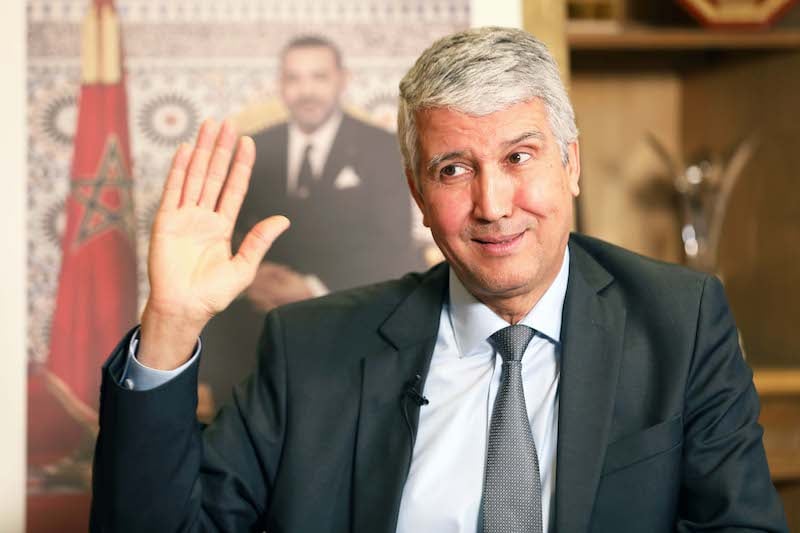
The Minister of Agriculture, Mohamed Sadiki, reassured Moroccans about the return of vegetables and red meat prices to normal before Ramadan, affirming the involvement of all stakeholders to overcome the repercussions of the current crisis.
High prices, a multiplicity of reasons
In an interview with Hespress, the minister explained that the wave of high prices is the result of several factors, beginning with the Corona pandemic and then the prolonged drought that Morocco experienced, not to mention the repercussions of the Russian-Ukrainian war, up to the recent weather disturbances in the Kingdom and the drop in temperature to unusual levels.
This had an impact on the growth and maturity of many crops, particularly basic products like tomatoes, onions, and potatoes.
According to the Minister of Agriculture, there is another factor behind the surge in prices, which is visible in the transitional phase of some crops, such as the end of the dry onion period and the entry into the green onion phase, which is a two to the three-week transitional period until production returns to normal, and this transitional period is also related to other products.
The government official confirmed that Morocco’s cultivated area for vegetables experiencing a wave of high prices is sufficient, with an increase of 400 hectares from last year, indicating that there is ongoing consultation with professionals to supply the national market as needed, and thus lower prices.
The red meat problem
The Minister stated that the Covid-19 epidemic had upset the equilibrium of the red meat supply chain because the vaccination of cows had been discontinued for two years, not to mention the protracted dry season of the previous year, which impeded the reconstitution of the herd.
In order to supply the market with foreign meat, he said, the government foresaw this eventuality and began acting accordingly in November and December of last year.
To that end, import taxes on domesticated cows were suspended to encourage importers to provide the domestic market with red meat. He also said that the imported cows would be used for slaughter in order to maintain and reorganize the national herd.
According to Sadiki, the wholesale cost of meat outside of Casablanca has decreased from 80 to 85 dirhams to between 72 and 75 dirhams.
Exporting to other countries
Sadiki confirmed that the Ministry of Agriculture has a clear contract with professionals regarding exporting abroad, pointing to the existence of daily tracking of the production and marketing process, with the goal of maintaining a balance between export and the national market, and emphasizing that “the priority is for the internal market which is unarguable.”
“The monitoring committees follow up with the specialists, and we give them export licenses and push them to give us the domestic market,” he continued.
Noting that the same approach was used last year, weeks before Ramadan, and yielded a beneficial result, with prices dropping after a few days.
Concerning the export of vegetables whose prices are now high, the minister stated that professionals are currently exporting cherry tomatoes only, which are not particularly popular in Morocco, implying that the export of conventional tomatoes will be discontinued in the near future.
According to the figures and data accessible to the ministry, the problem of high pricing is not tied to the issue of export, but rather to the cold wave.
Mediators and distribution control
The Minister stated that the “Green Morocco” plan’s strategy is primarily centered on production and management, as well as the value chain approach, from the producer to the end customer.
“Despite some control over the production, agricultural, harvesting, and logistics circles,” the minister says, “there are marketing and storage circles in which there are several stakeholders, sectors, and institutions.”
He adds that “the problem lies in the existence of some unknown circles that turn into speculative intermediaries.”
It is a problem at the level of wholesale market organization, distribution, and restructuring, and this is one of the goals of the green generation strategy, but of course, not only the Ministry of Agriculture is concerned, but with communities, the Ministry of Interior, and the rest of the sectors to solve these problems that have accumulated over time, and we are on the right track to overcome them.
“Tomatoes cannot, for example, be sold for four dirhams at the Inezgane market and arrive in Rabat then reach ten dirhams,” the government official said.
“Even after accounting for transportation and merchant fees, the mind cannot bear this,” he stressed.
Sadiki vowed to stand up to those who manipulate pricing, stating that regional committees, in collaboration with governors and employees, inspect storage facilities, monitor monopolies, and record infractions in order to penalize those responsible, emphasizing the importance of not being sympathetic to them.
Farming and water drainage
The minister denied the validity of the data promoted by some experts and reports regarding the agricultural depletion of water in Morocco by about 80%.
The minister emphasized that the water crisis is not caused by avocado cultivation, which accounts for approximately 10,000 hectares, while red watermelon cultivation accounts for approximately 18,000 hectares, indicating that “watermelon” cultivation has always existed, but the problem is that it has spread to areas where it should not be grown, such as the Zagora region.
He explained that the new “Green Generation” strategy organizes agriculture and addresses these issues, as the ministry has adopted new types of drought-resistant crops, highlighting the ambition to plant 100,000 hectares of carob in exchange for lifting subsidies on water-depleting crops such as “flowers,” avocados, and lemons.
“The new strategy aims to achieve balance in agricultural distribution at the national level,” Siddiqui says, adding that “the goals of the green generation are sustainable agriculture, putting people at the center of the equation, and choosing agricultural systems that give us more production with less water.”
Eid al-Adha
In order to prevent any disruptions in the heads of sheep during Eid Al-Adha, the Minister informed that the procedure connected to delaying the imposition of import tariffs on cows also includes the flock of sheep.
He went on to explain how the importer from abroad must leave the rams and sheep for the Eid period and reorganize the herd in order to meet the daily consumption during this time. He also claimed that professionals have been instructed to stop slaughtering sheep and to make do with importing during this time instead.

add your comment
Terms of publication : Not to offend the writer, people, sacred things, or attack religions or the divine self, and refrain from racist incitement and insults.