Decades after it was proposed, a submarine tunnel project linking Morocco and Spain across the Strait of Gibraltar has returned to the forefront, after discussions on Thursday brought together Nizar Baraka, Minister of Equipment and Water, and Mohamed Abdel Jalil, Minister of Transport, and Logistics, with Spain’s Minister of Transport and Urban Programs, Raquel Sanchez Jimenez.
The talks, which come within the context of the 12th session of the Morocco-Spain high-level meeting, resulted in the parties’ commitment to “set a date in the coming days for a meeting of the joint committee, in order to discuss the next steps regarding the submarine tunnel project between Spain and Morocco across the Strait of Gibraltar.”
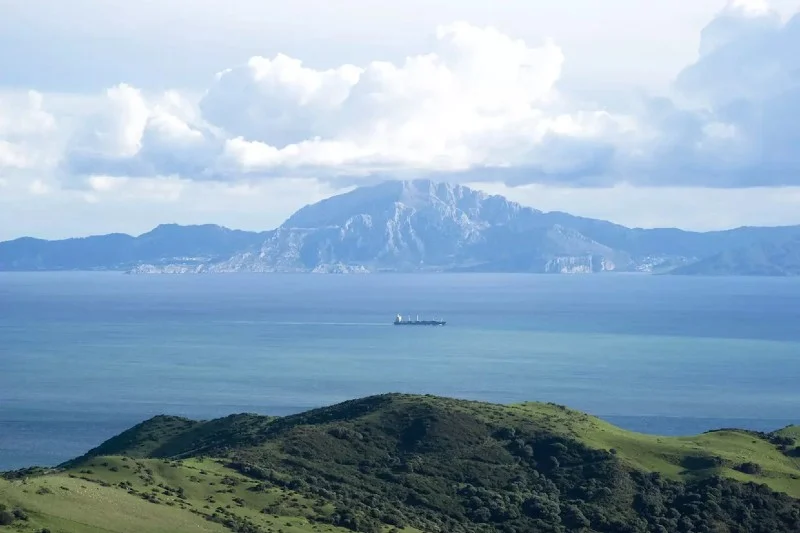
The project includes the construction of a tunnel across the seabed at the intersection of the Atlantic and Mediterranean, and it was previously agreed that the tunnel would be 28 kilometers long at a depth of 300 meters linking Punta Paloma (Tarifa) with Malabata (Tangier).
The Spanish minister said: “We will give impetus to the studies of the project to link the Strait of Gibraltar, which was initiated by both countries forty years ago,” describing the project as “strategic for Spain and Morocco, as well as for Europe and Africa,” reported Spanish media.
Although it was not expected to be on the table at the bilateral summit yesterday, as there was no reference to it by Moroccan or Spanish officials, the project had been in the working for some months now.
The Moroccan Government Council approved in November the appointment of Abdelkabir Zhoud as Director General of the National Company for the Studies of the Strait of Gibraltar of the Ministry of Equipment and Water, a step forward in the promising Morocco-Spain maritime tunnel project.
The company is tasked with coordinating with the Spanish Company for Fixed Telecommunications Studies Across the Strait of Gibraltar (SECEGSA), in order to re-examine the underwater tunnel project linking Morocco and Spain.
The Joint Committee was appointed to study the feasibility of unifying the two continents back in 1979, a project that was affected in more than one stage by many factors, including political and diplomatic crises.
SECEGSA recently announced its inclusion among the beneficiaries of European support under Spain’s recovery plan to conduct new studies on this infrastructure.
As part of the draft budget for 2023, the Spanish government allocated 750,000 euros for the company, in order to prepare a new study with the participation of a German company specializing in the preparation studies related to maritime tunnels.
“Although the amount is not huge, it is a gesture from the Spanish government and a message that the project is far from forgotten, and that progress is being made to make it a reality despite the difficulty,” Spanish newspaper Larathon reported.
Izzedine Khresh, a professor of political science and international relations at Hassan II University in Casablanca, said that the appointment of a general manager of the National Company for the Studies of the Strait of Gibraltar is a signal from Morocco of its desire to push this project towards activation and bring it into existence.
This project has long been the subject of a Moroccan-Spanish agreement, and promises significant material gain and logistical ease to both countries and continents.








add your comment
Terms of publication : Not to offend the writer, people, sacred things, or attack religions or the divine self, and refrain from racist incitement and insults.