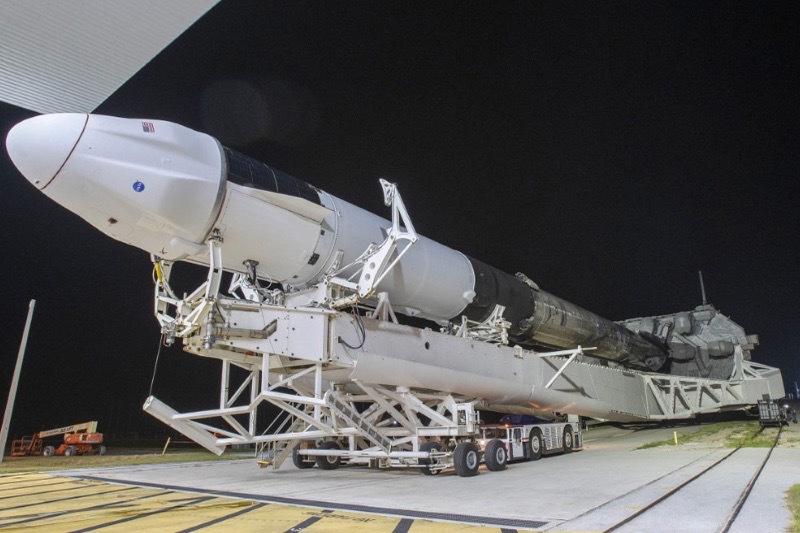
Moroccan students from a Guelmim primary school contributed on Tuesday to a space experiment, part of the International Space Station’s (ISS) National Laboratory Center’s dedicated program, in collaboration with NASA.
Under the name “ExoLab-Mor-01,” Moroccan Initiative for Space Industry partnered with the Moroccan Scientific association to facilitate the involvement of the students on the biological experiment.
Participants describe this project as “a first in Morocco,” as it sees these students collaborate with astronauts and scientists from the biggest space agencies abroad.
The ISS is a multinational collaborative project involving five leading space agencies: NASA (United States), RosCosmos (Russia), ESA (Europe), CSA (Canada) and JAXA (Japan).
Ownership and use of the space station is established through intergovernmental treaties and agreements.
Moroccan Science projects meant for outer space, notably the Mohamed VI-A & B satellites, have never ventured towards the ISS, where many leading countries conduct various experiments and establish a multi functional link in orbit around the earth.
The experiment, which captures carbon dioxide in survival experiments in space and on earth, is part of Exolab’s many student-led biology experiments.
Exolab’s student collaborates get to conduct experiments (such as growing plants) in their classrooms, using ExoLab equipment distributed for educational purposes, while following along with a concurrent experiment on the ISS.
Exolab is part of Magnitude.io’s hands-on educational experiments. partnered with NASA under the Space Station Explorers project.
The initiative consists of educators, learners, and organizations that provide STEM learning through connections with the ISS National Lab for students, educators, and the public.
Magnitude.io, a US education center in Berkley, California, describe their mission, saying: “We envision a collaborative world that empowers life-long learners with the skills, knowledge, and courage to go boldly into the unknown and to champion the principles of sustainability wherever humans explore, whether on Earth or beyond.”






add your comment
Terms of publication : Not to offend the writer, people, sacred things, or attack religions or the divine self, and refrain from racist incitement and insults.