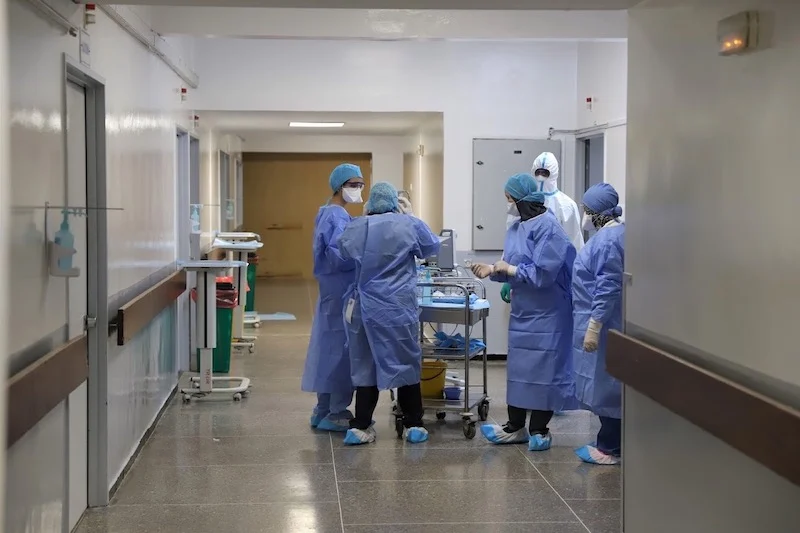
“I like my job, no matter what,” Red crescent nurse Fatiha Douhab told Hespress EN, who is still feeling traumatized from doing her tasks during the circumstances surrounding the COVID-19 pandemic.
“I don’t fear anything in my work, even though I know deep inside that I am exposed to a lot of risks,” she added.
As the world celebrated World Mental Health Day last week, Hespress EN spoke to nurses who sacrificed much of their safety to assist patients during this period.
“I caught the virus once while working in the early months of the pandemic’s outbreak,” Douhab continued.
The pandemic first appeared in the country in late February 2020 and is still ongoing, with only a few cases reported daily recently.
“I volunteered to work immediately after the outbreak of the pandemic,” nurse Fatima Ezzahra Belline in Rabat’s Moulay Youssef hospital told Hespress EN.
“I was taken aback and felt a mixture of stress, fear, responsibility, and pride in front of citizens,” she said, adding that nursing is about sacrificing and denying yourself to save others.
“But I’m still terrified of having to devote my entire time to work, as I did during the total lockdown,” she continued, as Belline felt detached from her three children and family in order to avoid affecting them as much as possible.
“I’m still suffering from post-traumatic stress disorder that facts will repeat themselves again,” she said.
Regarding mental health support, Belline stated that there was a green number created for that purpose, but neither she nor her coworkers used it previously.
“We attempted to improve our mental health as a team, and we were acutely aware of how much weight was on our shoulders,” she added.
“Unfortunately, a coworker caught the virus and was taken to a nearby health center to be hospitalized, along with other medical personnel in the region,” she continued.
“These facts made me realize that the same thing could happen to me at any time,” Belline added, noting that, “I had to keep working in order to contain the virus and avoid the worst-case scenario.”
“Sometimes, I remember finishing my work by 2 a.m. and avoiding close contact with my family to protect them from being affected,” she added.
Nurse in the oriental region, Souad Amine also told Hespress EN, “I was stressed and worried about the deception of seeing people sick and not having a solution.”
“During the peak of the pandemic, reanimation units were insufficient for all patients, leaving us with no choice,” she explained.
“I was infected three times by the virus because I was directly exposed to it,” she added, noting that COVID-19 was linked to 80% of tasks.
“As I have asthma, I was aware that my health was in jeopardy,” she said, adding, “ by the end, I had made up my mind that whatever is meant to happen will happen.”
“Six coworkers were hospitalized, and two others passed away,” she added.
The World Innovation Summit for Health (WISH) in collaboration with the World Health Organization (WHO) released a report entitled “Our duty of care: A global call to action to protect the mental health of health and care workers,” which was recently presented on October 5 at the WISH global health conference, according to US magazine nursing times.
The study findings showed that at the height of the Covid-19 pandemic, 23-46% of healthcare workers witnessed anxiety, while 21-37% experienced depression.
Rates of burnout were at 66% in nurses and physicians and 52% in other health professions, while post-traumatic stress disorder (PTSD) was seen in 28% of nurses and 17% of other health workers. The highest rates of PTSD were in those who worked in Covid-19 units, added the same source.
The main causes of burnout were increased contact with Covid-19 patients, a lack of personal protective equipment, and work stress, according to the same study findings.







add your comment
Terms of publication : Not to offend the writer, people, sacred things, or attack religions or the divine self, and refrain from racist incitement and insults.