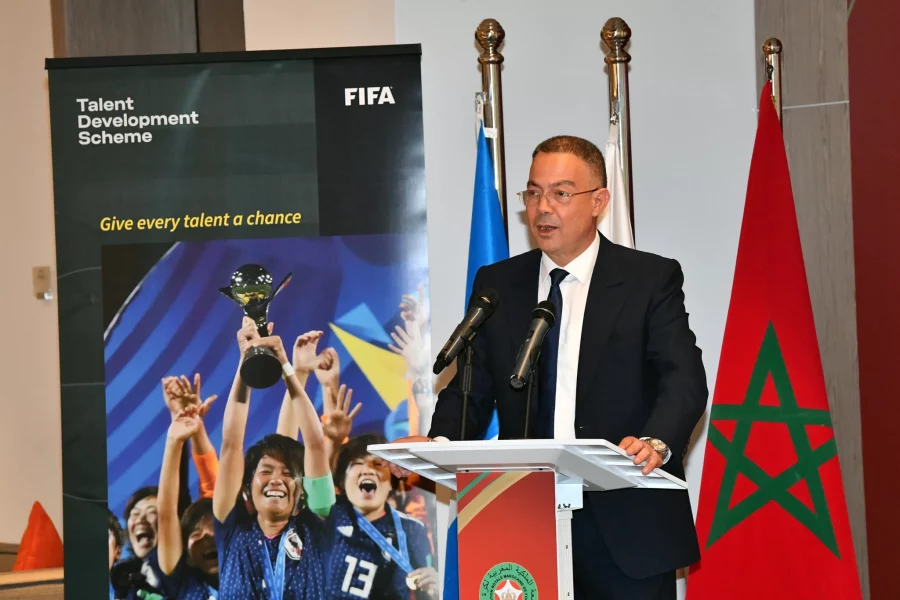
FIFA held a recent workshop within the Mohammed VI Football Academy with the attendance of more than 50 development specialists and regional technical advisers to discuss talent development strategies, share best practices, and prepare the ground for the rest of FIFA’s member associations to support the scheme.
The Talent Development Scheme (TDS) which was launched in February 2020 by FIFA Chief of Global Development Arsene Wenger, is a program that offers bespoke assistance for member associations (MAs) to help the latter achieve their full potential and continue the measures taken in order to reduce the disparity in the level of football between different regions of the world.
Fouzi Lekjaa, president of the Moroccan Football Federation (FRMF), stated in his opening speech at the workshop that “the development of football in Morocco is founded on a triangular approach that should form the basis of the development of any system: facilities, talent, and qualified personnel,”
He continued voicing his determination that the FRMF “is convinced that those three fundamentals have to be in place for the process to develop as it should.”
Along with the opening of Mohammed VI Football Academy in 2019, which covers 30 hectares and boasts the latest facilities and equipment, that complies with FIFA standards.
Moroccan authorities, since then, have been developing local facilities overseeing development over the kingdom’s 12 regions, starting with talent detection among young players attending club academies.
Lekjaa highlighted the efforts emanated by the FRMF in assuring clubs to have their own academies, adding that “the regional academies are the same as the national academy, just smaller.”
“The best players from the regions go to the center of excellence, which has coaching and medical staff who work with young players spotted in grassroots football and take them up to the next level,” explained the FRMF president.
During his clarification of the selection process adopted by FRMF, he emphasized on the root of the development cycle design saying that “talent detection starts at grassroots level, with that talent then channeling into the clubs, the regional academy and on to the national center of excellence.”
FRMF is set to embark on a journey of closing the net as tight as it can and make sure that no potentially gifted individuals slip through it.
“We have embarked on a sports studies program with the Ministry of National Education to create school structures across the country that can accommodate boys and girls who play football all the time, offering them a timetable adapted to every level of schooling,” said Lekjaa.
He continued: “We are trying to deliver maximum added value in footballing terms so that we can take that raw talent at the age of ten and allow them to express it and raise their game. The idea is to prepare them for life as professional players and for them to kick on and join clubs.”
FIFA Technical Director Steven Martens said that “the Moroccan Football Academy is very important for FIFA and football in Africa, not just because of its facilities but because of its programs.”
Steven expressed his convincement that this sports investment will pay off, saying that “there is no question that the work Morocco is doing now will yield results in the long term. After all, Morocco stage the CAF Women’s Africa Cup, and its youth team are starting to put some excellent performances together.”
Former Portugal Striker Nuno Gomes, as a high-performance specialist involved in the TDS project, stated his satisfaction by congratulating the Moroccan Football Academy on its amazing facilities and the association with its president “who had the vision to build this infrastructure with the aim of developing talented young players,” as he described.
Another high-performance specialist involved in the aforementioned project, former France defender Mikael Silvestre, hailed the quality of the national academy by saying “it is outstanding. It’s lush and green, the pitches are ready and the working environment is first class.”
The workshop gave FIFA technical director and his team the perfect opportunity to explain the importance of the TDS and FIFA’s development programs, in which he said that “it’s a scheme in which we have consultants taking part along with experts, coaches from around the world, former players, former coaches and former directors of football. We are here to train the leaders of today and to prepare them.”
In this regard, Martens highlighted that 154 countries have already signed up for the scheme and it is vital for FIFA to help each and every one of them at their own level.
Based on an innovative study on talent development launched two years ago, the TDS follows FIFA President Gianni Infantino’s 2020-2030 vision of making football truly global.
In line with study’s results, national associations can focus on specific aspects of their development needs, Martens emphasized that ‘’it’s a great idea but a huge challenge too.” He elaborated that “it involves all the associations and the countries organizing a regular school’s competition that could perhaps lead into international competitions.”
The technical director highlighted that the most important thing is to give young people the chance to meet up and play regularly and thanks to the scheme that will realize this plan, that is set in motion.
He added “every association wants their national association, but there’s a lot more to football development than just a path to the top. You have to make sure players stay in the game and are excited by it.”







add your comment
Terms of publication : Not to offend the writer, people, sacred things, or attack religions or the divine self, and refrain from racist incitement and insults.