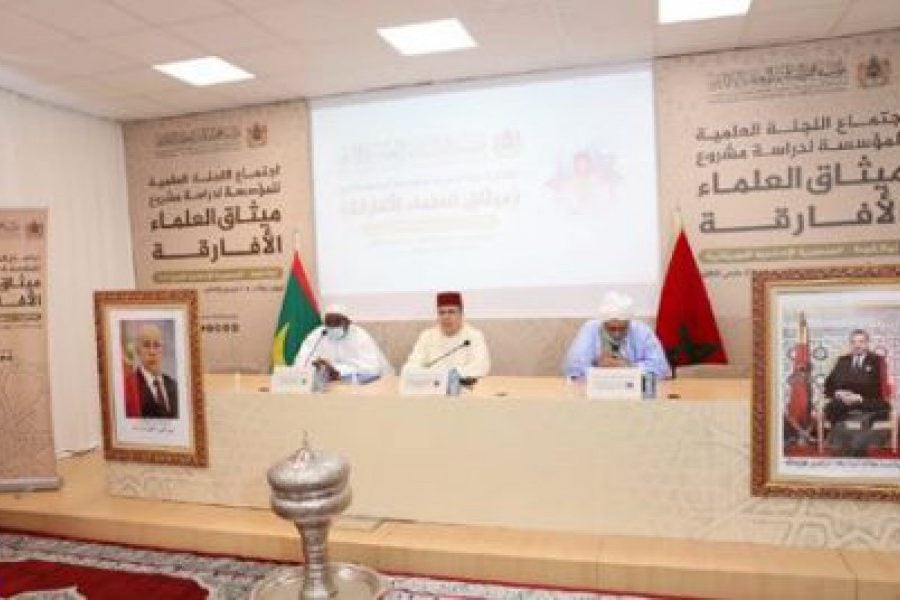
The meeting of the Scientific Commission of the Mohammed VI Foundation of the African Ulema, devoted to the examination of the project of the “Charter of the African Ulema”, opened Saturday in Nouakchott, with the participation of scientists, experts and members of the Foundation from several African countries, in addition to a delegation of Moroccan scientists.
The two-day meeting takes place after the recommendations of the ordinary session of the Supreme Council of the Mohammed VI Foundation of the African Ulema, held on 17 and 18 December 2019 in Fez and crowned by the approval of the elaboration of a reference document, as “the Charter of the African Ulema” affiliated to the Foundation.
The charter focuses on five complementary principles: “Science and Scholars in the African Context”, “Preservation of the Great African Religious Constant Values”, “Islamic Values and the Protection of the Religious Commons”, “Protection of Spiritual Security in Africa” and “Africa: Prospects and Aspirations”.
The main aspect of these principles is the consolidation of the religious commonality as a doctrine and behavior at the level of the African continent, in order to protect the spiritual security of its peoples.
The Nouakchott meeting, the first of its kind held by the Foundation outside Morocco, aims at discussing and studying the draft Charter, in order to develop its aspects through serious research and in-depth debate.
During his opening speech, Secretary General of the Mohammed VI Foundation of African Ulema, Sidi Mohammed Rifki, said that the dangers that threaten Islam require the full coordination between African Ulema to face the destructive currents.
This must be done “through the explanation and teaching of our religion which advocates peace, harmony and unity, between Muslims and non-Muslims and this, to preserve our common African identity that His Majesty King Mohammed VI, President of the Foundation, does not cease to call for its consolidation and upholding,” said Rifki.
He added that “the provisions of the practical implementation of the content of the Charter of African Ulema within African societies, of multiple religions, customs and languages, impose to the researchers to evoke the human values and the founding principles of the instinctive, healthy and harmonious moral system which characterize the African humanism in terms of values, principles, customs, ethics and particularities”.
He also stressed that “the characteristics, specificities and features of the African human being, which differ from one region to another and are generally characterized by peculiarities, should be taken into account when drafting the African Ulema Charter”.
Rifki also said that the Mohammed VI Foundation of African Ulema will remain, under the high patronage and enlightened leadership of His Majesty King Mohammed VI, Commander of the Faithful, faithful to its principles and objectives in order to protect the Muslim religion and the noble human values in their African dimension.





add your comment
Terms of publication : Not to offend the writer, people, sacred things, or attack religions or the divine self, and refrain from racist incitement and insults.