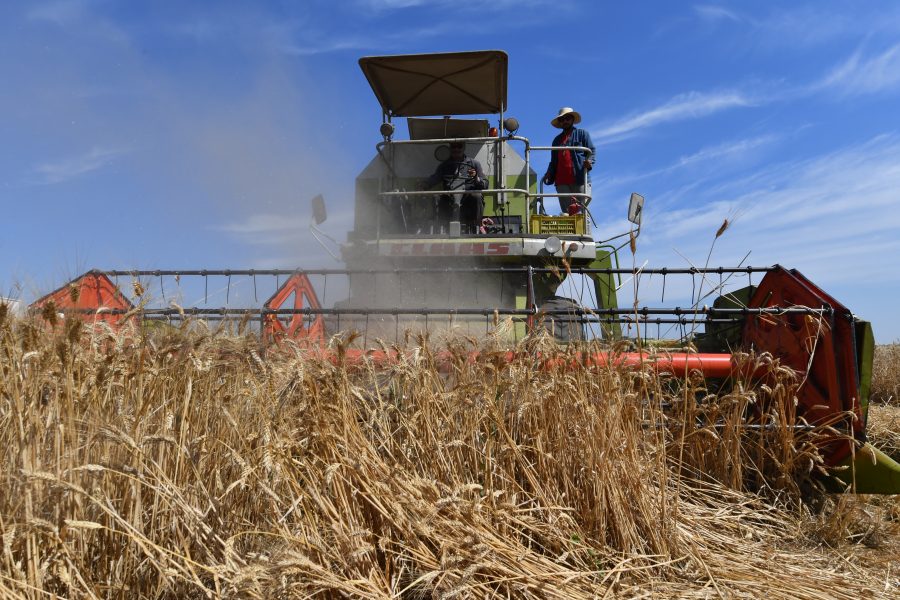
Against the backdrop of the Russia-Ukraine war, fears of wheat shortages are growing worldwide, prompting Morocco to create an additional reserve of soft and hard wheat, according to Mohammed Sadiki, Minister of Agriculture.
Sadiki said that the government is implementing a vision to create a national and integrated ecosystem of strategic commodities stock.
In response to an oral question in the House of Representatives on “securing strategic stock of food products,” the Minister explained that his department has established a team dedicated to the identification of products concerned by this stock, as “measures that will be put in place to ensure food sovereignty.”
These will be the commodities that domestic production does not allow to cover, namely cereals, sugar, and cooking oils, in addition to agricultural inputs, especially seeds, nitrogen fertilizers, and pesticides that are not produced locally.
This stock, which is added to the available stock said to currently cover five months of Moroccans’ consumption, will be made available to the National Interprofessional Office of Cereals and Pulses, and will be liquidated according to the situation and in coordination with professionals in the field.
“We are facing a multifactorial and uncontrolled crisis, and the government is making every effort to monitor the development of this situation and deal with it according to the means available,” added Sadiki.
He also stressed that pending the final vision of this stock and the mechanisms to ensure its implementation, the Ministry of Agriculture has begun the gradual establishment of a reserve stock of soft and hard wheat, jointly with the Ministry of Finance.
While the national cereal harvest reached a record high in 2021, with 10.3 million tons, the expected harvest in 2022 will be heavily impacted by the drought that hit the country this fall and winter, as rainfall was 41% below average since the beginning of 2022.
“Moroccan farmers have planted an approximate 3.5 million hectares of cereals, 44% of which is soft wheat, 24% durum wheat, and 32% barley,” Sadiki told MPs, adding that “53% of the crop is expected to be lost and only 21% is in good condition, 16% in average condition and 10% poor.”





add your comment
Terms of publication : Not to offend the writer, people, sacred things, or attack religions or the divine self, and refrain from racist incitement and insults.