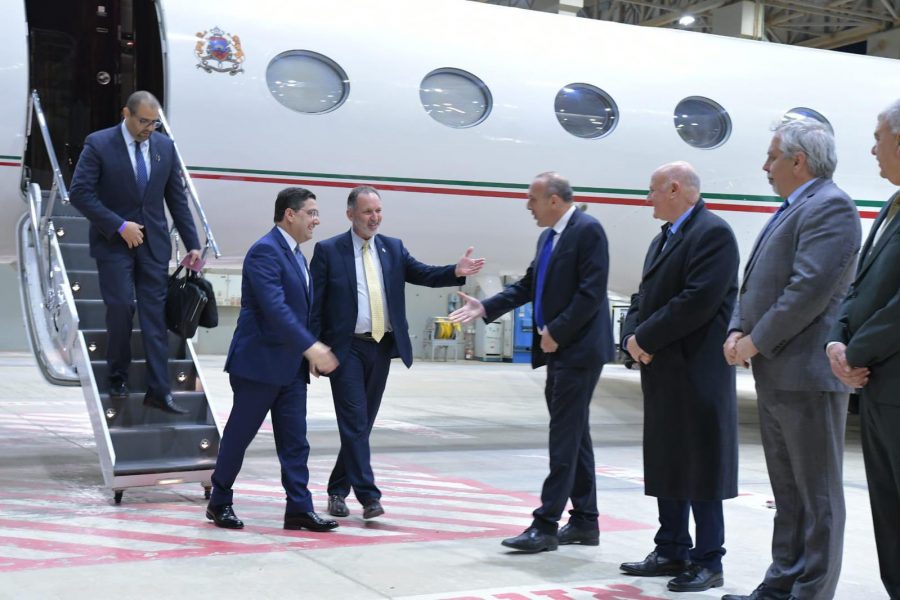
Moroccan Minister of Foreign Affairs, Nasser Bourita arrived to Israel to participate in the Negev Summit, alongside signatories of the Abraham accords.
Israeli Foreign Minister Yair Lapid welcomed the Moroccan official’s arrival on Twitter, as well as the arrival of the Emarati, Bahraini and Egyptian foreign ministers
ברוך הבא ל #פסגת_הנגב – שר החוץ של מרוקו נאסר בוריטה ????
أهلا بك في قمة النقب – وزير خارجية مملكة المغرب ناصر بوريطة
Welcome to The #Negev_Summit, Moroccan Foreign Minister Nasser Bourita?רפי בן חקון, לע״מ pic.twitter.com/mmD7eukJ0J
— יאיר לפיד – Yair Lapid? (@yairlapid) March 27, 2022
ברוך הבא ל #פסגת_הנגב – שר החוץ של איחוד האמירויות השייח׳ עבדאללה בן זאיד ????
أهلا بك في قمة النقب – وزير خارجية دولة الإمارات العربية المتحدة الشيخ عبدالله بن زايد
Welcome to The #Negev_Summit, Emirati Foreign Minister H.H. Sheikh @ABZayed? בועז אופנהיים, אסי אפרתי, לע״מ pic.twitter.com/VX5MMYYxkG
— יאיר לפיד – Yair Lapid? (@yairlapid) March 27, 2022
The “historic” Negev Summit, as described by the head of Israeli diplomacy Yair Lapid, is held today, Sunday, in the presence of United States of America Secretary of State Antony Blinken, and the foreign ministers of Israel, in addition to the Arab countries that have normalized relations with Israel including the United Arab of Emirates, Egypt, Bahrain, and Morocco.
In a joint statement, Israeli President Isaac Herzog and Blinken said the U.S. and Israel “will work together to find further regional cooperation that will benefit all the peoples of the region to prevent any threats to Israel.”
Blinken added that this Summit “would have been unimaginable just a few years ago. We are seeing that normalization is becoming the new normal for this region, and I think that will attract more and more countries as they see the benefits of these partnerships in the region.”
As a part of a tour of the Middle East and North Africa regions, the Summit, extending on two days, will allow the leaders to debate on regional challenges, tackling mainly the Iranian threat.
“Pisgat Hanegev” of its official name, the Summit takes place at the Kedma Hotel in Sde Boker, proximate to the tomb of the first Prime Minister of the State of Israel, David Ben Gurion.
The Emirates normalized relations with Israel in 2020 as part of a series of agreements brokered by the United States, known as the “Abrahamic Accords” Bahrain followed suit, then Morocco and Sudan.
Following decades of Arab consensus to rule out peace with Israel due to the complexity of the Israeli-Palestinian conflict, Palestinians are now concerned that they are being left out, denouncing these normalizations as a “stab in the back.”
Arriving from Poland, where he accompanied U.S. President Joe Biden, Blinken will remain in Israel until Monday to meet with Prime Minister Naftali Bennett, traveling eventually to Ramallah for talks with Palestinian Authority President Mahmoud Abbas.
Blinken will continue his tour on Monday in Algeria and then in Morocco, and he will also meet the crown prince of the United Arab Emirates, Mohammed Ben Zayed.
Demonstrating that the United States has not lost interest in the MENA region regarding Washington’s undivided attention on China and, more recently, on the Ukrainian crisis, the U.S. officials aim to garner support to counter the Russian attack on Ukraine given the severe economic consequences of the war.
The meeting is also an occasion to discuss the security challenges of the Iranian nuclear deal and its threats in the region.
After almost a year-long negotiations in Vienna around the 2015 nuclear deal, which called for the lifting of international sanctions on Iran to significantly reduce its nuclear weapons programs and provide assurances that it is not pursuing a nuclear weapon, talks are at risk.
The agreement is almost a failure since former U.S. President Donald Trump announced his unilateral withdrawal from it in 2018, reintroducing harsh sanctions on Iran, negatively affecting the country’s economy.
“We have a disagreement on the nuclear program and its consequences but are open to an open and honest dialogue,” said Israeli Foreign Minister Yair Lapid in a joint conference this Sunday morning in Jerusalem, conjointly with Blinken.
“Israel and the United States will work together to prevent Iran from obtaining a nuclear weapon. However, at the same time, Israel will do everything that needs to be done to stop the Iranian nuclear program,” he added.
In this regard, Blinken condemned Houthi attacks on Saudi and Emirati civilians and infrastructure, stating, “The United States will continue to stand up to Iran when it threatens us or our allies and partners.”
“The United States and Israel are determined to prevent Iran from obtaining a nuclear weapon,” He continued, explaining, “Beyond its nuclear efforts, Iran continues to engage in a range of destabilizing activities.”
Note that a year following the U.S. withdrawal from the Iranian deal, Iran has gradually backed away from implementing most of its fundamental commitments stipulated in the deal.
On Saturday, European Union Foreign Minister Josep Borrell hoped to reach an agreement with Iran on its nuclear program “in a few days,” while Enrique Mora, the European Union diplomatic representative coordinating the talks, traveled to Tehran.
However, U.S. State Department spokesman Ned Price stated that “an agreement of this type is neither imminent nor certain,” adding that “there are several difficult issues that we are still trying to resolve.
Prime Minister Naftali Bennett, that stated at the beginning of the weekly cabinet meeting that Israel is currently experiencing a period of “good diplomatic relations,” has declared in February that they are concerned that the Iranian deal would not prevent Iran from acquiring nuclear weapons.
Nevertheless, according to reports of the Israeli press, Lapid “affirmed that Iran is not only an Israeli problem. The world cannot allow a nuclear Iran where the Iranian Revolutionary Guards will continue to sow terror”, explaining “we have disagreements, but the dialogue continues.”
Concerning the Ukrainian crisis, Blinken reaffirmed his support for the mediation of Bennett in Ukraine. “We agree with Israel that Iran will not acquire nuclear weapons. The Russian aggression against Ukraine shows why a nuclear-armed Iran will constitute a kind of immunity. We think the nuclear deal is on the right track”, He argued.
Referring to U.S.-Israeli relations, “The relationship between our two countries is unbreakable. It is the closest bond of friendship and the strongest alliance in Israel,” said Yair Lapid.






add your comment
Terms of publication : Not to offend the writer, people, sacred things, or attack religions or the divine self, and refrain from racist incitement and insults.