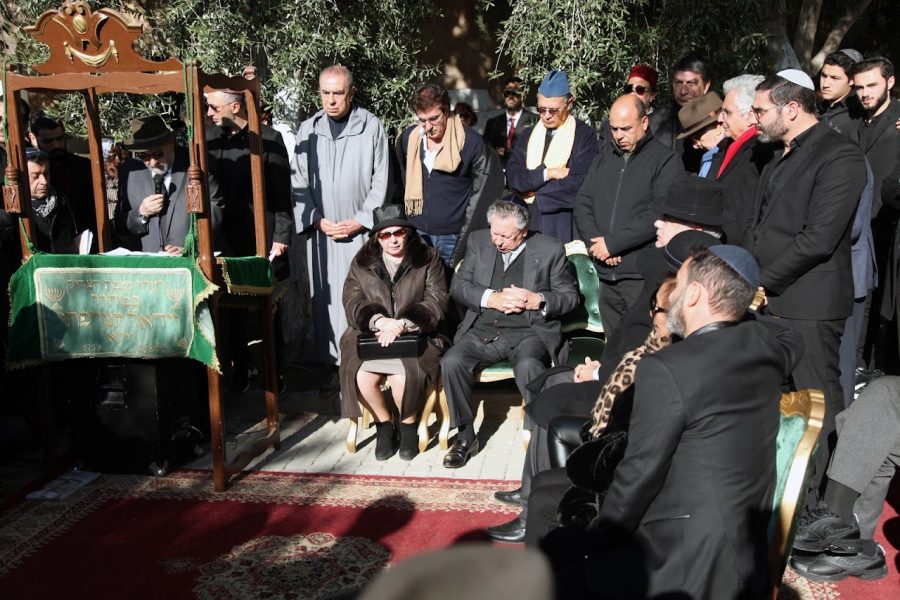
The Jewish community represents an inseparable component of the Moroccan identity and the kingdom’s history, a symbiosis meeting two cultures. “The voice of Contemporary Jewish-Moroccan Writers” emphasizes this aspect, aiming to put particularly Jewish-Moroccan authors in the spotlight.
The book is a cultural display and a call for the preservation of the Kingdom’s Jewish heritage, shedding light on the voice of contemporary Moroccan-Jewish writers.
“In the tradition of ‘literary interviews’, this book gives a voice to writers and artists of Jewish-Moroccan origin, who, even though they are far from their native land and committed to new ways of life, have had the brilliant idea of restoring the essence of a multi-century Moroccan culture”.
It is with these words that, Hind Lahmami, Professor and researcher at Moulay Ismail University of Meknes, introduces her piece of literature “The voice of contemporary Jewish-Moroccan writers”.
Based on a double legitimacy; a historical basis with the Jewish presence in Morocco since at least the first century BC, and a political ground following the new Moroccan constitution of 2011, the book is a literary representation of the community of Jewish-Moroccan authors.
Composed of a corpus of works by Jewish-Moroccan writers of the Diaspora, born in Morocco, but for multiple reasons, accompanied their families to other countries, the book seeks to shed the light on these writers.
It concerns eight main others – Georges Amsellem, Sylvia Assouline, Gabriel Bensimhon, David Bensoussan, Ami Bouganim, Asher Knafo, Nessim, Sibony and Thérèse Zrihen-Dvir, are interviewed on a number of personal, literary, and educational points.
Each of the writers’ exchanges on their early years in Morocco, the traditions of their hometown, their literary choices, their views on the 2011 Constitution, and, above all, their desire to see their works programmed in the upcoming Moroccan curricula.
The interviews provide enlightenment regarding the perspectives of Jewish-Moroccan writers within and about the Moroccan society, emphasizing the importance of their attachment to their historical and cultural roots.
In this respect, professor Hind Lahmami expresses, to Hespress EN her motivations, her ambitions, and her perspectives regarding the place of Jewish-Moroccan authors in the Moroccan literature.
– In your opinion, why it is the importance of the restitution of a multi-secular Moroccan culture for the identity of the country?
“The restitution of Jewish-Moroccan culture to the country’s identity is important in many ways. Firstly, it is a right of our Jewish fellow citizens guaranteed by the Moroccan Constitution, especially that of 2011 which rehabilitated the Hebrew tributary.
Secondly, it is a duty to history. The Jewish community has always lived in Morocco, and the remains in Volubilis show stelae with Hebrew inscriptions, in addition to history books, travelers’ notebooks, and literary productions that attest to the Jewish presence several thousand years ago in Moroccan lands.
Is it plausible to erase a part of the history of a multicultural Morocco with one stroke? It is a question of our cultural heritage and the richness of our civilization which needs all its resources.
Thirdly, it is a deontological question, one cannot consider literary works produced by people born in Morocco and speaking about Morocco in their works, as being foreigners. Having dual nationality does not mean that one is no longer Moroccan, the best example being that of our MREs.
Finally, Moroccan society implicitly recognizes the presence of Jewish culture, be it in music, cuisine, art (renowned tailors, jewelry stores, etc.), medicine, and in almost all areas of life, it is just a matter of being aware of it.”
– What can be done to enhance the voice of Jewish-Moroccan authors at both the literary and institutional levels?
“Like any writer who glorifies their country, their king, their traditions, and their values, whether this author is Muslim or of another faith, they are certainly entitled to our consideration and esteem.
At the literary level, it would be time to take into account the productions of Jewish-Moroccan writers and to propose some of them in the educational curricula: stories in the primary cycle and novels, plays, poetry collections in the secondary cycle.
Similarly, at the university level, modules should be developed with the title of “Judeo-Moroccan literature” following the example of “Maghrebian literature” which is still taught in all the faculties of literature in the kingdom. It is inadmissible for us that our students know foreign writers and ignores local ones.
In the same way for all the other university establishments, whether they are faculties or Grandes Ecoles, a transversal module on cultural diversity should be introduced in the curricula to participate in a renewed interest in Moroccan heritage.
This can only further consolidate the attachment of the people to a modern country that represents them. Especially since we live in an era of globalization and global skills are required in the profiles that seek positions of responsibility”.
– In your words, what can the resumption of relations between Morocco and Israel signify for the community of Jewish-Moroccan authors?
“The resumption of relations between Morocco and Israel is well appreciated by Jewish-Moroccan writers who see it as a kind of bridge between their home and host countries.
Direct flights, the operation of postal services, the cancellation of visas, and many other advantages are all positive points that will facilitate cultural exchanges between the two countries.
The Israeli community of Jewish-Moroccan origin can act as an intermediary between Moroccans and Israelis, explaining the Israeli mentality and introducing us to its literature, art, and educational experience. There are many ways to cooperate if both sides know how to do it”.
It is to note that diplomatic relations between the Kingdom of Morocco and the State of Israel were officially normalized in December 2020, setting the stage for a multidimensional partnership.
This new era of relations between the two countries gives academics of both origins new interest to dive into the common history and the biding identity for Jewish-Moroccan communities.



any Moroccan who has drunk Sebou water, breathed the air of the Atlas, spoken the Darija dialect must be treated with respect and consideration. Whatever his color, his religion, his secondary nationality. The Moroccan Jewish community has given a lot to its country and will continue to do so as well established in Morocco or elsewhere. His love for Morocco is unwavering