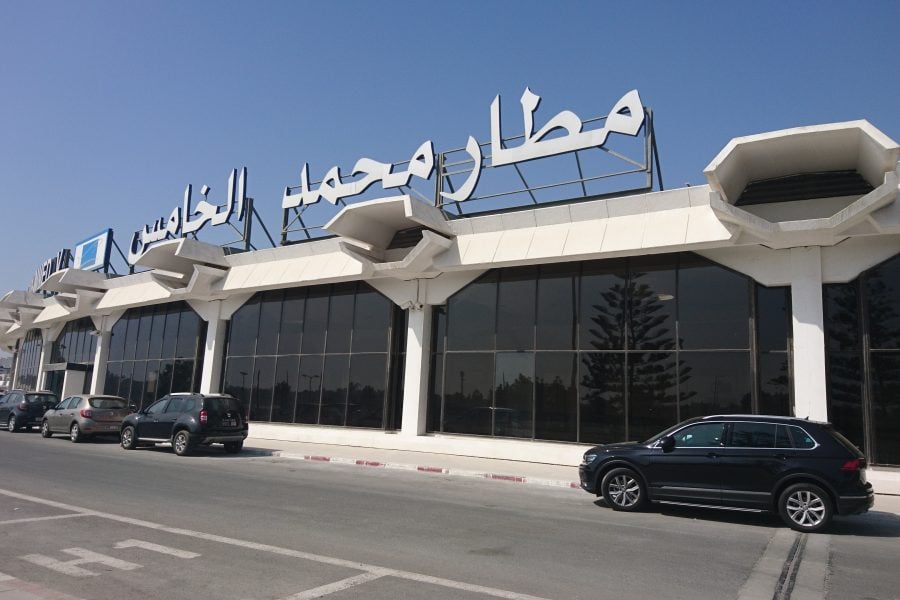
Leila K, a Moroccan employee, and student residing in France first rejoiced when she heard about the reopening of Moroccan borders following a two-month closure, thinking she will finally be able to see her family after almost a year of travel and sanitary restrictions.
But after reading the requirements issued by the Moroccan government, it was made clear to her that she would not be able to come this February.
“A fake reopening,” that’s what many Moroccans abroad such as Leila are calling the latest government’s decision to finally reopen air and sea travel.
In addition to a mandatory vaccination pass, Moroccan authorities are now requiring a negative PCR test performed less than 48 hours before boarding.
Leila tested positive for COVID-19 this January 2022. Having received both initial vaccine doses, her vaccine pass expires this February.
Unable to receive her booster shot due to her recent infection with the virus, she now finds herself unable to justify her “sanitary status” to Morocco’s requirements.
In addition, her positive test was a rapid antigen test, irrecevable by Moroccan authorities, as they require a PCR to prove a previous infection.
“Authorities are making these simple trips overly and exagerently complicated,” says Leila, who after months of restrictions sees her only vacation month gone to waste.
Leila told Hespress EN that “many Moroccans here, myself included, are feeling extremely discouraged to come back,” firstly due to these new conditions, and second due to “fear of being stranded in Morocco, unable to get back to our jobs and school in France if the borders are closed again.”
Moroccans are considering the “risks” of coming back home, telling Hespress EN that “the Moroccan government announces these decisions in an arbitrary manner, last minute, and without prior notice.”
Similarly, these concerns are echoed by tourists who have become accustomed to vacationing in Morocco but are now switching to other destinations such as Turkey and Tunisia, countries with more “predictable” travel measures related to the pandemic.
Chaimae Lemellem is one of them. She told Hespress EN that considering her employer “does not allow remote work outside the European Union territory,” she was compelled to switch her vacation to Turkey in fear of being stranded in Morocco.
Many tourists are in the same predicament, while domestic tourism sector workers agree that “these measures will discourage many from coming to the country.”
Morocco’s border closure, which spanned the entire crucial winter peak season, has left various sector professionals in a “dire” situation.
One measure, in particular, is worrying hoteliers. The Moroccan government announced in its statement that there is a “possibility of additional PCR testing 48 hours after arrival for tourists, in their residences and hotels.”
“No tourist will prefer a destination with such measures,” says Khalid B, a hostel owner in Fes, adding that “the risk of infection is around us all, it’s not fair to target tourists well after it’s been proven that they are negative upon arrival.”
From travel agencies to hotel and business owners, tourism professionals have been protesting and staging sit-ins for months, denouncing the government’s “death grip” on the sector.
But the recent reopening is still not enough for the workers, as these safety policies are “excessive and discouraging” in the eyes of many.
Back in 2019, the tourism industry contributed approximately $8 billion to the Moroccan economy, making up 7% of the country’s national Gross Domestic Income that year.
According to Central Bank forecasts, the sector is expected to contribute a mere $3.6 billion this year.
Over 50% of tourism revenues have been lost in the last two years, and as governments around the world are fighting to regain their pre-pandemic indicators, the Moroccan government seems to be “unresponsive” to the sector’s claims.
Despite billions in distributed aid to tourism and travel workers, it has yet to cover the monumental losses big and small businesses are enduring.
Morocco’s strict entry measures were announced after the country’s health authorities maintained that “the third COVID-19 wave, fueled by Omicron, is on the decline.”
Most critical and hospitalized cases have been recorded among the unvaccinated, and individuals over the age of 60.
And yet, the government seems to be harboring a significant amount of worry, presented under the guise of “caution,” as Government Spokesperson Mustapha Baitas has stated on multiple occasions.
Hespress EN reached out to Said Afif, a member of Morocco’s Scientific Committee, to enquire about the thought process behind such strict, discouraging measures.
Afif told Hespress EN that “these measures were issued by the government, following the committee’s advice to reopen borders.”
Afif called the measures “sensible,” adding that “since we’ve established that vaccination is the only way to efficiently fight the pandemic, requiring a vaccine pass makes sense.”
The doctor and advising member stated that apart from the “special” measures announced, such as random PCR tests for tourists 2 days following arrival to the Kingdom, all other protocol measures are “normal, to ensure the safety of most.”
When it comes to the overall development of the government’s handling of the domestic sanitary situation, Afif says that “we should keep a sense of optimism, while adhering to precautionary measures.”
The doctor’s statements are similar to what the government’s stance has been, which is that the policies to counter the pandemic take the well-being of the majority, without accounting for special cases such as Leila’s.
But travel, on board full capacity planes and boats, does not limit the risk of infection. Travelers departing from far departure points are still at risk of contamination, which may render their PCR tests useless.
The case for opening borders but with “strict” entry conditions does not limit the spread of the virus, which is what’s prompting many Moroccans and foreigners to call out the limiting measures as such, “nonsensical, exaggerated, and inevitably detrimental” to the country’s economy and sanitary stability.







add your comment
Terms of publication : Not to offend the writer, people, sacred things, or attack religions or the divine self, and refrain from racist incitement and insults.