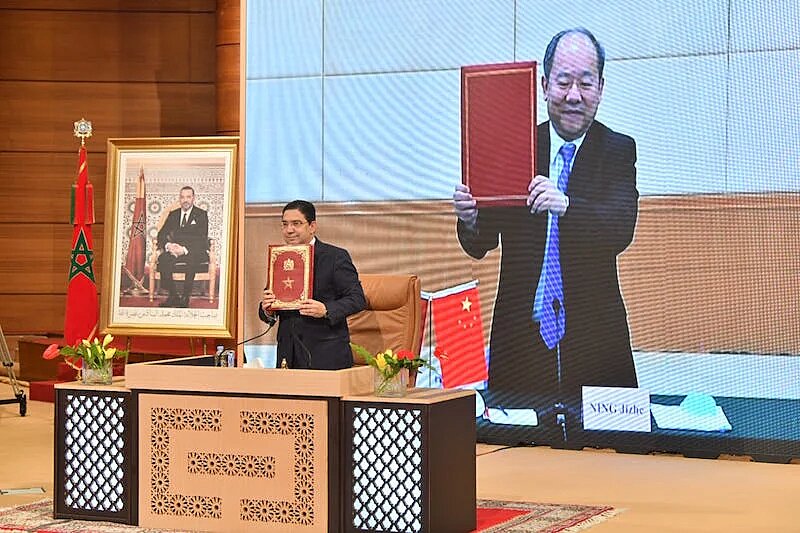
Morocco and the People’s Republic of China signed an agreement on the Joint Implementation Plan for the Belt and Road Initiative last Wednesday, cementing a six-year-long growing bilateral partnership that spans multiple sectors.
The Belt and Road Initiative, also known as the New Silk Road or the 21st Century Silk Road, is based on pumping huge investments to develop the infrastructure of global economic corridors, linking over 70 countries.
Launched by the Chinese President in 2013, the initiative aims to establish a land belt of railways and roads through Central Asia and Russia, and a sea route allowing China to reach Africa and Europe, at a total cost of a trillion US dollars.
Morocco is set to significantly benefit from this agreement, as one of the first countries in Africa to join the Belt and Road back in 2017, specifically in promising sectors such as infrastructure, advanced industries, and technology.
According to the Moroccan Ministry of Foreign Affairs, the Joint Implementation Plan for the Belt and Road Initiative agreement aims to encourage access to Chinese funds stipulated in the Belt and Road Initiative, with the aim of implementing projects in the Kingdom, facilitating trade exchanges, and establishing mixed companies in various fields, in addition to boosting cooperation in the field of energies, including renewables.
This agreement is also concerned with cooperation in research and development of technology, energy, agriculture, and technological and technical cooperation, as well as vocational training.
Under this agreement, the Chinese government pledges to encourage major Chinese companies to invest in Morocco, especially in the automotive, aviation, high-tech, e-commerce, agricultural and textile sectors.
During his speech at the signing ceremony, Moroccan Minister of Foreign Affairs Nasser Bourita said that the initiative “opens new horizons in the field of trade and investments, and brings additional opportunities that are compatible with the new development model of the Kingdom.”
The timid results of the close bilateral cooperation between both countries, dating back to 2017, started with the military area, like Morocco, which is developing several military bases on its territory, deployed a few weeks ago a Chinese air defense battery north of the capital, in Sidi Yahia, west of the country.
This is the first delivery of four ordered from China back in 2017. Morocco received the Chinese FD-2000B defense system this December, which the Royal Armed Forces (FAR) installed within the same week of delivery.
In terms of trade, the bilateral exchange volume reached 4.76 billion US dollars, an increase of 2% amid a raging COVID-19 pandemic and stagnant international trade. This joint convention will provide for a volume exceeding 6 billion USD in 2022.
Bourita says that the partnership between Morocco and China derives its strength from openness to Africa, noting that the signed agreement explicitly provides for tripartite cooperation for the benefit of the continent.
He highlighted that Morocco and China will launch and jointly implement three-year cooperation projects that aim to promote sustainable development in the African continent, with Bourita concluding that Morocco is a partner that shares similar ambitions with China, to make the Belt and Road Initiative a success for South-South cooperation.
The Chinese authorities had designated Morocco as a “pivotal country” in the framework of the Belt and Road initiative.
After lifting visa requirements for Chinese tourists, the Asian tourists have flocked to Morocco’s largest tourist cities and attractions, in addition to various Chinese small businesses opening in those same cities.
The number of Chinese visitors to Morocco has grown from 10,000 in 2015 to 200,000 Chinese nationals in 2018.
More than 80 joint projects with China or Chinese companies are currently active in Morocco, or under implementation throughout the Kingdom.
According to Ning Jie, vice-chairman of the Chinese National Reform and Development Committee, China’s direct investments in Morocco amounted to 380 million dollars, the majority of which are allocated to infrastructure, communications and marine fishing.





add your comment
Terms of publication : Not to offend the writer, people, sacred things, or attack religions or the divine self, and refrain from racist incitement and insults.