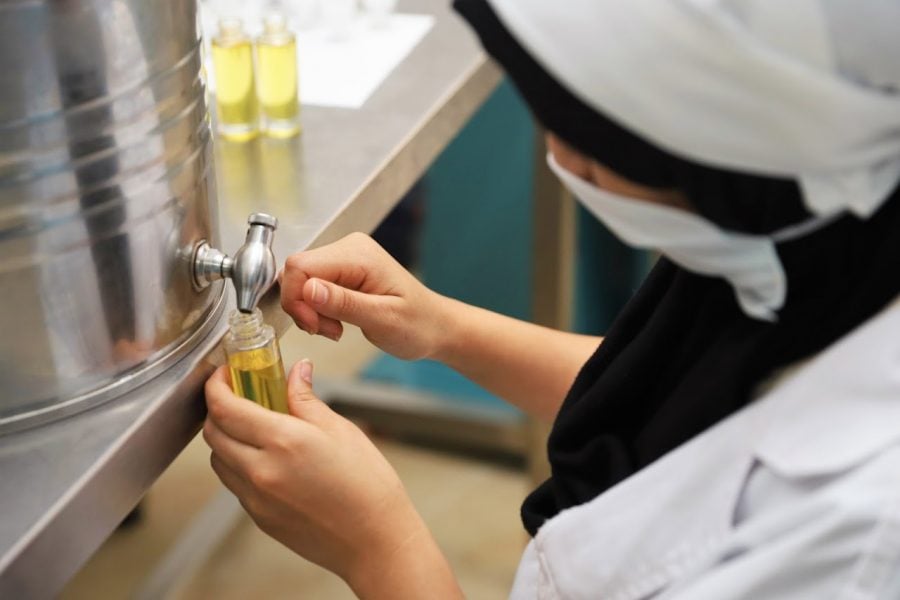
Argan cooperatives and sector workers are multiplying calls for government action, amid a serious pricing and scarcity crisis within the sector.
In addition to challenging weather conditions and droughts, workers are facing an unprecedented spike in the price of Argan derivatives’ primary raw material, the Argan seed.
The seed’s price per kilogram had previously ranged from MAD 3 to MAD 4, whereas today, it’s set at MAD 10 for a kilogram.
Cultivators say the meteoric rises in prices “is due to the invasion of foreign companies, who are competing to get their hands on the rare seed by offering astronomical prices,” Nazha Kouhil, president of the TADNST cooperative in Essaouira told Hespress EN.
The UNESCO classified cultural, intangible heritage of humanity is now “being exploited by a multitude of foreign companies” that mostly use it as a raw material for derived cosmetic products. Considering the scarcity of the trees and the low agricultural outcome from this year, they are competing by offering very high prices to farmers and Argan growers.
The new prices are “unaffordable, and do not match the buying power of most cooperatives,” Kouhil said, adding “many cooperatives have had to close their doors and stop production because they could no longer afford to buy the Argan seed or fruit.”
The buying power of cooperatives is also highly discouraged by increasingly low demand, says the president, who is convinced swift government action is crucial to preserve this “national natural treasure” and protect it from devaluation and international exploitation.
In recent months, many cooperatives have closed their doors, while women who transform Argan seeds into oil from their homes have also halted activity, all due to the prices.
Rachida Mrabet, a housewife from Agadir who used to work for an Argan cooperative, told Hespress EN that her “entire family’s livelihood is threatened.”
Rachida’s husband, an Argan seed supplier, is also facing great difficulties, telling Hespress EN that “even that now, I can benefit from the high prices, sourcing is very difficulty and scarcity are becoming more significant, I requested a loan to be able to buy a comfortable supply to re-sell, which I had not done in over 20 years.”
Mohamed Lachram, a member of the Federation of Argan Oil Producers in Essaouira defended the rise of prices to Hespress AR, saying that “this rise is in the interest of the farmer and the producer,” expressing his wish that “the price must remain at this rate.”
While most interviewees agreed that the higher the raw material price, the higher they can price their derivatives and finished product, Nazha and Rachida maintain that access to the market should be closely regulated and monitored by authorities.
“Our main concern is that these rises affect Moroccans first,” says Rachida, lamenting that “today, Moroccan workers are getting crushed while foreign investors are exploiting the scarce resource and reaping all the benefits.”
Morocco has a number of bodies and mechanisms framing the exploitation of Argan such as the National Agency for the Development of Oasis and Argan Zones (ANDZOA), whose role remains highly administrative, as it functions under the Ministry of Agriculture.







The use of argan in cosmetics must be le main raising of prices rise