“The boy died, “ shouted helpless father Jamal al-Durrah while cowering behind a concrete block on a street corner in Gaza, on 30 September 2000, amid heavy gunfire, with his 11-year-old son, Mohammed Dura, slumping dead across his lap.
Fifty-nine seconds, filmed by Talal Abu Rahma, a Palestinian cameraman freelancing for France 2, showed the father and his son, as they were caught in the crossfire between the Israeli military and Palestinian security forces, sheltering desperately behind the concrete block, Jamal waving to the military forces asking them to stop, Mohammed screaming in terror beside his father before falling dead on Jamal’s lap.
In front of the scene of his dead 11 year old son laying in a pool of blood, the bereaved father cried, amid the continuous gunfire’s heavy sounds, “the boy died, the boy died.”
Jamal’s helpless cries fuelled the second Intifada that started on 28 September when the, then opposition leader, Ariel Sharon, heavily guarded by Israeli soldiers and policemen, walked into al-Aqsa mosque in Jerusalem.
Sharon’s move provoked an angry reaction from the Muslim population, who hold the mosque to be the third holiest site in Islam.
Fighting broke out between the Palestinians defending al-Aqsa and security forces guarding Sharon, seven Palestinians were killed in the fighting and thus the second Intifada was started.
In two days, the Intifada spread across Palestine and into Israel. The Israeli army faced off against unarmed civilians.
On the fourth day, 20 Palestinians were killed by Israeli bullets, missiles, tanks, and helicopters.
The second intifada, compared to the first that erupted in 1987, was characterized by a large number of confrontations and an escalation of military actions between the Palestinian factions and the Israeli army.
Palestinian factions also carried out attacks inside Israeli cities, targeting restaurants and buses, killing hundreds of Israelis.
According to official Palestinian and Israeli figures, the second intifada killed 4,412 Palestinians, in addition to 48,322 wounded, while 1,100 Israelis were killed, including 300 soldiers, and about 4,500 others were wounded.
Among the most prominent events of the Al-Aqsa Intifada was the invasion of Jenin camp and the killing of the commander of the Israeli parachute unit, in addition to 58 soldiers, and the injury of 142 soldiers in the camp.
Members of the Popular Front for the Liberation of Palestine assassinated, during the Intifada, the Minister of Tourism in the Israeli government, Rehavam Ze’evi.
During the intifada, the areas of the West Bank and Gaza Strip were subjected to military incursions and the destruction of thousands of homes and homes, as well as thousands of acres of agricultural land were bulldozed.
On 7 March 2001, Sharon, on the right-wing Likud party, became prime minister of Israel. He held the Palestinian leader Yasir Arafat responsible for “terrorism”, and gave himself the green light to crack down on Palestinian “terrorist” groups.
Sharon assassinated the largest number of leaders of the first row in the Palestinian political parties and military movements, in an attempt to weaken the intifada, and to confuse the resistance factions, as Israel imprisoned leaders, Marwan Barghouti, a politician figure, and dozens of leaders of the Palestinian factions.
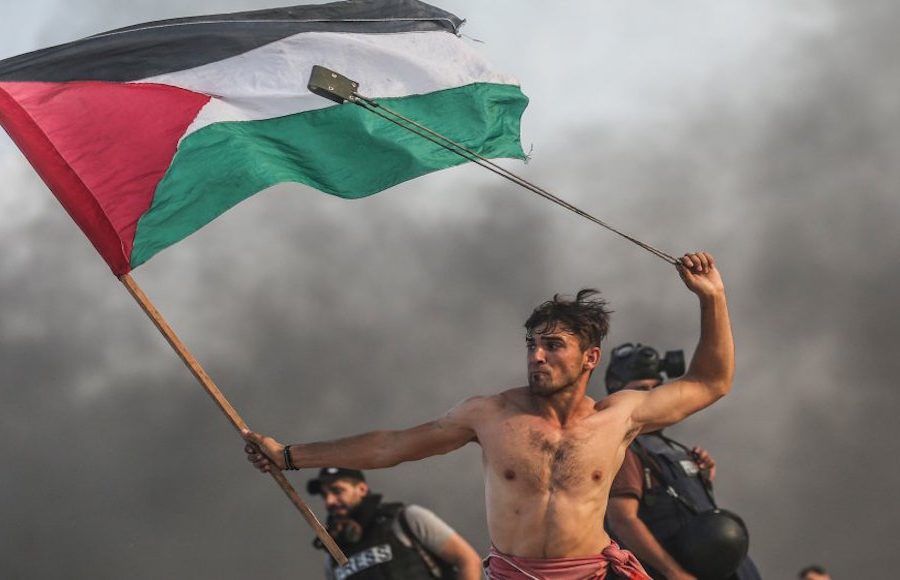
The second intifada witnessed a development in the tools of the Palestinian resistance, compared to the first intifada, whose most prominent tools were stones and Molotov cocktails.
The Palestinian factions have worked to develop their military wings, especially the Al-Qassam Brigades, the armed wing of the Islamic Resistance Movement (Hamas), which has greatly expanded its equipment and equipment, and now owns missiles that strike Israeli cities and towns.
The settlement of Sderot, in southern Israel, was on the cusp of receiving the first homemade Palestinian rocket launched by the Al-Qassam Brigades, a year after the start of the Second Intifada on October 26, 2001, after the brigades rapidly developed their capabilities to manufacture rockets.
In 2002, the occupation of Jerusalem began building the separation wall to prevent entry of Palestinians from the West Bank governorates within the Green Line and the occupied city of Jerusalem.
The Second Intifada, or so called Al-Aqsa Intifada, stopped on February 8, 2005, after Israelis and Palestinians reached armistice agreement at the Sharm el-Sheikh summit.
Twenty one years after the second Intifada, Palestinians are still fighting for the right of a Palestinian state with stones, handmade rockets and spoons while the scene of Mohammed sheltering behind his father is still engraved in the Palestinian collective memory as a symbol of horror and terror that Palestinians experience in the daily life.
add your comment
Terms of publication : Not to offend the writer, people, sacred things, or attack religions or the divine self, and refrain from racist incitement and insults.