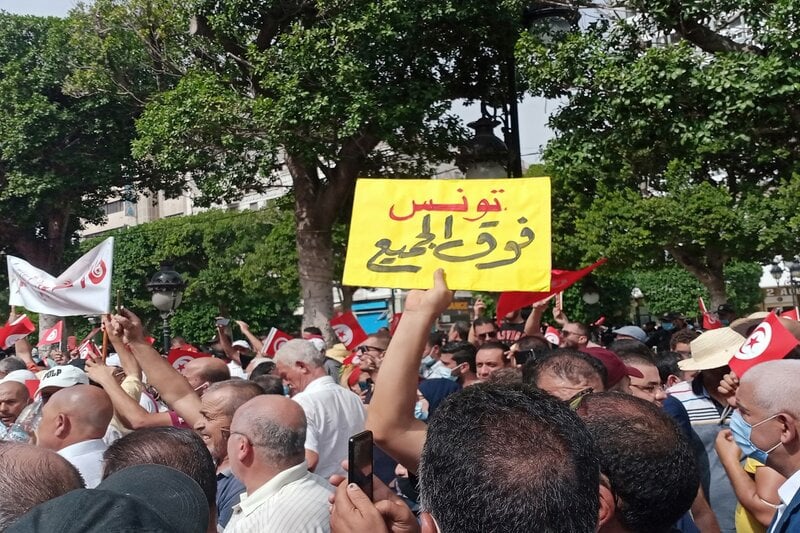
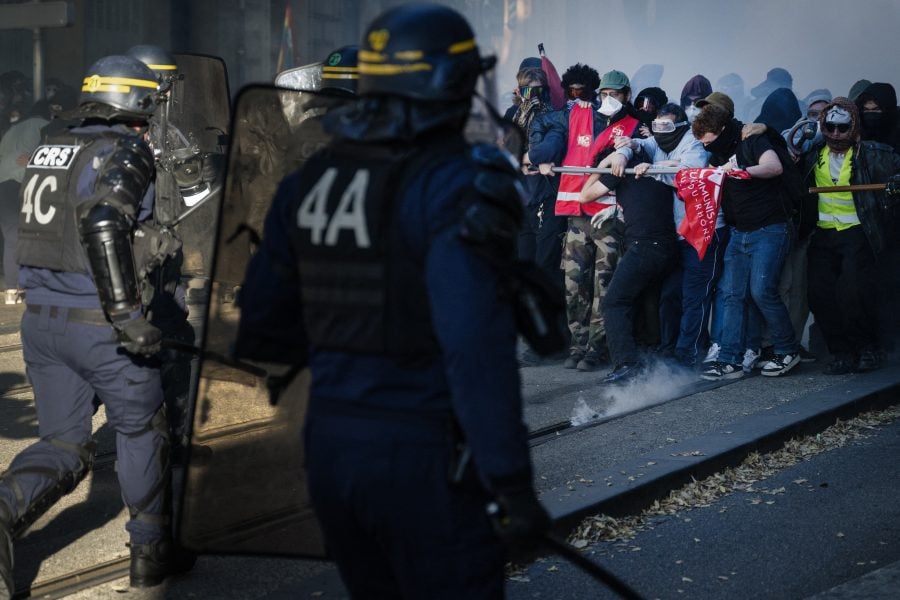
About 3,000 protestors gathered in Tunis on Sunday under heavy police presence to protest Tunisian President Kais Saied’s seizure of governing powers in July and called on him to step down.
Saied this week brushed aside much of the 2014 constitution, giving himself the power to rule by decree two months after he sacked the prime minister, suspended parliament and assumed executive authority.
“The people want the fall of the coup,” demonstrators chanted in the center of Tunis as their voices echoed along Habib Bourguiba Avenue, a focal point of the demonstrations that ended the rule of former President Zine El Abidine Ben Ali on January 14, 2011.
The protests against Saied started last week, when several hundred people held the first protest against his decisions.
Saied’s last decisions have endangered the democratic gains that Tunisians won in the 2011 revolution that triggered the Arab spring protests and has also slowed efforts to tackle an urgent threat to public finances.
Saied has said his actions, which his opponents have called a coup, are needed to address a crisis of political paralysis, economic stagnation and a poor response to the covid-19 pandemic as he promised to uphold rights and not become a dictator.
Saied still has wide support among Tunisians, who are tired of corruption and poor public services and believe in his promises.
The Tunisian president has not put any time limit on his seizure of power, but he promised that he would appoint a committee to help draft amendments to the 2014 constitution and establish “a true democracy in which the people are truly sovereign.”
Tunisia’s largest political party, the moderate Islamist Ennahda, has called Saied’s moves “a flagrant coup against democratic legitimacy” and called for people to unite and defend democracy in “a tireless, peaceful struggle.”
Ennahda has been the most powerful party in Tunisia since the 2011 revolution that led to the ousting of its long-time president, playing a role in backing successive coalition governments.
However, Saied’s seizure of power has left the party facing a severe split, as more than 100 prominent officials of Ennahda, including lawmakers and former ministers, resigned on Saturday in protest at the leadership’s performance.
Egypt, Saudi Arabia and the United Arab Emirates, which are suspicious of Islamists across the Middle East, have expressed support for Saied.
Tunisia’s influential labor union on Friday rejected key elements of Saied’s action and warned of a threat to democracy as opposition widened against a move his foes call a coup.
Five other political parties issued a joint statement condemning Saied’s seizure of power on Wednesday.





add your comment
Terms of publication : Not to offend the writer, people, sacred things, or attack religions or the divine self, and refrain from racist incitement and insults.