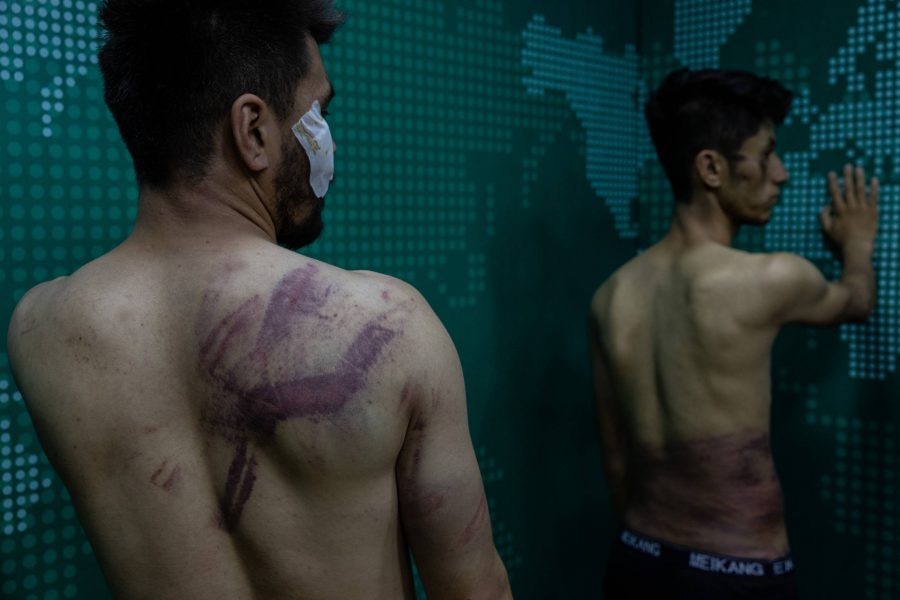
Taqi Daryabi and Nemat Naqdi, two Afghan journalists from Kabul-based media outlet Etilaat-e Roz, were covering protests in the capital against Taliban violations of women’s rights, when they were held by Taliban forces.
Etilaat-e Roz reported that their journalists were taken to a police station, where they were placed in separate cells, and hit severely with cables. Both men were released a day later and received medical care at a hospital for injuries to their back and faces.
The images of the two journalists, displaying the brutal bruises covering their bodies, are being shared widely on social media, raising global concerns over the Islamist group’s ability to deliver on the promise to protect human rights and press freedom.
“One of the Taliban put his foot on my head, crushed my face against the concrete. They kicked me in the head… I thought they were going to kill me,” Nemat Naqdi, a photographer with Etilaat-e-Roz, told AFP.
He was accosted by a Taliban fighter after they saw him clicking pictures during the protest against the violation of women’s rights in Afghanistan. Although he managed to pass the camera to someone in the crowd, three Taliban fighters caught him and took him to the station, and accused him of organizing the rally, according to his statement to AFP.
When he asked them the reason for being beaten, he was told: “You are lucky you weren’t beheaded.” Naqdi added in the same press statement.
Human Rights Watch (HRW) and Committee to Protect Journalists (CPJ) slammed the Taliban for its attack on journalists, criticizing the extremist movement for not living up to its promise of allowing Afghanistan’s independent media to continue operating freely and safely.
CPJ reported that the Taliban has detained and later released at least 14 journalists in the last two days, of whom at least six were subjected to violence during their arrest or detention.
The committee also reported that Taliban fighters detained Wahid Ahmadi, a TOLO news photojournalist, on Tuesday while he was filming the protest near the presidential palace in Kabul. They took his camera and handcuffed him, before taking him to military headquarters. He was released approximately three hours later, after the broadcaster communicated with the Taliban cultural commission, according to a CPJ report.



add your comment
Terms of publication : Not to offend the writer, people, sacred things, or attack religions or the divine self, and refrain from racist incitement and insults.