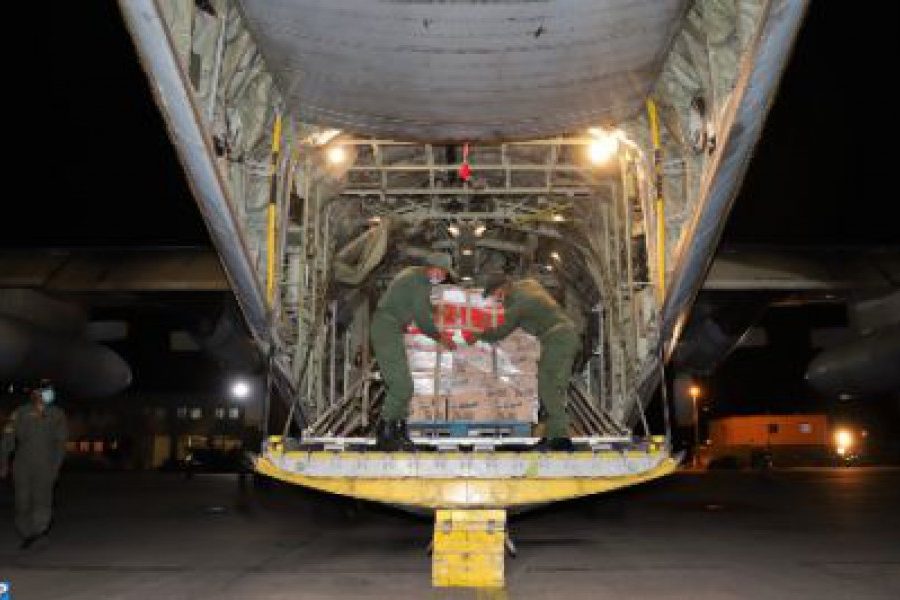
The initiative to deliver food aid to the Lebanese armed forces and people, carried out upon high instructions of HM King Mohammed VI, reflects Morocco’s effective and real solidarity with a brotherly Arab people, writes “Al-Ittihad Al-Ichtiraki” daily on Thursday.
In a story by Talaâ Saoud Al-Atlassi, the newspaper notes that this initiative is “a beam of hope in the climate of despair experienced by the people of Lebanon, due to the lack of Arab solidarity with this country.
This Royal decision comes in response to a request made by the Lebanese side and as part of solidarity with this brotherly country, so as to enable it to face the economic challenges and the repercussions of the Covid-19 pandemic, he says.
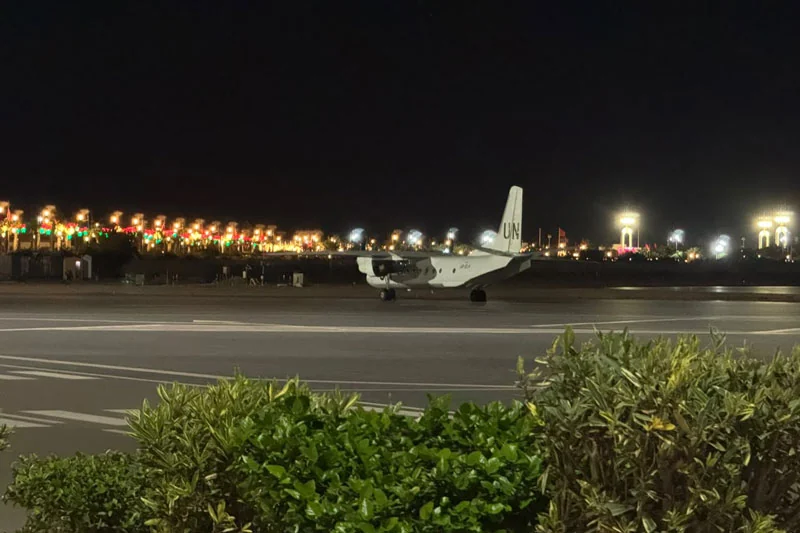
As of Saturday morning, Moroccan military planes started to arrive at Beirut Airport to deliver these aids, estimated at 90 tons of foodstuffs of first necessity.
HM King Mohammed VI was the first to respond to the request of the Lebanese army “given its propensity for solidarity from an intellectual, political and logistical point of view,” Saoud Al-Atlassi notes, recalling the launch by the Sovereign of the usual Ramadan operation of food support for 3 million Moroccans in a situation of social vulnerability, an initiative organized for many years.
Morocco deserves to be seen by the Arab political and intellectual elite outside the prism of slogans, Middle Eastern centrality and all the notions that are part of the Arab reality. It should be looked at as an Arab country whose leader is working to mitigate the crises and make progress, the author says.
“It is a ray of hope in an Arab reality in crisis. An experience that deserves to be examined and followed. If not for these Arab issues, Morocco would have contributed effectively in this desired Arab solidarity, a solidarity that is effective, efficient and realistic,” Al-Atlassi underscores.
The initiative of HM the King comes after the deployment of a Moroccan field hospital in Lebanon, upon Royal instructions, in the wake of the tragic explosion that rattled the port of Beirut, according to “Al-Ittihad Al-Ichtiraki.”
The new royal initiative is intended in particular for the Lebanese army, which enjoys credibility with the Lebanese and works to preserve the unity and sovereignty of Lebanon against the effects of sectarian differences and external interests, says Saoud Al-Atlassi.
“Through this initiative, Morocco does not harbor any designs on Lebanon, nor does it support any political current against the others or any confession against the other ones. Let’s hope that other Arab countries would follow the example, especially those with hydrocarbon resources that can support the Lebanese people,” reads the article.
HM King Mohammed VI has established solidarity as one of the levers of His management of the country and has built His societal project of reform and modernization on the value of solidarity, writes Saoud Al-Atlassi.
This solidarity is deployed through social, material, practical and permanent mechanisms rather than on the basis of an occasional, partial, or temporary act of charity, the publication notes.
On the eve of the solidarity initiative with the Lebanese army, HM King Mohammed VI had launched what observers have described as a social revolution that stems from this same perception of solidarity marking royal policies.
Allowing 22 million Moroccans to benefit from mandatory social protection has become a reality that will be implemented through practical actions over the next four years.
“This seemed unattainable until HM the King announced this project two years ago. Within two months, the Council of Ministers adopted the organic laws of the project which was approved by the parliament. The official launch ceremony, under the chairmanship of the Sovereign, consecrated this project.
Work is underway to enable 22 million Moroccans, including workers, farmers, self-employed and workers in the non-formal sector, to benefit from the compulsory social protection, which musters medical coverage, family allowances and retirement.
“It is a social revolution that builds on solidarity and enshrines it as one of the pillars of public management in Morocco with a view to promoting the citizens’ social rights, allowing them to enjoy the resources of their country and, therefore, encouraging them to serve their country,” the author continues.
On the situation in Lebanon, Saoud Al-Atlassi refers to the tribute paid to one of the “pillars of the Lebanese and Arab press,” namely Talal Salman, founder and director of the “As-Safir” newspaper, in the presence of a group of prominent thinkers and writers in Lebanon. In their discussions, the latter unleashed storms of sorrow, even despair for some, on the Arab situation in general.
On this matter, Salman spoke about “the revelation of the impotence of the regime in his country where wealth is shared among the powerful” and the expansion of the political, economic and social crisis in Lebanon (the explosion of the port of Beirut, the collapse of the national currency and the decline in employment opportunities). These events have shaken the confidence and tranquility of the Lebanese, according to the publication.
Saoud Al-Atlassi also dwells on the dwindling confidence of the Gulf countries in Lebanon, “which were the economic and political levers of the country before and after the civil war.
Some speakers added that Lebanon was “no longer attractive at the political, tourist, banking level, neither for the Arabs nor for others.” The crisis and its tragedy have been exacerbated by the effects of the epidemic that invades Lebanon and the world and by the governmental paralysis with no cure in sight.
A day after this sad meeting, “a voice would be heard in Lebanon from Morocco saying: you have someone who cares about Lebanon out of solidarity, fraternity and nationalism.”
This is the gist of the statement by the Royal Office announcing that King Mohammed VI had ordered a personal royal donation in the form of basic food aid for the benefit of the Lebanese armed forces and the brotherly Lebanese people.
Saoud Al-Atlassi also recalls his meeting, in 1986, with George Hawi, Secretary-General of the Lebanese Communist Party, on the sidelines of “one of the nationalist and revolutionary conferences that Colonel Muammar Gaddafi used to hold in Tripoli.”
“During the conversation, the martyr Hawi turned to me and said: my compatriot Al-Atlassi please safeguard the specificities of the situation in Morocco. One of these characteristics is the Monarchy. Preserve it. Preserve the monarchy that protects Morocco from many dangers and misfortunes that we face today,” the author says.
“Moroccans have attached themselves to the Monarchy, which preserves – with them and through them– the Motherland and works for its development. The King leads Morocco, with historical foresight to overcome problems as well as the political, social, economic and cultural obstacles, with the thought, the spirit, the policy and the mechanisms of social solidarity,” Saoud Al-Atlassi concludes.



add your comment
Terms of publication : Not to offend the writer, people, sacred things, or attack religions or the divine self, and refrain from racist incitement and insults.