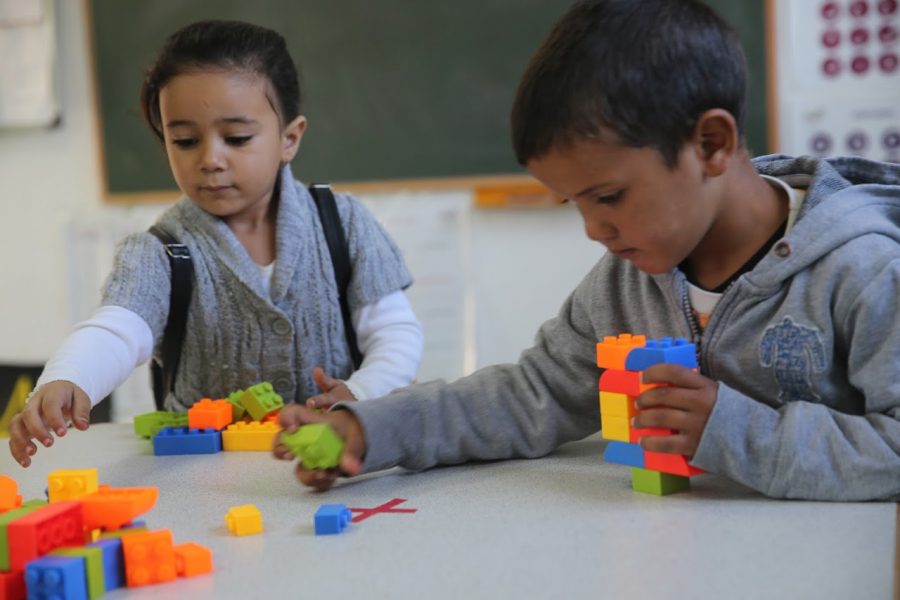
“Kids do not need money, they need a family.” That’s how Amina, an American Pakistani mother of a Moroccan child and the cofounder of BLOOM Charity, through her statement tries to encourage adoption in Arab countries since it is not that common.
“Many people in Muslim communities are generous with zakat, but we must also be generous with our love. Building a family through adoption is a very different experience in which you gain even more than you give.” Amina says growing her family through adoption has been her biggest blessing.
“I always wanted to make a difference in the world, and I knew that by growing a family through adoption, I could make a difference for at least one person. My maternal instincts were always there, even leading to the nickname ‘MamAmina’, growing a family through adoption always felt like my higher purpose.”
She said she was nervous when she first met her son and asked Allah for a clear sign that she was on the right path.
“That morning when I went to the orphanage I met Khadija, a wonderful lady who was helping us throughout the whole process. She told me she had a dream where my son was wearing a Moroccan robe of dark green silk, with embroidery all over it, and that in the dream they marveled at how he was just a perfect child.”
“That moment I knew that was my sign; that was the dream that I was asking Allah to give me and she was the one who had it. Khadija was like an angel sent by Allah to deliver that message. I hugged her and started crying and I thanked her so much. At that moment I knew that I was on the right path.”
“Most adoptions that are done internationally in Morocco through kafala are not that easy.” Amina says that in the process of her adoption. “They kept adding requirements. Some judges are still hesitant to allow international adoption, so there is a big interest but it is a slow and careful process.”
Most Moroccans fear that once those kids leave Morocco they are lost forever and their identity or their heritage is forgotten.
Amina says the total opposite “the best thing I ever got is from Morocco. I am a mother of a Moroccan; it is a piece of me now. It is a huge gift that I got from my son.”
“In BLOOM we have these small gatherings with families that have adopted from Morocco to revive those roots and keep the connections alive. Every five years I’m planning to take my son to Morocco to visit the country where he came from.”
Amina was the first one who adopted in her family but not the only one. Her sister, Noma, adopted from Morocco as well. She had begun to consider adoption while she was expecting her third child. A devastating earthquake left thousands of children orphaned in Northern Pakistan so she wanted to go there and give an abandoned child a family. But adoptions were closed in Pakistan and she put the idea out of her mind.
When her sister was going to Morocco to adopt her son, Noma knew she wanted to be there to support her younger sister. Little did she realize that she would also meet the little boy that was meant to be her own.
“The images of the children in the orphanage haunted me. I couldn’t stop thinking about them and the isolation and deprivation I witnessed in their eyes. One of those children was meant to be my son.”
“My son was 4 years old when I adopted him. At the time, adopting children older than age 2 from Morocco was rare. Most parents adopted newborn babies.”
“I read many articles and spoke to several people who tried to deter us from our decision, due to either cultural reasons or fear of the unknown when it comes to adopting older children. My husband and I knew that our son was meant to be ours and so we proceeded with our adoption anyways.”
“Our son is thriving now. He knows he has a family who loves him but he is also proud of his origins and the country he came from, Morocco. We are planning a trip soon to take him see the culture we are trying so hard to maintain here in the US through for example: our way of dressing in religious celebrations like Eid. And one little thing about him, he loves his cup of mint tea after dinner.”
Due to their adoption experiences, the sisters were inspired to launch BLOOM Charity, a nonprofit that improves the lives of orphaned children loving in Morocco holistically through building PlayGardens and providing enrichment programs in the orphanages. This work provides the children living in orphanages with the chance to laugh, learn, hope, and heal.
In order to make Moroccans accept international adoption through kafala, another American mother of several adopted Moroccan kids in telling her story says “Some people assume all foreigners are coming with bad intentions and a lot of money. Everyone I know who has adopted from Morocco, and I know there are exceptions, did so to give a child a home and to make a family.” “My children live as Moroccans in America. Their status as adopted children is completely irrelevant”.
In her description of the process of her adoption: “It is a very complicated process both from the Moroccan side and from the side where you are coming from. It is not easy… Some courts allow single mothers to adopt and some don’t. Some allow converts to adopt and some don’t. Some require parents to speak Arabic and some don’t… It’s a big problem that in the absence of national law, the regional courts and individual judges decide who can adopt, that makes it a very arbitrary and subjective process…”.
“International adoption is beneficial for the Moroccan children. There are more children who need forever families than Moroccans who have been able to adopt them”.
Fatima Elwafy, president of Osraty-Parents Kafil association, states that judges are only doing their jobs. “Those children are their children, of course they are going to take everything into consideration before giving that child away…”, “we can’t think of that as an exaggeration but rather as a way to assure that those children are granted a very suitable home”. She continues “we understand that no matter how high quality the orphanage is, it can never be compared to the warmth of the family”.
However, Fatima agrees on the fact that once kids cross borders, they are guaranteed much rights and access to healthcare. “I remember vividly a baby boy, who was in a matter of life or death condition, was adopted by a Moroccan living in France. The moment she stepped foot in France, doctors run their tests to see what is critical and what can be done to make him be as healthy as a normal baby.” “Now that I see his pictures, I look back at the tiny baby that I was so worried about…”
Fatima continues commenting on the Kafala law in Morocco as to her it is very important to talk about whenever mentioning international or national adoption. “When kafala law came to light in Morocco, it surely helped a lot but it came in a period that is much different from now, so the ones in charge need to take that into consideration.”
“For instance kafala contract should not be dropped after the makfoul is getting 18 years old. Instead, it should be extended for life. Also One third of the inheritance must be included in the law of kafala after the adoption of the child makfoul. The activation of this one third then should be after the death of one of the kafil parents or after the makfoul reaches 18 years old. And the heritage should be converted to money to assist the child after the death of his makfoul parents” Nacer Nafea, 21 years old makful states.
He continues, “I was 19 when my mother died. Kafala stops after 18 as I said, so I had no place to go because of some family problems. Let’s face it; Moroccan families rarely accept adopted kids as their own”. He continues, “If it wasn’t for my mama Fatima, her association (Association des Parents Kafils) and some friends of hers, my fate would have been the streets after the death of my Kafil mother Mina, even if I had my heritage.”
“We must not forget the situation of these kids in orphanages prior adoption”, Fatima adds. “Most orphanages are trying their best, but alone they can’t achieve anything”. Amina and her sister Noma share the same idea “kids in orphanages are taken care of in the bare minimum”, says Noma “there was an orphanage in Mekness where the kids haven’t seen the outside world for 6 months and that’s actually what drove us to build a playground in the terrace of that orphanage to give those kids the chance to play and be kids”.
While Nacer was recalling some of the memories in the orphanage, he came across this passage that he says “must’ve traumatized some of the kids there for life”. “I remember we were showering and a cat stormed into the shower. We all were naked and suddenly we see the genitor coming in running with a broom. As soon his eyes laid on the cat, he kept on hitting it over and over again while all the blood is shattering in front of us the kids until it was no longer capable of moving.”





add your comment
Terms of publication : Not to offend the writer, people, sacred things, or attack religions or the divine self, and refrain from racist incitement and insults.