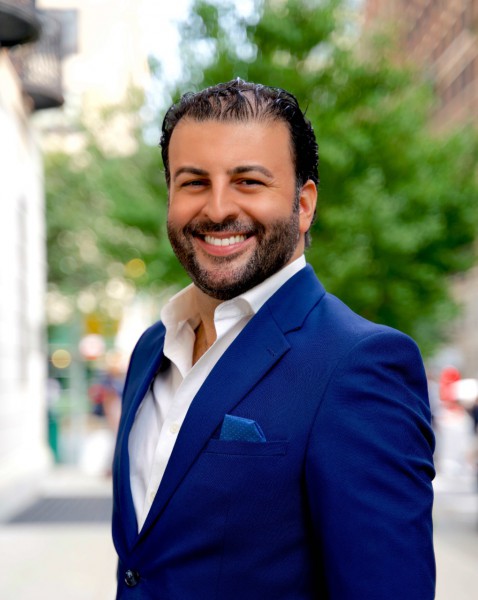
French Moroccan artist and opera singer David Serero has won numerous awards for his artistic endeavors. In 2021 alone, Serero has won four Broadway World Awards for Best Performer of the decade, Best Producer of a Musical of the decade, Best Producer of a Play of the decade, and Best Opera Singer of the year.
In February 2021 during the pandemic’s total shutdown of the arts scene in New York, Mayor of New York Bill de Blasio honored Serero with a Certificate of Recognition for his contributions as an opera singer, actor, director, and producer to the “City’s dynamic cultural landscape.” The mayor said that Serero had “enriched our vibrant performing arts sector and uplifted and inspired diverse New Yorkers.”
Serero sat down with MAP in New York City for this interview.
Q: You live in New York City. During the whole pandemic the city was shut down. Broadway was dark. Live music was not allowed. Theatre productions prohibited. As a prolific artist and producer of shows, how did you manage in the City that supposedly never sleeps but really was almost dead?
A: I had just turned 40 in April, 2020, and with or without the pandemic I had wanted a break, to take one year off. I had so many things that I wanted to finish: albums, shows, theatre productions. I had all these hard drives full of music and shows that I had done over the last 5 or 6 years. They were full of files that needed to be edited. So for me the pandemic was the break that allowed me to come at them with fresh eyes.
Q: New York is famous for its Broadway Theatre. Before the pandemic, you were involved in many Broadway productions. Writing, producing, starring in them, and directing them.
A: Yes, I always had multiple things going on that provided a revenue stream. Only the shows stopped. I had my other royalties and other sources [of income]. There were at least 12 plays, about three books, and maybe four or five albums, and a dozen movies [that I needed to work on]. Plus, I reorganized my You-tube channel and website. I updated my bio. In the future, I will try and reserve time to catch up.
Q: With Broadway being dark for more than ten months, how did it feel to receive Mayor de Blasio’s award recognizing your efforts to keep Broadway alive?
A: Oh that was really good. I had thousands of people voting for me. The news went big and Mayor de Blasio gave me recognition with beautiful words. “You have lifted the cultural landscape of NYC, I applaud you.” I am really, really grateful to him.
Q: I want to ask you also about something we had an exchange about just in passing on Facebook: Moroccan opera, performed in darija.
A: Yes, I’m also creating the first Opera Company of Morocco. This will be for Moroccan singers, not necessarily those born in Morocco, but those of Moroccan origin. The idea is to write new opera in darija. And we would find a Moroccan theme, with traditional stories. What I want to do first, though, is to do Carmen in darija. The other idea is to do the Otello that I did in NY adapted to the Moroccan style. I would keep the phrases in French and have Moroccan classical songs like Sidi Habibi. That will make it easier to find singers in Morocco who can sing this repertoire. For Carmen, we can do the dialogs in French and the singing in darija. And we would do it with the piano.
What I always learned is think big, start small. All the shows I’ve done were done with the best quality, but with stuff I could control, and with costs I could control. This is something special.
Q: Carmen and the traditional classical operas have huge choruses and huge forces typically and multiple soloists. Given the potential difficulty in finding Moroccan singers, have you thought about doing Baroque opera that takes fewer forces?
A: I’m not afraid of taking the big Verdi (operas) and bringing them to my style. It’s what I’ve been doing here in NY. I took Don Giovanni and made it my own. The recitative — I did it as dialogs. I made it Jewish, and I made it funny. I added stand-up comedy and jokes. I had the audience participating in it.
For Morocco, originally, I wanted to do Don Giovanni. I think Carmen would be great. But what I would love to do would be Nabucco in Arabic.
I can’t wait to go to Morocco to mix the Western culture of opera and the beautiful maghrebi culture. At the end of Morocco there is an “o.” So it’s already the first step of opera.
One idea I had is to do Fiddler on the Roof in Arabic.
Q: Are you considering giving promising young Moroccan singers an opportunity to perform with some of the established operas as part of their training?
A: First, I have to do an inventory of singers that are in Morocco who need to be trained and singers of Moroccan origin who are already trained but not in Morocco.
In the meantime, I have so many productions to finish. By the end of June, I will finish almost everything. I have a big musical, The Ten Commandments, which was in French and a big success, and I am adapting it into English. I hope by the end of the week, I will finish the musical Ann Frank.
Q: What would you tell young artists who have not been able to perform for more than a year before a live audience?
A: I hope they have used that time to perfect their art. When you’re an artist at the beginning you have to perform, and perform, and perform. But then afterward, you have to think more and to perform only when necessary. Of course, you must practice. I hope they used that time to practice more at home. To make their high notes stronger. To revise their techniques, to learn new roles. So that if one day they are cast in a new role, they will have already done the groundwork – to improve their languages, have time to listen to other music and to watch many opera productions. To read about it, and to watch documentaries. And if they are an actor, to read some monologues out loud.
Q: You are extremely adept at marketing. What advice do you have for young people on how to market themselves and become known?
A: First you have to envision where you want to go. What is the farthest role you want to reach and build your way to it. Again, think big, but start small.
The artist is not an entrepreneur. I am lucky I have my business acumen. You cannot take offence that someone didn’t like your show. I work with people for the long term. You never know where life takes you.
The best marketing you can do is on yourself. You can go back to and honor your past. Call the people who hired you before. Don’t go to sing for the big people too soon.




add your comment
Terms of publication : Not to offend the writer, people, sacred things, or attack religions or the divine self, and refrain from racist incitement and insults.