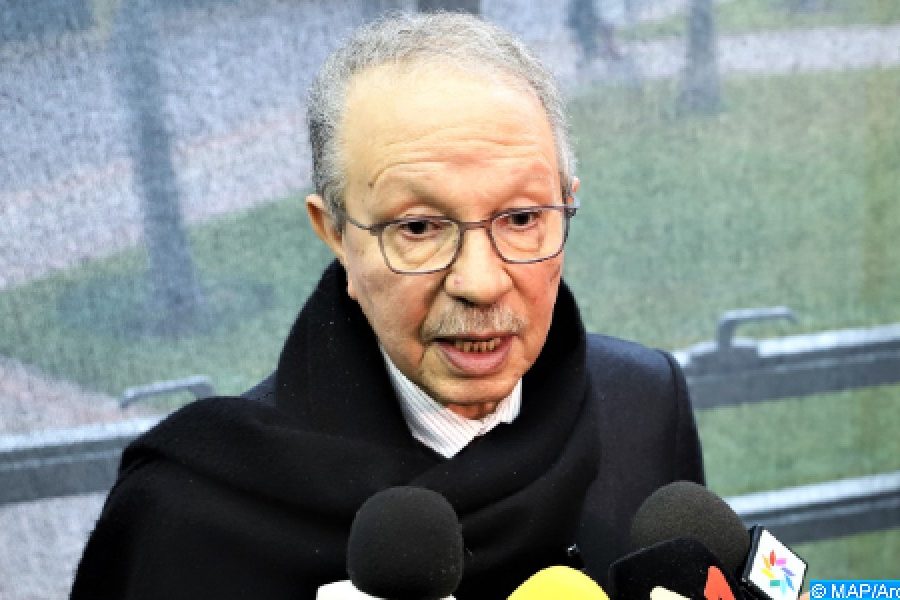
The High Commissioner for Planning, Ahmed Lahlimi Alami, on Wednesday underlined the need to set up an institutional regionalization of the capacities for the production of information and data analysis.
Speaking at a meeting in Rabat with the representatives of 6 United Nations agencies on the means of support for the 3rd survey on the impact of Covid-19 on households, Lahlimi said that Morocco is in a phase of change which requires the establishment of a strong institution to be able to follow the evolution of data in order to feed regional and national institutions.
The Kingdom, he went on, can face this economic, social and cultural but also geographical disparity only through the development of institutions which are essential in each region with information and analysis production programs, stressing the need to provide these institutions with sufficient human and material resources.
It is a question of setting up a system integrating all the regional public and private stakeholders, while providing each region with databases to be continuously fed, said Lahlimi Alami, specifying that the High Planning Commission seeks to draw up statistics based mainly on the regional dimension, which makes it possible to provide more information on the situation of households.
Referring to the issue of immigration, Lahlimi Alami noted that the HCP pays particular attention to predictable post-Covid mutations, adding that disparities between the North and the South of the world are expected to increase further.
He also shed light on the case of children who have suffered from the psychological impact of Covid-19, calling, in this regard, the United Nations Children’s Fund (UNICEF) to think of the means to mitigate these effects, in particular through the analysis by psychiatrists and psychologists of the behavior of the post-Covid child.
For her part, Maryam Bigdeli, representative of the World Health Organization (WHO) in Morocco, reviewed the health challenges to be met by households in order to emerge from this crisis, noting that the commitment of the WHO revolves around aspects that could be developed, particularly in terms of access to health care, disease risk factors and health expenditure.
In her turn, the representative of UN Women in Morocco, Leila Rhiwi, welcomed the efforts made by the HCP to have a clear vision on the situation of households in the Kingdom.
She also praised the fruitful partnership between the HCP and the UN agencies, which made it possible to truly refine the analysis and knowledge on several specific issues and strategies aimed at guiding public policies.
This meeting focused on the technical means of collaboration with the HCP for the preparation of a future major survey of the impact of Covid-19.
The HCP therefore plans to conduct this major national investigation based on analyzes of the 12 regions of the Kingdom, while individualizing the investigative approach.







add your comment
Terms of publication : Not to offend the writer, people, sacred things, or attack religions or the divine self, and refrain from racist incitement and insults.