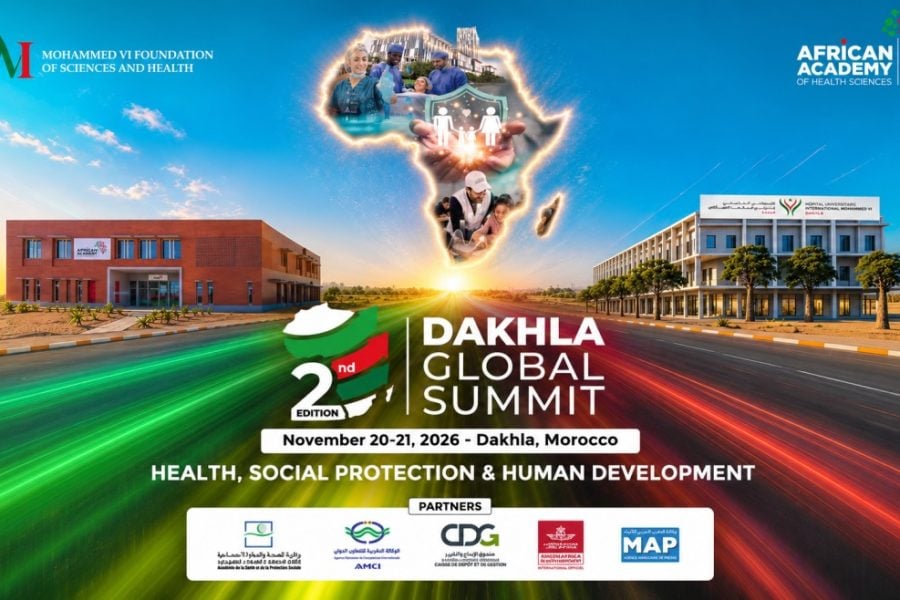
The second edition of the Dakhla Global Summit kicked off on Friday with the participation of political leaders, institutional decision-makers, and scientific experts, focusing on the major challenges of health, health sovereignty, and human development in Africa.
Organized by the Mohammed VI Foundation for Science and Health (FM6SS), in collaboration with the African Academy of Health Sciences (AAHS), this summit takes place at a time when health has emerged as a major issue for sovereignty, stability, and economic development.
The summit’s program includes presentations by leading African figures, a ministerial roundtable on the theme “Public Policies and Health Outcomes,” and six scientific sessions on the continent’s main health challenges.
It will focus on three main areas: access to health services, social protection, and human development, particularly in the fields of training, research, and innovation.
To this end, six priority objectives will guide the summit’s work. These include strengthening health sovereignty and resilience, advancing regional equity in access to health care, accelerating the development of social protection, and promoting sustainable financing models to support the transformation of health systems and ensure their viability.
Investing in human capital and scientific innovation, and establishing a more operational framework for African health cooperation through institutional partnerships, joint projects, and mechanisms for monitoring commitments are also among the objectives of this meeting.
Following a first edition marked by the adoption of the Dakhla Declaration and a 2026-2030 roadmap, the summit aims to take a new step forward by fostering concrete cooperation among African institutions, particularly in the areas of training, research, and health capacity-building.
The choice of Dakhla, home to the African Academy of Health Sciences, also reflects a broader ambition: to reinforce the city’s role as a hub for African dialogue and cooperation, in line with the vision of His Majesty King Mohammed VI, may God assist him, for active and solidarity-based South-South cooperation.
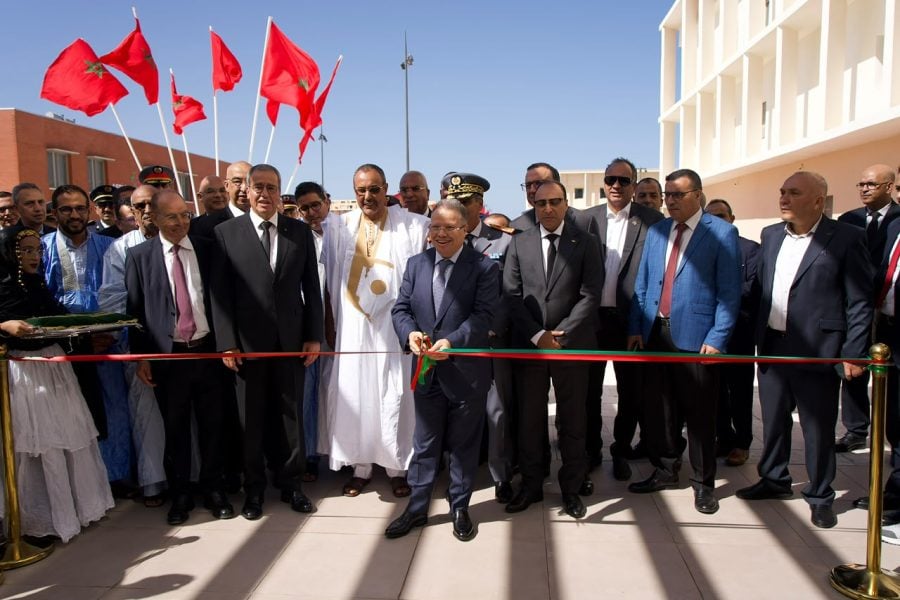
The opening ceremony was attended notably by Minister of Health and Social Protection, Youns Bjijou; Minister of Higher Education, Scientific Research, and Innovation Azzeddine El Midaoui; and wali of the Dakhla-Oued Eddahab region and governor of the province of Oued Eddahab Ali Khalil. Former African heads of state, ministers, elected officials, institutional leaders, members of the African Academy of Health Sciences, as well as African and international faculty members, researchers, and experts also took part in the ceremony.
During the opening ceremony, attendees watched a video presentation on the Mohammed VI International University Hospital Complex in Dakhla, inaugurated on Wednesday to celebrate the 71st Independence Day.



add your comment
Terms of publication : Not to offend the writer, people, sacred things, or attack religions or the divine self, and refrain from racist incitement and insults.