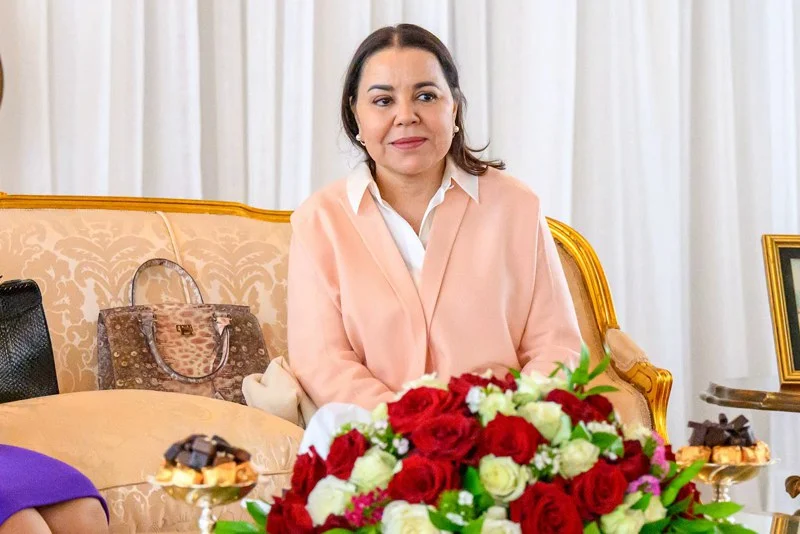
Her Royal Highness Princess Lalla Asmaa, President of the Lalla Asmaa Foundation, inaugurated the Lalla Asmaa University, the first Inclusive University worldwide, on Thursday in Rabat.
The inauguration of this University reflects the strong and steadfast commitment of His Majesty King Mohammed VI, may God assist Him, to advancing scientific excellence, promoting innovation in the field of health, and improving living conditions and social and professional integration for the deaf and hard of hearing.
This University, with leading partners such as the Pasteur Institute, Chicago, Louvain, and Montpellier, offers a free curriculum in hearing sciences, thanks to 4 schools and 16 degrees, from certificates to master’s degrees, open to all youth, whether hearing or not: together, on the same benches, they will become the caregivers, interpreters, engineers, and entrepreneurs of tomorrow, according to a statement from the Lalla Asmaa Foundation, adding that the entire society learns accessibility there, as the year 2030 draws close.
Her Royal Highness Princess Lalla Asmaa, President of the Lalla Asmaa Foundation, has thus opened the doors to an unmatched campus, both in the region and in Europe: hearing care, sign languages, technologies, and trades are brought together for the first time, for deaf, hard of hearing, and hearing students, with the hearing sciences curriculum free of charge, the statement specifies, noting that more than 11 centuries after Al Quaraouiyine, founded in Fez in 859, the Kingdom is once again inventing a form of higher education.
Under the impetus of His Majesty King Mohammed VI, may God assist Him, who has placed human capital and inclusion at the heart of the Kingdom’s project, and thanks to the steadfast involvement of Her Royal Highness Princess Lalla Asmaa, Morocco is acquiring an institution still unknown to the world, the same source adds.
Upon her arrival, Her Royal Highness was received by Prof. Nawal Bouyahyaoui, President of the Lalla Asmaa University, before unveiling the commemorative plaque.
Top-tier partners, from Paris to Chicago
Before Her Royal Highness, Karim Essakalli, Deputy President of the Foundation, signed 5 agreements to anchor the university in the global elite of hearing. These agreements were inked, according to the statement, with:
-IHU reConnect, Paris. The first European hub dedicated to hearing and speech, bringing together the Pasteur Institute and 3 AP-HP hospitals: Necker-Enfants Malades, Pitié-Salpêtrière, and Lariboisière. Signed by its director, Prof. Anne-Lise Mamessier Giraud, the agreement opens cutting-edge research to the university, from the genetics of deafness to gene therapy, as well as pediatric audiology from Necker and adult audiology from Pitié-Salpêtrière. -Montpellier. The University of Montpellier, heir to the oldest active medical school in the Western world, its Audiocampus, and Cochlear Academy, represented by François Pierrot, Vice-President of International Relations, Prof. Jean-Luc Puel, and Karim Abdennour, Director for the Africa zone. The convention transmits the training model to Morocco for fitting and implant professions, opens pathways to research, and supports diplomas in auditory implants.
-Louvain and Brussels. The Catholic University of Louvain, the Haute École Léonard de Vinci, and the Cliniques universitaires Saint-Luc, the first cochlear implantation center in French-speaking Belgium, represented by Prof. Naïma Deggouj. The letter of intent commits to cooperation in the French language on the implant clinic and training audiologists.
-Mohammed V University of Rabat. Initialed by its President Mohamed Rhachi, the convention brings the Lalla Asmaa University closer to the Kingdom’s first modern university, for training and research.
-SNRT. The public audiovisual pole, which equipped the Motion Lab studio, commits through the voice of its Chairman and CEO, Fayçal Laraïchi, to train sign language interpreters for broadcast alongside the university, to create accessible programs, and to open up image-related professions to young deaf people.
The statement notes that a 6th convention was concluded a few weeks ago in Rabat with an American academic institution (Chicago), which brings American expertise in Applied Behavior Analysis (ABA), a discipline born in the United States and virtually absent in Morocco. It supports the university’s master’s degree and ABA laboratory: training of certified analysts, supervision, and exchanges of teachers and students.
“For years, the Foundation provided care. Today, it trains those who will provide care side by side, regardless of whether they can hear. Such is Her Royal Highness’s vision: that inclusion becomes the norm,” explains Karim Essakalli, Deputy President of the Foundation, quoted in the statement.
4 Schools, from professional certificates to master’s degrees
Lalla Asmaa University has 4 schools offering 16 degrees, 3,500 spots, and a boarding facility opening in 2027 to students from all regions and abroad. These include:
-School of Hearing Sciences, Communication, and Clinical Neurosciences. A free curriculum: audiology, speech therapy, auditory-verbal therapy and parental guidance, clinical psychology to support children, adults, and families, applied behavior analysis, and a diploma in auditory implants reserved for ENT surgeons.
-School of Sign Languages, Interpreting, and Accessibility. Sign language interpreters, specialized teachers, inclusive media professionals.
-Inclusive School of Technologies, Innovation, and Digital Creation. Computer science and artificial intelligence, graphic design, and digital art.
-Inclusive School of Trades and Vocational Training. Computer graphics, pastry and chocolate making, culinary arts and service, Microsoft certification.
7 laboratories to research, care, innovate, and undertake:
The new University houses seven laboratories:
1-Innovation Lab. The research laboratory: artificial intelligence and humanoid robots whose hands learn to sign in sign languages from around the world.
2-Motion Lab. A motion capture studio, equipped by SNRT, which records Moroccan sign language to create signing avatars, educational capsules, and a visual reference dictionary.
3-Inclusion Lab. The incubator, born from a Moroccan-Belgian cooperation: guidance, interpersonal skills, entrepreneurship, right up to business creation.
4-Digital Lab. The digital workshop where students design websites, applications, and software, and learn to bring them to life.
5-ENT Dissection Laboratory. To practice, to the millimeter, implantation gestures before operating on a patient.
6-Audiology Laboratory. To practice hearing examinations and the adjustment of hearing aids in real conditions.
7-Applied Behavior Analysis Laboratory. To learn how to support, session after session, children presenting other developmental needs.
Thanks to Lalla Asmaa University, a high school graduate, hearing or deaf, can become an audiologist, speech therapist, clinical psychologist, sign language interpreter, artificial intelligence developer, or chocolatier. An ENT doctor will come to specialize in implants. A bank will send its agents there to learn how to host a deaf client; a hotel, its receptionists; a 2030 World Cup stadium, its hospitality teams. Among students, there will also be young people supported by the Foundation, many of whom, implanted as children, can speak today: they will benefit from the same courses as their peers, the statement continues.
Co-organizer of the 2030 World Cup with Spain and Portugal, Morocco will therefore have to welcome every visitor, including the deaf and hard of hearing, in its stadiums, hotels, transport, and public services, the same source added, noting that the university is already training those who will be on the front lines: guides, receptionists, stadium reception staff, and agents of banks and administrations.
On this occasion, Her Royal Highness Princess Lalla Asmaa toured the laboratories and workshops, before meeting the teaching staff.
Throughout the visit, Her Royal Highness was accompanied, space by space, by Prof. Abdelaziz Raji and Prof. Naïma Deggouj to the auditory implant simulation space, Philippe Castro, designer of the audiology laboratory, Fayçal Laraïchi to the Motion Lab studio, Loubna Tricha, OFPPT Director General, to the culinary workshops, Amine El Mezouaghi, Director General of the Digital Development Agency, to the Digital Lab, H.E. Gilles Heyvaert, Ambassador of the Kingdom of Belgium to Morocco, to the Inclusion Lab, Loubna Jazouli Hadid, General Director of Decenture, to the Innovation Lab, as well as by Soumia Erras and Prof. Leïla Essakalli to the hearing aid laboratory, the statement concluded.



add your comment
Terms of publication : Not to offend the writer, people, sacred things, or attack religions or the divine self, and refrain from racist incitement and insults.