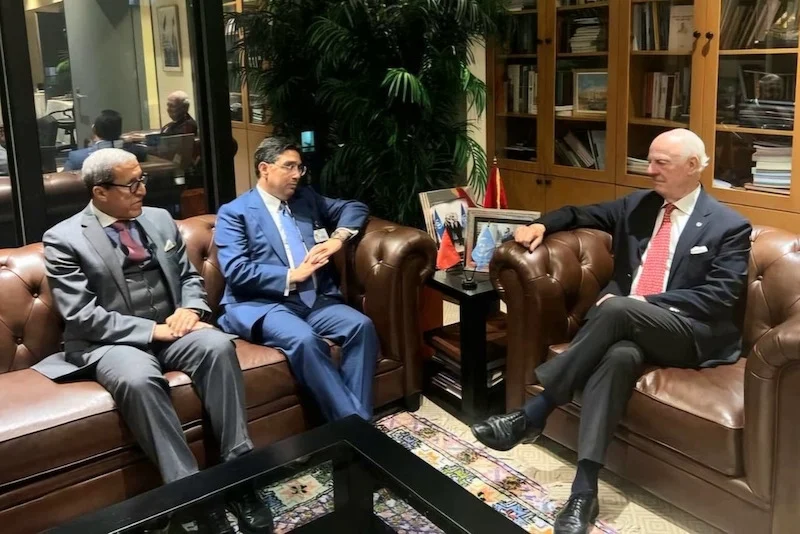
Staffan de Mistura, the United Nations secretary-general’s personal envoy for the Sahara, has declined to answer questions from Hespress about the latest developments in the dispute, citing ongoing deliberations at the UN Security Council.
In a written response to Hespress, Christopher Thornton, an adviser to the personal envoy, said de Mistura had decided not to give media interviews at this stage, either on the record or off the record, given the sensitivity of the discussions underway at the Security Council.
Thornton said the envoy recognized the vital role of the media in providing the public with accurate information. His team would contact Hespress when de Mistura decided to resume media engagements, he added.
Seven areas under consideration
Separately, UN sources told Hespress that a closed-door briefing de Mistura delivered to the Security Council on October 8 addressed elements that, in the envoy’s approach, could be considered when developing an autonomy framework as a potential basis for a political settlement.
According to the sources, the elements cover seven areas: constitutional guarantees for the continuity of an autonomy arrangement; the division of powers between local authorities and the central state; arrangements for political participation in local institutions; and mechanisms for obtaining the population’s consent to a final-status agreement.
The other areas concern local management of regional budgets and the distribution of natural-resource revenues; protection of local cultural and linguistic identity, particularly Hassani culture; and international guarantees to oversee implementation of any potential agreement and ensure that commitments are upheld over the long term.
Together, these areas cover constitutional, institutional, economic and cultural arrangements, as well as safeguards for implementing a possible agreement.
Their presentation, however, does not mean that they have been formally adopted as agreed conditions by the parties. A final settlement would still depend on negotiations and the parties’ willingness to engage in the UN-led political process.
Obstacles to a political settlement
During the closed-door briefing, de Mistura and Alexander Ivanko, the secretary-general’s special representative and head of the UN Mission for the Referendum in the Sahara (MINURSO), also addressed developments on the ground and prospects for the political process.
A UN source previously told Hespress that de Mistura had submitted documents containing recommendations and conclusions from his latest contacts with the parties, as part of efforts to prepare conditions for renewed political engagement and advance a mutually acceptable settlement.
The briefing came as the Security Council prepared to consider the future of MINURSO, whose mandate is due to expire on October 31.
According to the source, de Mistura identified two principal obstacles to progress: reports of gunfire and non-compliance with the 1991 ceasefire agreement, and persistent mistrust among the parties, which continues to limit prospects for political understanding.
The envoy stressed the importance of short-term confidence-building initiatives alongside efforts to address issues on the ground. Creating conditions conducive to negotiations, he indicated, requires political engagement to be accompanied by measures that reduce tensions and improve the prospects of reaching an agreement.
UN Secretary-General António Guterres’ report issued in early October also underscored the importance of sustaining political efforts and avoiding actions that could undermine them, according to the account provided to Hespress.
The UN source added that de Mistura continued to coordinate with the US administration in an effort to overcome existing obstacles and facilitate progress in the political process, as the Security Council prepared to discuss MINURSO’s mandate and the latest UN report.
Disagreement over the basis for negotiations
The reported elements of the briefing come amid continued disagreement over the framework for future negotiations, particularly the role of Morocco’s autonomy initiative.
Morocco maintains that its proposal for autonomy under Moroccan sovereignty should serve as the basis for a political settlement. The Polisario Front, meanwhile, opposes adopting the proposal as the foundation for future discussions, according to its latest statement.
The disagreement extends beyond the institutional details of a possible autonomy arrangement to the political framework within which negotiations would take place. Defining the powers of local institutions and the safeguards accompanying any agreement therefore remains linked to the negotiating process and the parties’ willingness to discuss practical arrangements.
The ongoing Security Council consultations take on added significance as members assess the political process and the future of MINURSO. With de Mistura seeking to advance discussion of possible settlement arrangements and the Polisario Front contesting the proposed negotiating framework, attention is turning to the UN’s next steps and its ability to keep the parties engaged in efforts toward a final settlement.


add your comment
Terms of publication : Not to offend the writer, people, sacred things, or attack religions or the divine self, and refrain from racist incitement and insults.