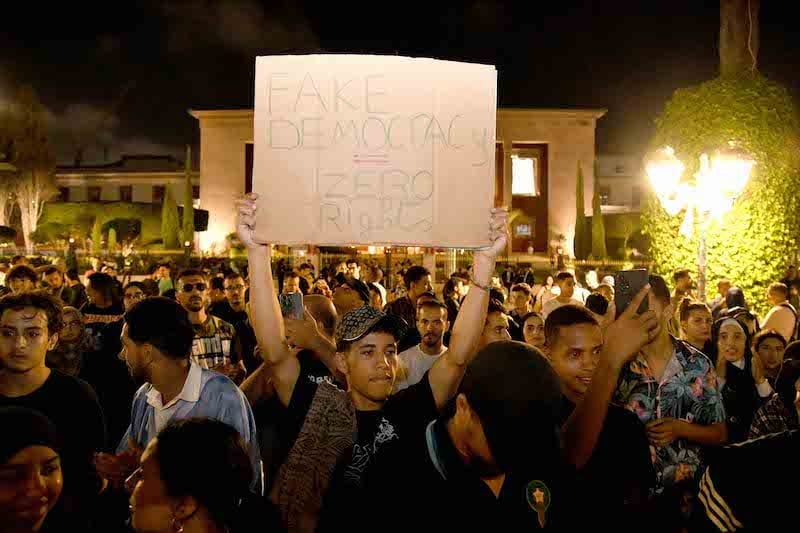
A year ago, Morocco’s political class was blindsided. Researchers had spent years describing Moroccan youth as disengaged, still shaped by the exhaustion following 2011 and smaller flare-ups. Then, within days, a leaderless online collective called Gen Z 212 organized the country’s largest protest movement since 2011, coordinated almost entirely through the gaming app Discord.
A year later, the movement has largely faded, and its rapid rise deserves as much scrutiny as the crackdown that followed.
Fast rise, faster fall
Researcher in political science Abderrafie Zaanoun’s reconstruction of the movement’s trajectory, published in the academic journal Rowaq Arabi, shows Discord membership growing from roughly a thousand users to over 100,000 within a single month, September 2025, and protests spreading from six cities to 23 within ten days.
At its peak, the server held around 250,000 members, organized under a slogan that captured its whole design philosophy: “every voice is leadership, and every space is a center.”
By early 2026, membership had fallen to under 180,000, and live listener audiences collapsed from around 10,000 to fewer than 300. A December 10 remobilization attempt, timed to International Human Rights Day and built around freeing detained protesters, drew what Zaanoun calls very weak turnout.
Anniversary reporting describes the movement as essentially wiped from the streets a year on; and Morocco’s rights group AMDH puts total arrests during and after the unrest at roughly 5,700, with about 650 people still imprisoned, a figure that comes from the group itself rather than an official count.
A structure built to mobilize fast, not to last
The most useful explanation for why Gen Z 212 rose and fell so quickly isn’t repression ,though repression mattered, it’s the movement’s own architecture.
Abdelilah Farah’s analysis for Carnegie’s Sada journal frames the protests as an expression of a broader shift in how young Moroccans engage politically: not through parties, unions or any hierarchical organization, but through horizontal, anonymous digital networks, the same online spaces, Farah notes, where Gen Z’s cultural references (anime characters, gaming communities) shape their political imagination as much as ideology does.
That structure is extraordinarily good at rapid mobilization, but it is also, almost by design, terrible at building the kind of durable infrastructure, recognized leadership, a negotiating body, alliances with existing institutions that can turn a protest wave into a lasting political force.
Discord gave the movement real operational sophistication, channels for coordinating slogans, voting on logistics, legal support for detainees, run by roughly 80 rotating volunteer moderators. But that structure also produced what he calls “organisational fatigue”: disputes over moderator legitimacy, banned dissenters, and the expulsion of founders who tried to open direct dialogue with the government.
The movement’s insistence on negotiating only through itself meant that when the state tried to engage, no one was authorized to answer. Its demands softened accordingly; an early memorandum calling for prosecutions and party dissolutions was walked back within a week after internal backlash, replaced by a more technocratic list.
By Zaanoun’s own account, the movement’s momentum “did not last more than a month” once these strains combined with shifting national and international conditions.
How the state defused it
Rather than treat the protests as a legitimacy crisis, officials reframed them as a problem of administrative efficiency, opening direct channels with ministers and coalition leaders who promised accelerated development spending.
The 2026 Finance Law committed close to $15 billion to health and education, about 10% of GDP, alongside a new mechanism letting independent candidates under 35 run with public funding covering 75% of campaign costs.
Hamid Behkak, a researcher at Morocco’s Center for Social Science Studies and Research, told Hespress that despite the funding, the result was just “two independent lists registered out of the total number of lists,” out of more than 1,850 overall, and neither won a seat, for lack of party backing.
The electoral offer on the table simply “lacked what it took to attract young voters.” Younes Belaidi of the Party of Progress and Socialism went further, telling Hespress the government and party response to the protests amounted to no more than “momentary silencing,” arguing the campaign drifted from jobs, health and education toward fights over candidate identities.
He said the September vote had “clearly exposed how disabling the electoral laws were” for young aspiring candidates, with parties prioritizing notables and money over younger activists carrying new ideas.
Why formal politics was never going to absorb this cohort
Afrobarometer polling from March 2026 found only around a third of Moroccans aged 18–35 expressed substantial trust in parliament, municipal councils or major parties.
The same cohort was less likely than older citizens to vote or join a party, but more likely to post political content online or join a demonstration, meaning the exact channel built to absorb Gen Z 212 required the institutional trust this generation measurably lacks.
National turnout fell to 38%, the lowest since 2007, with Hespress reporting youth abstention as a major driver.
What survived: the agenda, not the movement
Intissar Fakir’s analysis for the Middle East Institute places the protests’ legacy in the language of the campaign: “development” became a debate about the gap between Morocco’s international ambitions and the public services its citizens receive.
She traces the theme back to the 2021 political elite rise on a promise of technocratic competence, arguing Gen Z 212 made the question impossible to avoid rather than inventing it, while warning that parties promised a new development model without offering any clear mechanism to deliver one.
Parties gave health, education and jobs more prominence in their platforms and fielded some younger candidates, a few of whom won seats. But Gen Z 212 had no representatives authorized to negotiate with parties, leaving the movement without a say in how they took up its demands.
An episode, not an organization
Zaanoun’s own conclusion resists a clean verdict: there’s “no strong indication” Gen Z 212 became a durable movement, but the underlying grievances haven’t gone anywhere, and could resurface if global conditions produce another wave.
The sociologist Mehdi Alioua put it more sharply in anniversary reporting, saying the grievances have barely changed, and the anger is still there.
What’s measurable now is that youth unemployment is at 27%, institutional trust is still low, and turnout is at its lowest in nearly two decades.






add your comment
Terms of publication : Not to offend the writer, people, sacred things, or attack religions or the divine self, and refrain from racist incitement and insults.