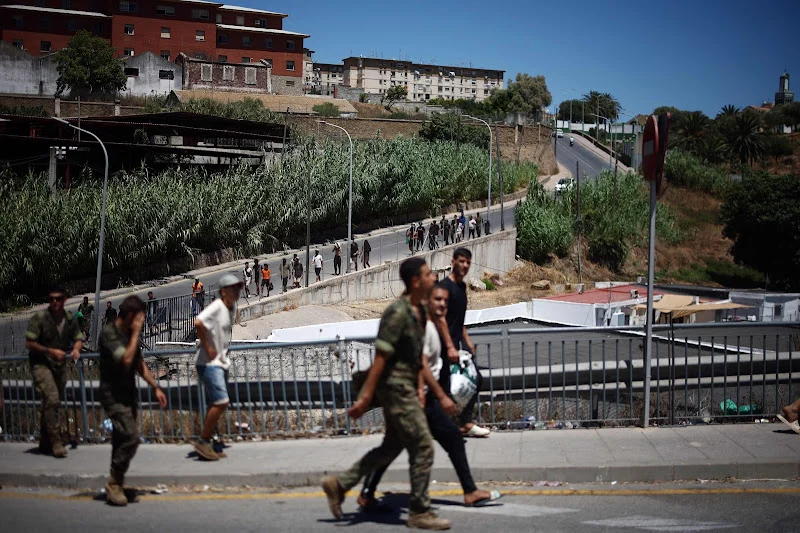
More Moroccan migrants who crossed into Spain’s North African enclave of Ceuta are withdrawing asylum applications and opting to return home as concerns over deportation and potential entry bans grow.
At least 5,672 people have voluntarily returned to Morocco since Aug. 10, according to police sources cited by Spanish newspaper La Vanguardia.
The figure includes migrants who entered Ceuta during a mass border crossing at the end of July, when more than 70,000 people crossed or attempted to cross into the enclave during a period of intense pressure on the border.
For some migrants, the decision to return followed weeks of living in overcrowded conditions, difficulties finding work and uncertainty over their legal status.
Three men from the Moroccan city of Tetouan told La Vanguardia that they spent about 50 days in Ceuta before deciding to return. One said he lived in a garage with about 15 other migrants, while another said he paid to stay in an overcrowded apartment shared by dozens of people.
Some migrants also found informal employment. One of the men worked long hours at construction sites despite infected wounds on his ankles, according to the newspaper.
Police sources cited by La Vanguardia said about a dozen Moroccans whose asylum applications had been rejected were facing deportation after exhausting their legal appeals.
A deportation order can result in a five-year ban on entering or residing in Spain. Voluntary departure does not carry the same restriction, a distinction that has contributed to an increase in migrants withdrawing their asylum applications.
Spanish government sources cited by La Vanguardia said 134 Moroccans had withdrawn their international protection requests, with the number expected to increase.
The development has also affected migrants housed at Ceuta’s Temporary Immigrant Detention Center, known by its Spanish acronym CETI. Meanwhile, areas of the city have increasingly faced similar pressures as authorities struggle to accommodate those who remain.
Morocco has said it is prepared to receive Moroccan nationals returning from Ceuta. Some migrants, however, told La Vanguardia they feared being transferred to locations far from their hometowns after crossing back into Morocco.
The situation has also contributed to tensions in Ceuta.
On Sunday, a group of residents attacked a vehicle carrying Ceuta lawmaker Julia Ferreras, a Gaza Flotilla activist and a human rights lawyer. Stones and eggs were thrown at the vehicle and one window was broken, according to Spanish authorities and Ferreras’ account.
Police arrested a 22-year-old man in connection with the incident and identified another person for allegedly resisting authorities.
Ferreras, a member of the Ceuta Ya! party, attributed the hostility toward migrants in part to rhetoric from right-wing political figures. She specifically criticized Ceuta President Juan Jesus Vivas for referring to migrants as “invaders.”
Spanish Prime Minister Pedro Sanchez condemned the attack and called for violence against migrants and others not to become normalized.








add your comment
Terms of publication : Not to offend the writer, people, sacred things, or attack religions or the divine self, and refrain from racist incitement and insults.