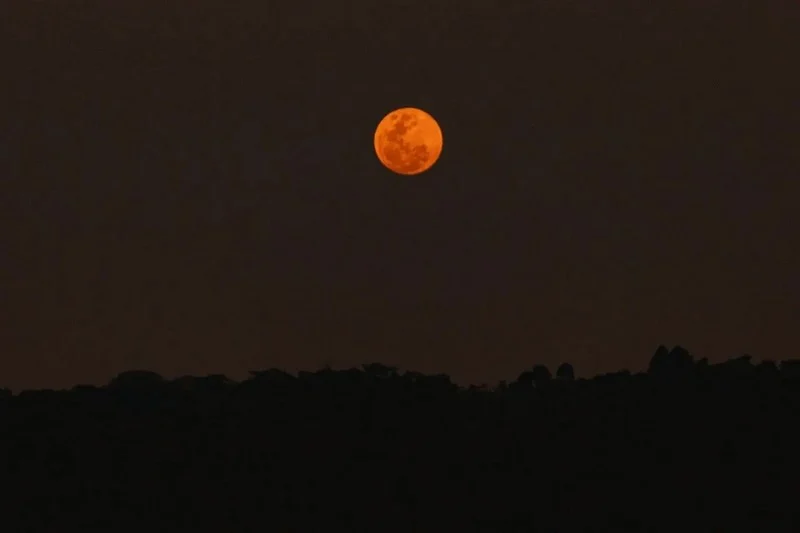
A deep partial lunar eclipse will be visible across Morocco before dawn Friday, with Earth’s shadow covering about 96% of the moon’s surface at the event’s peak.
The faint penumbral phase will begin at about 2:23 a.m. local time on August 28, although the initial shading may be difficult to detect.
The clearly visible partial phase will start at approximately 3:34 a.m., when the moon begins entering Earth’s umbra, its dark central shadow. Maximum eclipse will occur at about 5:12 a.m., while the partial phase will end close to 6:52 a.m.
The final stages visible from individual Moroccan cities will depend on local moonset times. In Casablanca, the moon will set at about 7:10 a.m., according to local eclipse calculations. Observers should choose an area with an unobstructed western horizon.
Two different figures describe the eclipse’s depth. Earth’s umbra will cover about 93% of the moon’s diameter, known as the eclipse magnitude, while approximately 96.3% of its visible surface will be inside the shadow at maximum, according to NASA.
Most of the darkened lunar surface may appear copper, orange or deep red. The color develops because Earth’s atmosphere scatters shorter blue wavelengths while allowing more red and orange light to bend toward the moon.
Unlike a total lunar eclipse, a narrow section of the moon will remain directly illuminated, preventing the disk from becoming completely dark. Its appearance may nevertheless resemble the “blood moon” associated with total eclipses.
The eclipse will be visible from the Americas and parts of Europe, Africa and western Asia.
Lunar eclipses are safe to watch directly, although binoculars or a small telescope can provide a clearer view.
Morocco’s next visible partial lunar eclipse is expected on January 12, 2028.




add your comment
Terms of publication : Not to offend the writer, people, sacred things, or attack religions or the divine self, and refrain from racist incitement and insults.